Around 8 years ago, it was a simple idea on a Montreal desk: how to encrypt and store a screenplay in a NoSQL database. A basic JSON schema, and an auto-generated Rust help documentation explaining it. Some simple tools on top to test the concept. There were plenty of interested emails, but mostly from engineers working in film who wanted to know how to use it.
But time and making a living gets in the way, along with plenty of other projects fighting for space. Then came AI, LLMs, and a whole new way of working. The need to store data against vector embeddings for RAG and other new methodologies changed everything.
Having a schema isn't enough when you need tools to illustrate what it can do, and guides to lay out how it can be used. So began a new GitHub account under @screenjson with a clearly defined set of new open source tools and a year's work to bring them alive.
- The schema itself: https://github.com/screenjson/screenjson-schema
- A simple exporter: https://github.com/screenjson/screenjson-export
- A web JS viewer: https://github.com/screenjson/screenjson-ui
- A desktop/iOS/Android viewer: https://github.com/screenjson/screenjson-viewer
But also two tools held back for commercialisation: screenjson-cli and Greenlight, an industrial grade batch processor.
The original article from 2017 probably needs a printout in PDF now.
He's talking about rape, i don't know what to do. I'll never forget those words. I knew who it was, but i couldn't believe it had now spread to the R. It was the fourth woman who'd contacted me about unwanted messages.
Three days before, Michael and I had an argumentative joint call phone call with a young British firebrand in New York who was keen to put us in touch with a well-known British libertarian ex-politician now based in the US. Michael was grotesquely drunk in the early hours of the morning, yet again. Afterwards, i threatened to hang up three times because he would not stop telling me, in lurid detail, how he forced his girlfriend's legs apart and raped her.
He wasn't confessing. He was boasting.
I had wrangled a planned exit: quietly terminate any relationship with Michael in the first week of November; let him promote the Great Repeal work on the agreement it would be publicised as the end of a planned 6-month experiment together. We started working together in May, and by early August i knew he had a serious alcoholism problem and something else wasn't right. By September, i knew something was very wrong. And this month, it was a matter of whether the police needed to be called. All of this when i am on the other side of the world to Albion.
What had emerged was a Jekyll/Hyde figure, exhibiting all the characteristics of psychopathy. Jekyll was a smooth-talking lawyer on YouTube with a fraudulent Middle Temple accent. We were meeting Hyde sporadically, but he had a total lack of any remorse, gloated about raping women, was obsessed with extreme pornography, and was gleeful in how he got away with it. Moreover, he was extremely ruthless and hungry.
I had no idea how obsessive and malicious he'd become.
Meeting Mr Jekyll
A few things always struck me as strange about my "co-editor," Michael Reiners. First, he didn't know much about law, as i expected, and he wasn't particularly good at it. When you meet a barrister, they invariably have a certain manner or affect about them which is wooden and tedious; overly-formal and patronising – which he lacked. Second, he always seemed to wear the same ill-fitting pin-striped suit and unironed white shirt which looked like they would smell bad, and on particular video calls he appeared as if he'd been sleeping on a park bench. Third, he was extremely cagey about his age. Fourth, he obsessed over his belief he was ugly, when he's an average-looking chap. Fifth, despite supposedly being a pupil of David Starkey, Starkey seemed to avoid him. But mostly, it was strange how the people who met Reiners weren't interested in following up any further.
Quickly, out of nowhere, i was thrust without my consent into a Twitter group chat without my knowledge. Looking back, it exemplified the "grooming" attitude: consent was not required. I saw this over and over: hundreds of people added into revolving private group chats when they never asked for it. One of them was, unbelievably, Fraser Nelson – of all people.
Things had started to take a severe downward fall in August, a month after we'd soft-launched the Restorationist and achieved some modest success: 40,000 visitors a month; glowing praise for articles; small media appearances. It was all my work, but i added Michael onto articles to help him publicise "our" work. We had an unspoken agreement he could promote my work at the Restorationist, which hadn't been formalised because i simply wasn't sure.
I like to write with two good friends of mine who have known me in real life under my real name for years. There are two other one-off writers i have known since i was in my twenties who also go under pseudonym. We use Slack because it's professional. All of us work in tech, and many of use our first and middle names for our single-member LLCs as is fairly typical in the US if you run different startups. I have a double-barreled surname which is easily recognisable if you know it.
Our jobs are sensitive. Mine is particularly sensitive. Privacy is an important part of being responsible, and a consideration to friends and family who may not want to get caught up in political debates.
Michael was obsessive over X group chats, Discord, Telegram, and Signal. He'd never heard of Slack at all, which was odd. I wasn't sure who this person was so i kept them separate and used the "I Am Spartacus" firewall. I am very glad i did.
He was obsessed with followers. Envious and enraged at everyone who had 10,000, but he didn't. Hundreds of pounds spent on boosting his own posts and endlessly retweeting old ones with comment chains.
The situation was synergistic, on an initial superficial level. I'm told i'm good at public speaking, but at heart, i'm a writer. I'm happier in the engineering room as someone else does the publicity. So i suggested we need our version of the Telegraph.
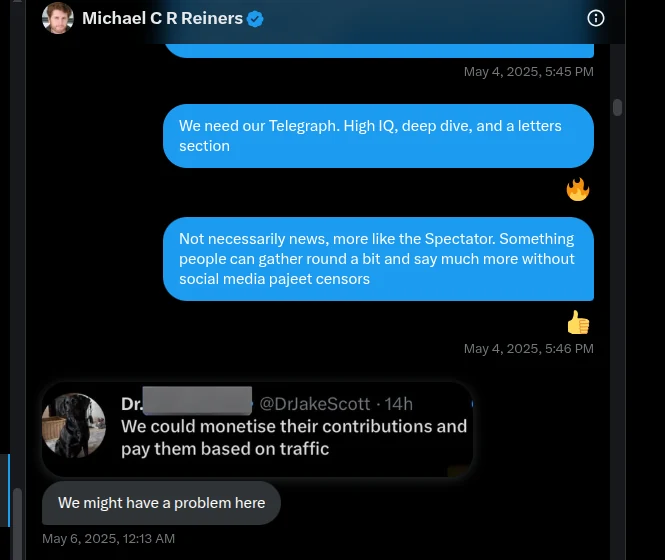
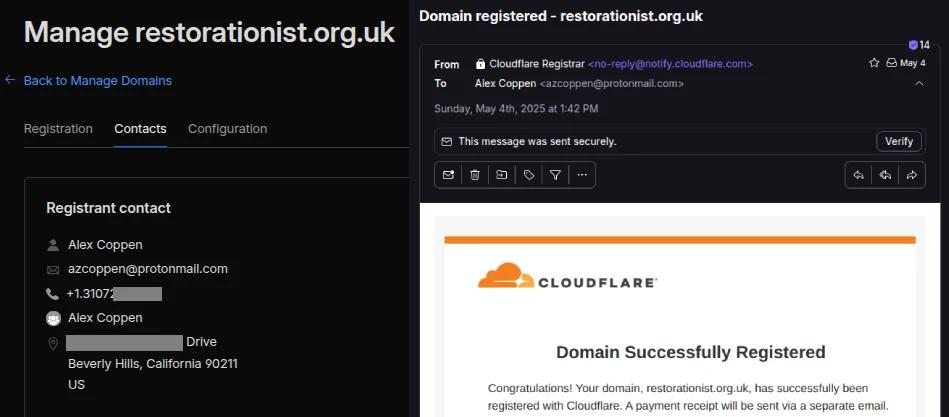
I bought restorationist.org.uk on my lunchbreak via my Cloudflare dashboard on Monday May 4 2025, and set it up on the same host i use for Devils Lane and FaithChef. They're the same software, and the former's design is quite similar.
We needed to hook something up which was simple, to prototype out my idea. So i picked the standard Ghost theme "source" with some sensible defaults: Cardo for the headline, Merriweather for the prose as the Reedsy standard. I used Photopea to create a simple logo and masthead. I could tell you the font for the header, but i think we'll leave that as a simple line of questioning for Michael to see if he can actually name it, or answer how many colours it exists in on the server.
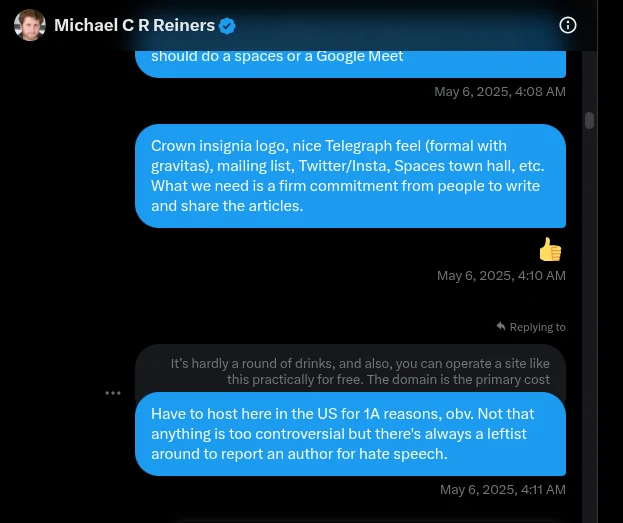
My reasoning was 1A hosting for speech protection and i even gave a rundown of the design aesthetic.
You can even see the date modification stamps on the logo files themselves:

I started plotting out the doctrine a bit, which you can see in the site's static pages.
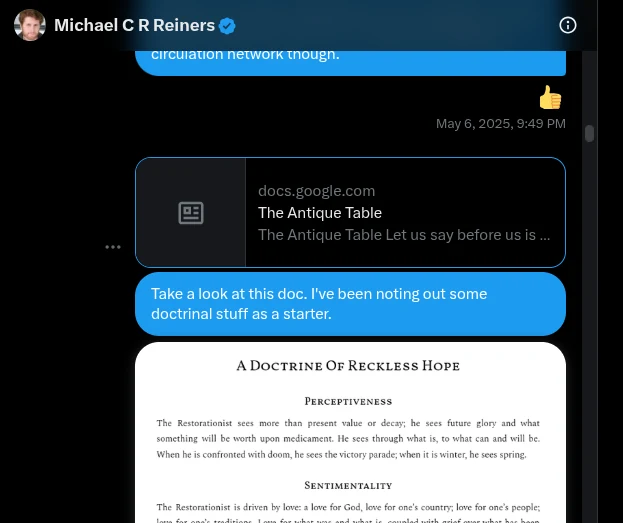
A week later i'd pushed up the basics to get it started.
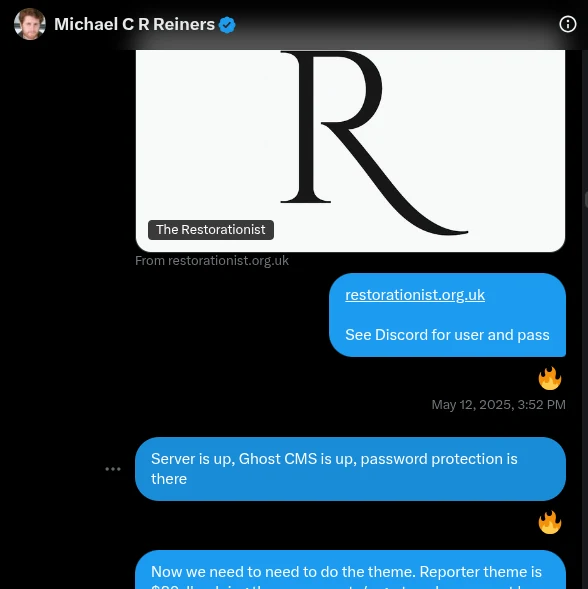
It wasn't much, but it was something. So i generated some placeholder text to see how it would look at scale once we had articles rolling in.
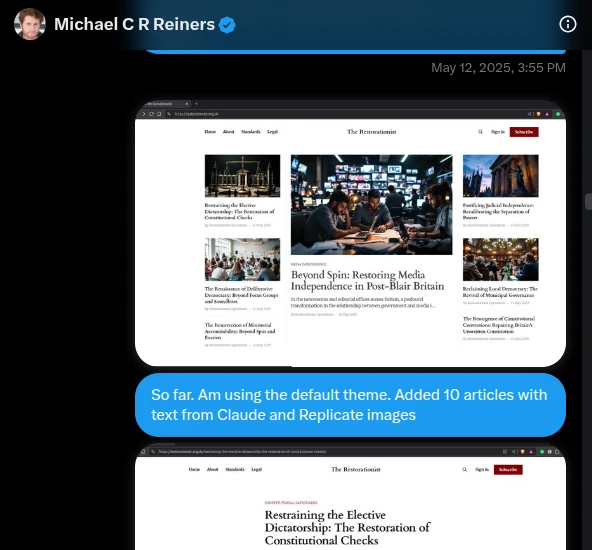
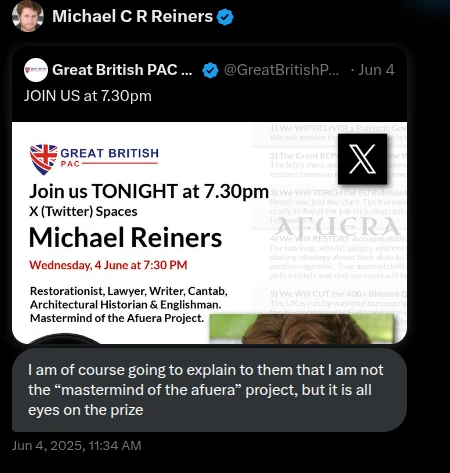
Michael had used my work on Project Afuera to land an "advisory role" at GB PAC, which was already turning fractious because of my derision of its uselessness. But for him, it was step one on the political career ladder, and i was in the way.
As you can see, he'd told prominent accounts it was his work. It isn't.
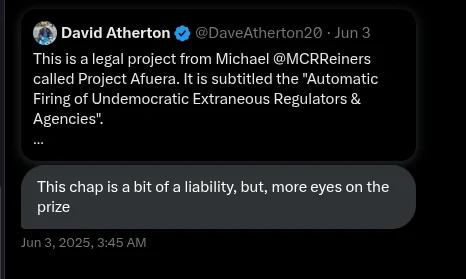
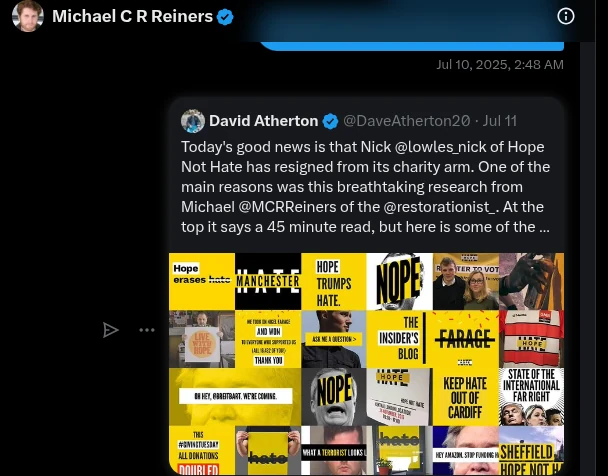
Then came a taste of early fame when my Hope Not Hate article was well received. He'd never written a word of it. I'd started a few weeks prior because i'd done a previous dive into Gerry Gable and wanted to dig into Shukman's false passport.
Dave Atherton, again, posting my work and crediting Michael for it.
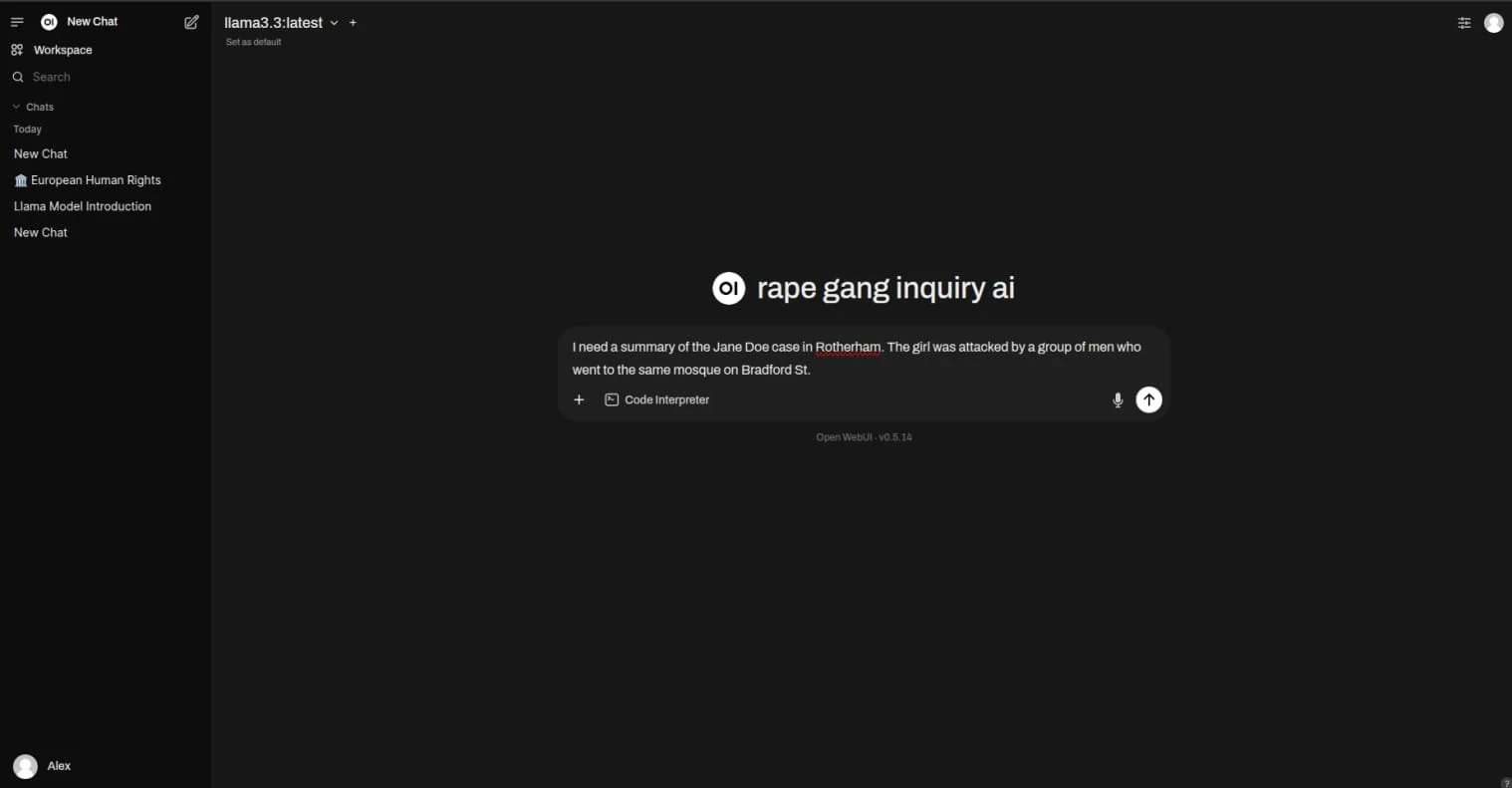
The next thing i wanted to do was build an AI LLM engine for the useless Lowe Inquiry, which i built out in text-generation-webui on top of Ollama.
Meeting Hyde
Two weeks after we launched, he was suspended from his job at the Nursing and Midwifery Council, where i was surprised to learn he wasn't working as any kind of barrister. He sent me the notice, and it was a serious complaint from multiple employees there about his social media behaviour. He claimed it was a witchhunt by Hope Not Hate, who had sent him an email with lurid allegations he ran an anonymous, utterly disgusting pornography account on X named "YeOldeMoby". I'd seen them myself: a weird obese balaclava-wearing depiction of "Sharpe" constantly posting about female obesity.
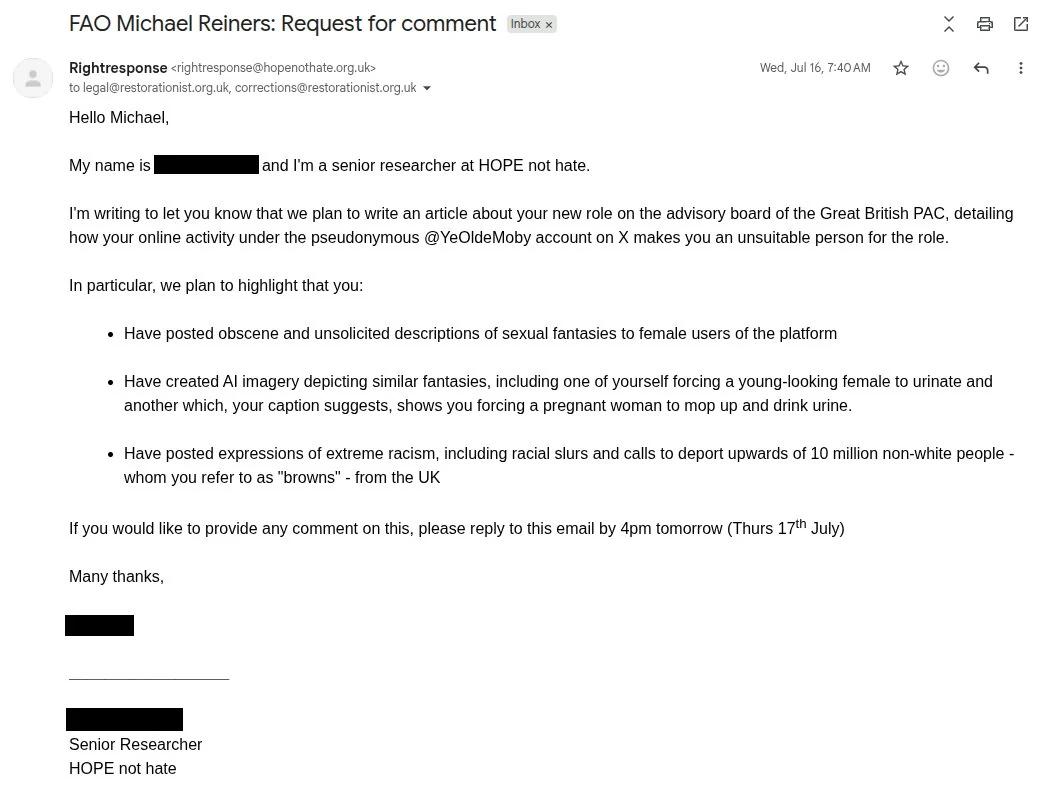
It wasn't. And they were right.
This was part of some bizarre tale of two incel trolls called "Moby" and "MI5" which formed a weird in-joke i didn't understand. Michael explained it like this:
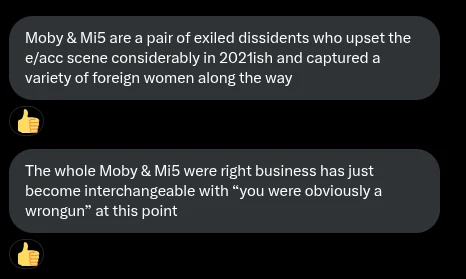
What i didn't know was "Moby" was Michael, and his friend – who i know the identity of but won't name – was "MI5 Captain Black." They were essentially online trolls who spent a lot of time insulting people in Silicon Valley.
There are two things i strangely admire about Hope Not Hate: a) they don't mind picking a fight, and b) they're good at research. I've never really considered them any kind of "threat" because they generally pick on lunatics who are trying to resurrect the BNP.
I'm a libertarian at heart, and everything must be solved by more liberty, until it can't be. I consider racism an exceptionally dumb idea, and i've lived all over the world so i know every human culture in existence is racist. I'm a vocal opponent of LGBT-anything as a Christian (alongside my belief it's fascist in nature a lot of the time and full of bullies) but i'd never pick on gays individually because my own view is homosexuality is scientifically-understudied as an irreversible development disorder requiring social accommodation. Plus, they have to triage their time to people bigger than 100-follower Twitter accounts.
In short, Hate Not Hope have no interest in me, and i don't have any interest in them, other than a bizarre fascination by how utterly terrified every group on the British right is of them. I do not like their tactics, and i absolutely stand by my accusation they have strayed way too far into criminal territory in pursuit of a quasi-religious cause.
It was around the same time the drinking binges and pornography emerged. Michael craved money.
Dozens of voice notes were being left in the early hours of the workday morning where he was incoherently drunk. They went on for days at a time. They were accompanied with what can only be described as exceptionally depraved AI imagery of highly obese women depicted in the style of Japanese anime. The severity got worse, and started to include bodily fluids and "feeder" terminology.
(text may not display well in some browsers.)
Lucy Brown, the writer and filmmaker, had me blocked despite the fact we'd never spoken.
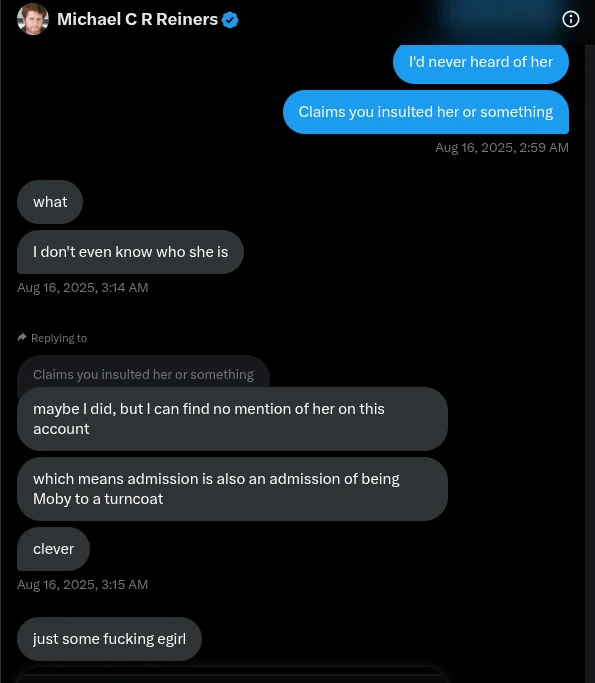
This was a blatant lie. It turned out Michael had sent her revolting messages, and she very reasonably assumed we were in league. It was blessing, oddly, as it ultimately led to us being introduced and becoming nascent friends (if she would permit me to call her so.) Lucy is a fearless lioness, and i'm sure she'll set the record straight for anyone who might want to know.
At that point, I was already into the next project building Tell Someone, and it was evident Michael had no interest at all in rape gang crime. He was enraged about being sidelined for a barrister role at Restore Britain after a drinking binge with Charlie Downes. He was pestering Ben Habib (who we'd spoken to briefly before) and Carl Benjamin.
He tried, and succeeded, at meeting Nigel Farage for lunch on Aug 8th with David Atherton and Lois Perry as a recommendation to be a new policy advisor for Reform UK or to stand for MP in Keithley. He wanted time on GB News.
He had a group of "12 Angry Men" on Signal as his "team," and 3 "investors" queued up i took one look at and baulked. I'm half a planet away and i could smell the rot. The group name changed endlessly with grandiose titles like "Founding Fathers," but i finally blew my lid when it became "Restorationist Advisory Board."
I never told Michael anything about myself. In fact, i gave him misleading information deliberately in some cases, as i could sense he was hungry for what he could use. He thought i was single, from about four different places in the south of England, and lived in three different places in California. I could have told him i was a carpenter from Nazareth and he would have believed it if there was a sniff of money or fame.
Some of it was comically absurd. At one point, Ashley Dean-Smith, a rather repulsive wannabe YouTuber who looks like a used car salesman and is on record saying he wants "power by any means," was clearly attempting to record a conversation on Michael's behalf – for the 2nd time, hoping for Cyprus money. So, i intimated i was a police officer by threatening to "arrest" Michael out of anger. Sure enough, it was circulated immediately i was a Hope Not Hate "infiltrator." We were watching in real-time as people deleted their messages. It was the other half's idea; i wanted to go big. but she said be subtle. She was right; they took the bait. It was so preposterous only highly-online, paranoid incels, without a wife to tell them they were mental, would believe it.
Tilly, by contrast, knows the name of the Surrey church leader who went to jail for abusing two of my friends. Dan ("Chris") gave up trying to teach me ASA 101 on a Bahamian island and actually threw me in the water out of frustration because i couldn't tie a bowline knot. The first time i met "Ollie" we were 16 in a West Sussex field and had smuggled 3 entire 3-litre brown bottles of Strongbow cider in our school uniforms and he puked on my arm. Paul was my rival in university i got thrown out of chemistry with for bringing books like "Psychedelic Chemistry" into the lab after we stupidly ordered them through Waterstones, but ended up becoming one of the UK's most influential pharmacologists while i tromped around Africa looking for trouble.
I simply didn't trust Michael Reiners, and i was right. I'm glad i didn't.
What i didn't know at the time was why he wasn't working as a barrister. Two years previously, he claimed to me he'd been in a bad relationship where he'd been "doxxed" online because of false allegations broadcast by an American girlfriend.
His bar registration had been updated to use his middle name, and it was the same tactic he requested as a resolution at this job disciplinary tribunal. But there was no record of him at the BSB despite him saying he'd been the subject of previous complaints and paid their yearly fees. There are no cases in any UK law database citing him as counsel on anything. Reiners has never tried a case despite having graduated in law for several years.
We checked with the Bar. Their response:
I have checked our records and confirm that we have a record of Mr Michael Colin Richard Reiners, who was called to the Bar in July 2022 by Middle Temple. They are currently on our records as an unregistered barrister, which means that they do not hold a Practising Certificate.
What this means is Michael cannot provide legal services to the public that are reserved legal activities (advocacy in courts, litigation, etc.). He must not present himself as practising or taking on clients. He can say “I am a barrister” as a qualification — but not imply he is practising law or regulated for client work, or it can become a possible criminal offence under the Legal Services Act 2007.
Michael's "relationship" with Sydney, a troubled American social media starlet incels love to hate, went badly wrong. And by bad, we're talking bad.
This was almost certainly how Hope Not Hate had pinned him: a simple Twitter search for his name with the girl's username, "custardloaf."
Except, "Sydney," the American girl had "doxxed" him to... the police. She claimed she'd been violently raped and had posted pictures of her in hospital covered in bruises. She fled the country rather than stay and testify in the Crown Court.
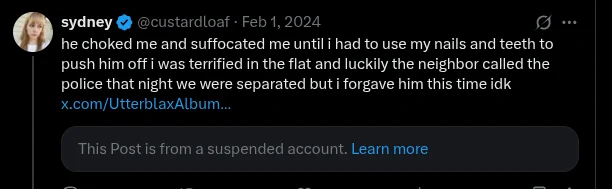
His story was she had a "psychotic breakdown" and he was forced to drag her out of his flat to eject her. There was a video of him in a banner mocking her as she explained he'd "poured juice" on her and pictures of her looking gaunt. This person had been the subject of intense cyberbullying to ruin her credibility as much as possible.

The "dispute" is still publicly online.
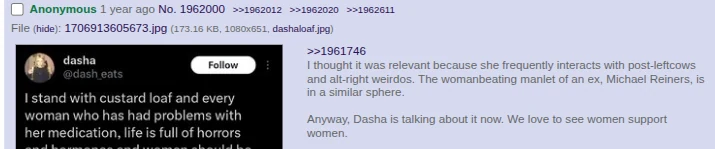
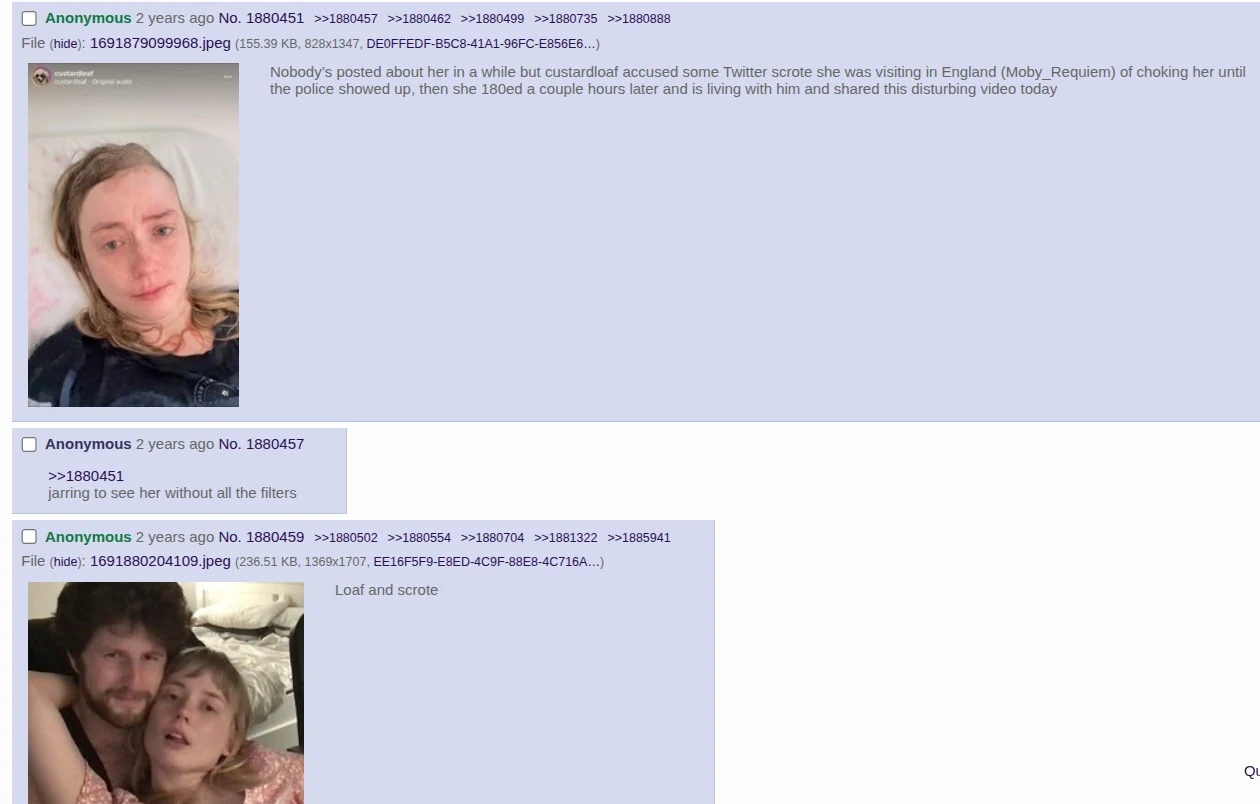
And Sydney absolutely did speak to the police. Officers attended, and equipment showing Michael's musical account "Utterblax" were shown being examined.

This wasn't "doxxing." This wasn't even close to "doxxing.' It was whisteblowing and crying for help.
Sydney later posted she'd fled the country rather than testify.

The Incidents At Scyldings
Michael had been graciously given a free ticket to The Witan, which had been the target of a Hope Not Hate investigation the year before, and this year was being held at a hotel in Birmingham. He'd told me he was a merely a visitor, but then claimed he was there as a "representative" of the Restorationist in consideration of the good work we'd – well, i'd – been doing.
I'd received a note on X there were rumours circling he'd been stalking a well-known right-wing female influencer's house in London (and some obscure mention of meeting her in Torquay), but brushed it off as wild hearsay. It struck a chord though as he'd made strange comments about her before.
I'm inclined to believe now there is something to that story, and not simply because of the early-hours-alcoholic behaviour. The same person is mentioned in his revolting messages, and she was frantic they were deleted. She also reached out to me on X to repetitively imply how "weird" it was she was mentioned. It also fits the lurid MO Michael drunkenly explained to me of incessantly pestering women until they gave in.
Anyway. Back to the Witan, which was a weekend in Bimingham.
Michael called me from the smoking area, excessively drunk, and was on a mission to find the Hope Not Hate "mole." He'd spent the entire time siting next to the chairman of a certain political party he'd been targeting, and i wasn't amused at the idea of them being photographed. When an awkward guy (an "artist" is how he described himself, and a very timid one at that from my read) followed him outside, he launched into an abusive tirade so harsh it was barely believable ("just fuck off!! why you don't you fuck off!!"). It was alarming. Hyde had appeared. This wasn't exactly the look i was hoping for at a conference.
He apparently spent the next two days drunk out of his mind. A well-known scientific commentator on the British right who traveled there with him (who was absolutely not aware of any of this) maybe able to confirm, should they choose to.
He gloated he had aggressively confronted a well-known female political figure in a hallway of the hotel about an incident where she was guilty of "doxxing." He'd targeted a young female lawyer – also well known – and sexually propositioned her in person and via social media. We eventually saw this message and it was the most bizarre, creepy, and repulsive solicitation one could imagine.
2:28 Terrible form, i've essentially been a sex pest
2:37 Come 427 (dare)
2:39 I just want to cuddle :333
3:33 Oh dear
3:34 I may have embarrassed myself but, sorta still stand by every word?
3:28 Dare you
(unknown) disregard this, i am an evil and treacherous man of ill character etc
This was at a professional event. To a woman he had met once, briefly. Hyde's style was very different to Jekyll. He was just a slimy creature women found repugnant.
Scyldings also recognised who it was immediately after it was disclosed, and were extremely fast to respond with concern.
And most worryingly of all, he boasted he'd sexually targeted another young female in a hotel corridor in a way which was so frightening to her she fled into an elevator. It wasn't clear what had happened and there's no way to know it was true or a drunk nonsense, but i could sense the angry glee in his voice. My fury and incredulity didn't seem to register.
He'd also contacted the woman leading Lowe's rape gang inquiry.
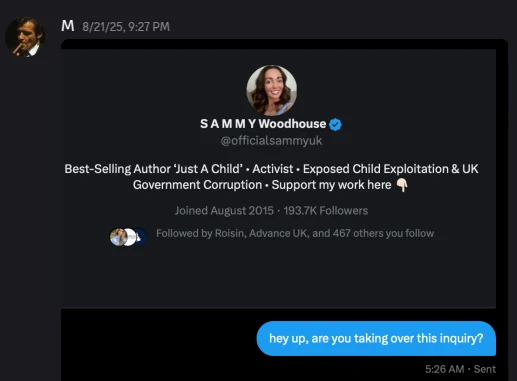
At this point, i'd had enough. The conversations on Slack grew far more intense, and it couldn't continue. The 6-month mark was the cut-off. No more. Something is not right with the guy at all.
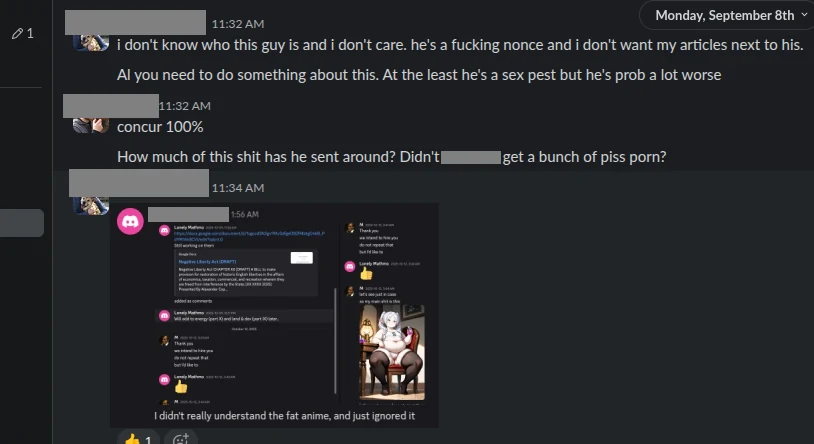
No access to the org.uk or server infrastructure. No access to membership data. No access to email management. If we allowed donations, absolutely no access to banking. No introductions to any of the pro real-life group. The key was just to gently move this along peacefully, parting ways in a civil fashion. "Chris" (author pseudonym, real name Dan), who lives in Austin, Texas, and i know from years back and my time in the Caribbean, actually flew out to California to talk about it because he was thinking about flying back to the UK to deal with it in person. He has an immigrant wife and a second infant they recently adopted, and neither of us considered it wise to go down that route. He had my first and middle name, and could be malicious.
We found messages of a utterly bizarre fantasy plot to take over The Mallard (wtf?), on top of another to install Jake Scott as editor of The Restorationist – a guy who had been fired from the Prosperity Institute for appearing in a Hope Not Hate expose, and had a "10k account" Michael was weirdly obsessed with hijacking on X under "Restorationism" which apparently was previously linked the Kemi Badenoch leadership campaign.
It was surreal. With the help of and $15,000 promise from a strange expat called Andrzej Czapiewski, the plan was presumably to convince me to out myself by revealing my ordinary real life within documents from one or more of these dodgy investors (there were at least 3). Michael had registered "Restorationist, LLC" in Delaware through Stripe Atlas without my consent, while drunk, and simultaneously placed his American girlfriend's name as the owner of a charity registration at Companies House.

I sent a warning in writing we needed a partnership agreement to set concrete boundaries and define roles, after just being sick and tired of him taking the piss. This was a hedge, because i was almost already decided there wasn't any way this could go on.
My point is - i never signed up for any of this or to be a prostitute furnishing your career by stroking these people. We never even agreed on starting an LLC, let alone what it was to be called - that says it all, doesn't it? A charity, now? Is that for "us", or for you?
This isn't "we," or "us," it serves you. Frankly i sympathise with your missus about being put onto things without knowledge. I'm not saying that to be nasty: i genuinely share the same frustration. It feels like being a passenger in the Michael ride when i built the fucking car.
What i got back as an agreement was absurd and unprofessional legal garbage from ChatGPT.
I never authorised this. Ever. And never would. This has nothing to do with the Restorationist and never had. I was diplomatic about it and played along, but there was never going to be any realistic chance I was going to use it.

If you request this record, you'll see I'm not on it. You'll see who is.
Michael later registered a company "The Restorationist Ltd" on October 24 2025, three days after he was removed. Take your own guess as to why.
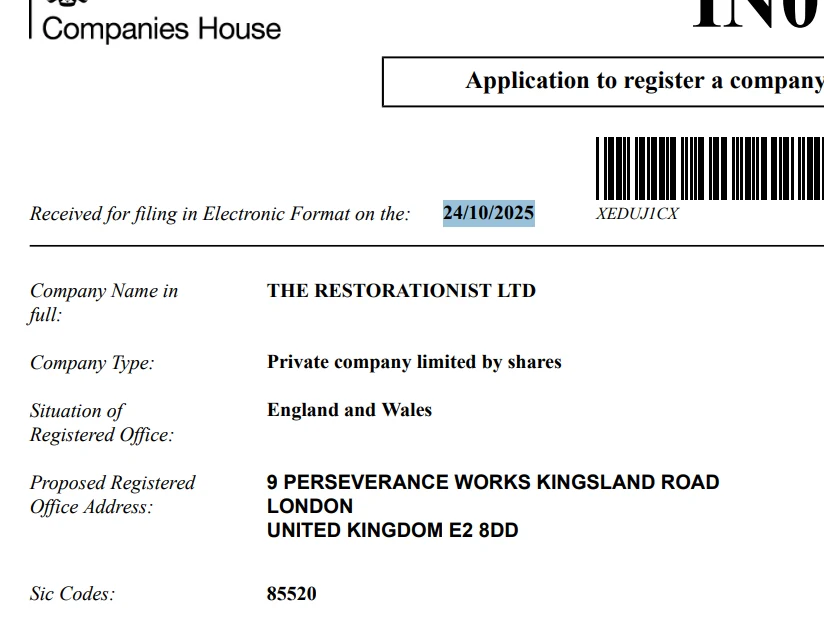
This is a daft scheme to hijack control of the .org.uk domain name. It's misuse of the law and called Reverse Domain Name Hijacking. The general plan here is to manufacture a pretence where he can legitimately claim to be an "owner" of it because he has a single-member company in the US and UK, precipitating a dispute with the registrar. He believes this will give him a weight of evidence to seize control of it, while complaining publicly he was "Zuckerberg'd" out of his "own" creation which never existed. Unfortunately, the dates don't quite match - but he's hoping the dispute will be private.
Michael unfortunately has some trouble here. I also registered many other .uk domain names, as is standard practice for SEO. These are just a few of them. I posted them deliberately on X, and lo and behold they ended up in the complaint. But more on that later.

It's going to be another uphill struggle explaining them all, as well as why the limited company was registered to the address of SAME DAY COMPANY.
This is, of course, fraud.
I had to contact all of them with written declarations and proof: Delaware, Companies House, Same Day Company, Stripe, Cloudflare, Nominet, and more. It
Fraud by false representation
(1) A person is in breach of this section if he—
(a) dishonestly makes a false representation, and
(b) intends, by making the representation—
(i) to make a gain for himself or another, or
(ii) to cause loss to another or to expose another to a risk of loss.
(2)A representation is false if—
(a) it is untrue or misleading, and
(b) the person making it knows that it is, or might be, untrue or misleading.
(3) “Representation” means any representation as to fact or law, including a representation as to the state of mind of—
(a) the person making the representation, or
(b) any other person.
(4) A representation may be express or implied.
(5) For the purposes of this section a representation may be regarded as made if it (or anything implying it) is submitted in any form to any system or device designed to receive, convey or respond to communications (with or without human intervention).
All of this sounds like a preposterous Bond movie arc, but it isn't and wasn't. It was idiotic.
I own the .uk names and tech infrastructure; all the work and copyright is provably mine. It would be an uphill task even with an AK-47, forger's pen, or sedatives. I was later accused of "scaring off" this "investor."
There's not enough time or space to go over all the smaller details, but Michael's pornography escapades had also multiplied. His "investors" were anime porn lovers, and he was seemingly their "dealer". One of them claimed to own 20,000 properties in the US. Andrzej had fled to Cyprus to avoid the annual scheduled days for capital gains tax. He had spent $1000 buying ads on X for himself and the site had locked his card after the usage was flagged for fraud.
Michael had a huge personal investment in the Restorationist for his own reasons, but no actual business agreement in writing or any legal ownership of its infrastructure. He wanted to be the "face" of the Restorationist and wear it like a skin suit – without consent.
He had tried to book himself on the Lotus Eaters podcast and was targeting the Homeland Party next in his career trajectory, along with paying for membership of Restore Britain and Advance UK. Thankfully he'd left GB PAC at my urging (mainly due to my intense dislike of its CEO). He also contacted at least 3 MPs.
Then, Michael was fired by the Nursing and Midwifery Council for gross misconduct.
Allegation 1 is given here to place into context a pattern of behaviour which was experienced and ejected by multiple people:
1. You have posted online content and reposted content which colleagues have found offensive and upsetting.
He voluntarily sent me the written decision, with his home address on it. It was just bizarre, and they seem also as bewildered he was trying to pin internal complaints on a phantom Hope Not Hate witchhunt against him.
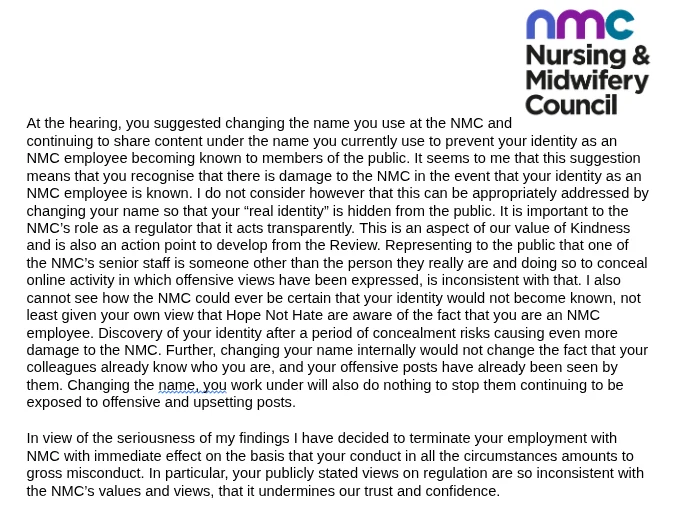
There was no Hate Not Hope witch hunt. Michael's employment was terminated for the simple reason his behaviour at work was deemed unacceptable through a two-month disciplinary investigation by their senior counsel. It appears, as one would expect, this cost him his own ability to practice law in the UK. According to the Bar, he is suspended.
Hope Not Hate were planning on exposing him for broadcasting revolting posts. The NMC cited offensive posting as a central conclusion of their termination, and from a brief read of the document they clearly did not want him around. The NMC is a charity, and these facts can be verified through a simple Freedom of Information Act request.
And he'd arranged for himself – without my consent – to "represent" the Restorationist publicly an event by the Traditional Britain Group, and "launch" parties he was organising in London its behalf.
This seemingly went well, but his observation after boasting about a "briefcase of business cards" was much of the audience was unnervingly keen to express their dislike of Jews, in coded language. An unnamed "silent investor" of Starkey's favourite Pimlico Journal wanted to "get money to" the Restorationist.
Make of that what you will. But it was fairly clear my work and this publication was personally feathering Michael's nest, and it would make perfectly sense wanting to take it for himself. I wasn't on board with the program, and I was now a problem.
"I Wake Up Every Single Morning, Rape My Foid"
Tilly is a lovely, beautiful bioscientist who lives in the South of England. She's incredibly sensitive, slightly neurotic, absurdly stubborn, and has a wickedly infectious cackle. Her imagination runs wild and gets her into some absurd territory. She's also a survivor of severe domestic violence and has a heart to work with other women to support them in difficult times. An English eccentric who is very emotional and reactive because her heart is worn on a slightly-autistic sleeve. She's eager to be liked and doesn't know how to handle conflict or sexual aggression well. But she'd be the most loyal and wonderful mother to any man's children they could imagine.
Michael lives with an American girlfriend who seems to be extremely shy, but highly intelligent. His last American girlfriend, "custardloaf" ("Sydney") wrote in her own posts she fled the country rather than testify; as mentioned, he claimed she either self-inflicted her own injuries, or received them while being thrown out of his apartment. These were constructed as a real-time jury defence where she was portrayed to an online mob that she had a "psychotic episode."
His best friend, who i had spoken to briefly as a fellow Christian, was also concerned.
yeah i was chatting to my mate last night who’s close with mike and even he was saying it’s gonna get to a point where mike and the work you’ve done is taken seriously, and the minute he gets into government in some capacity he will be outed for being obsessed with fat women
he keeps talking to me about raping women
he always played it close with this horseface girl when he dm’d her telling her he was gonna skin her a while back
the only time i recall him mentioning anything like this i messaged [girlfriend's name] to ask what was going on and she said there was nothing happening but she deleted her messages which i found quite odd
It transpired Michael had claimed to a mutual contact that he had met his current girlfriend by sending her an unsolicited social media message saying "i'm going to rape you to death."
I'd seen messages like this and simply assumed his alcoholism was spiralling.

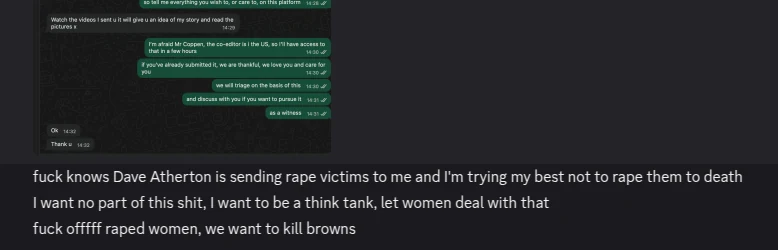

"Foid" or "femoid" is internet slang for "female android." It is a derogatory term used by "incels" ("involuntary celibates") which is analogous to "bimbo." The gist is a woman who is externally beautiful, but has no inner life or intrinsic value other than her sexual appeal. Like a doll, or autonomous android robot which happens to be female.
Tilly had mentioned Michael had sent her pornography and abusive messages before and she'd batted them away assuming it was alcoholism, but they'd been escalating beyond what she could fend off. Two other male writers had forwarded messages where he started with a familiar sequence: a) injecting them inappropriately by surprise into a conversation unrelated, b) inquiring whether the recipient found the grotesque image "arousing."
In California, every person who works, anyone, must do harassment training within 72hrs of taking a new position. Everyone recognises this scenario because it is given as the worst kind of incident in the workplace.
I'd demanded these message provocations stop, and noticed how much Michael enjoyed "forcing" them unsolicited on people.
"Alex, he's talking about rape. I don't know what to do. He's been drunk for 3 days, i tracked it."
She wasn't joking, and she later publicly posted the evidence on Twitter/X.
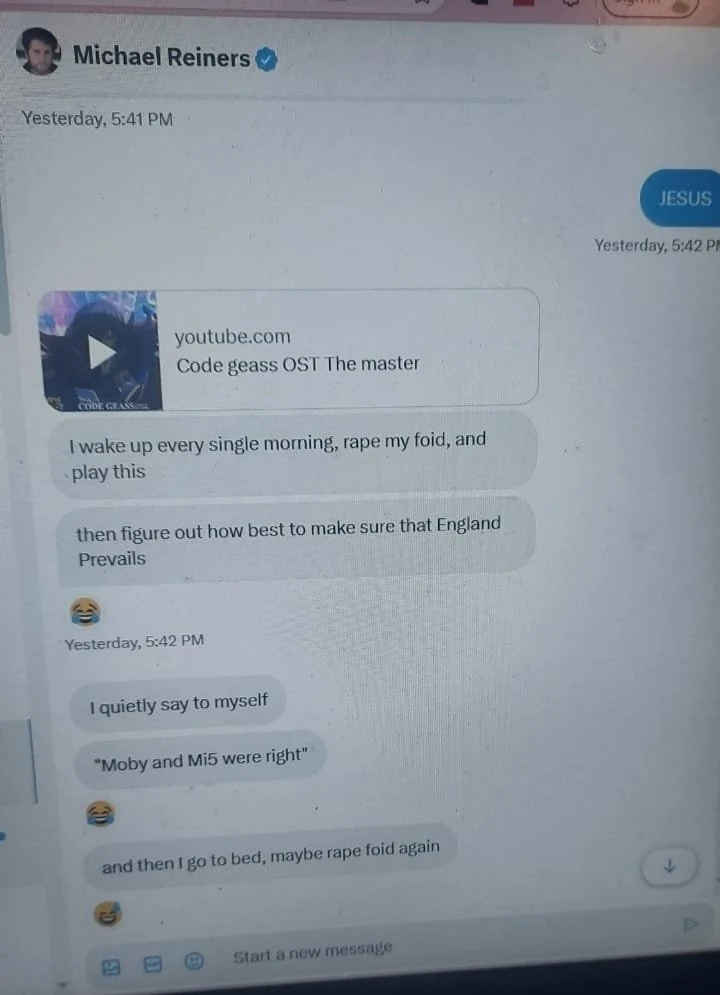
This included solicitation of fetishes for bodily fluids and was exceptionally graphic.
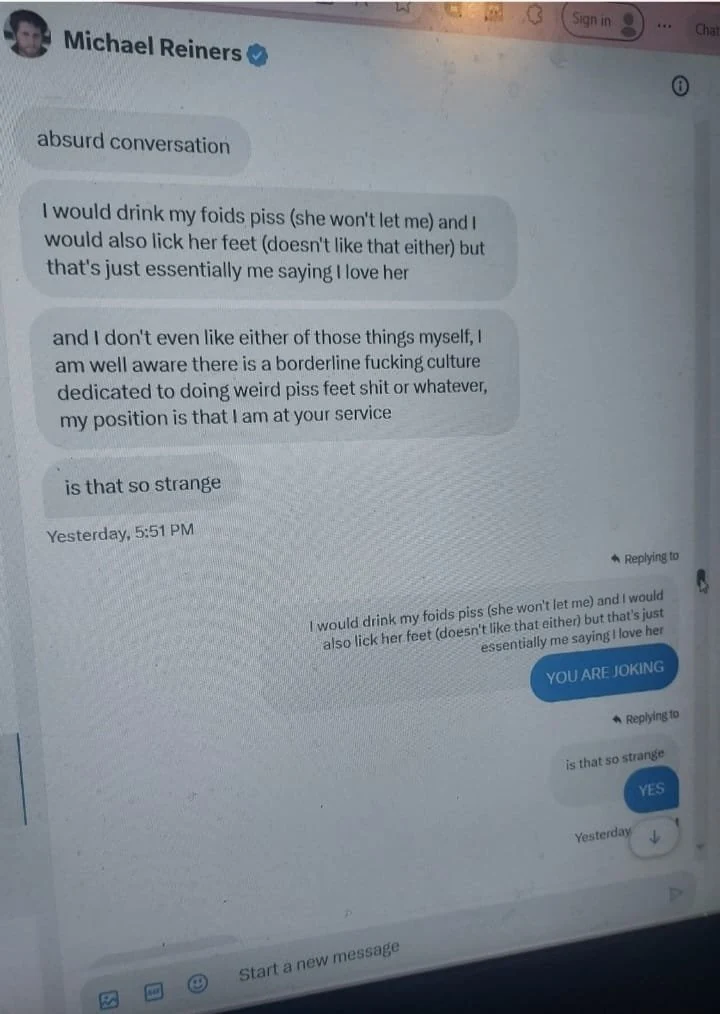
Three days after Michael had boasted to me on the phone about raping his girlfriend, Tilly was next. A clear pattern of escalation. Michael had joked in bad taste to me about "trafficking" (luring, more likely) girls from the US to the UK, and "exporting" them to his pornography-loving friends in the other direction. It's impossible to know the truth of that, but he advertised their online accounts frequently.
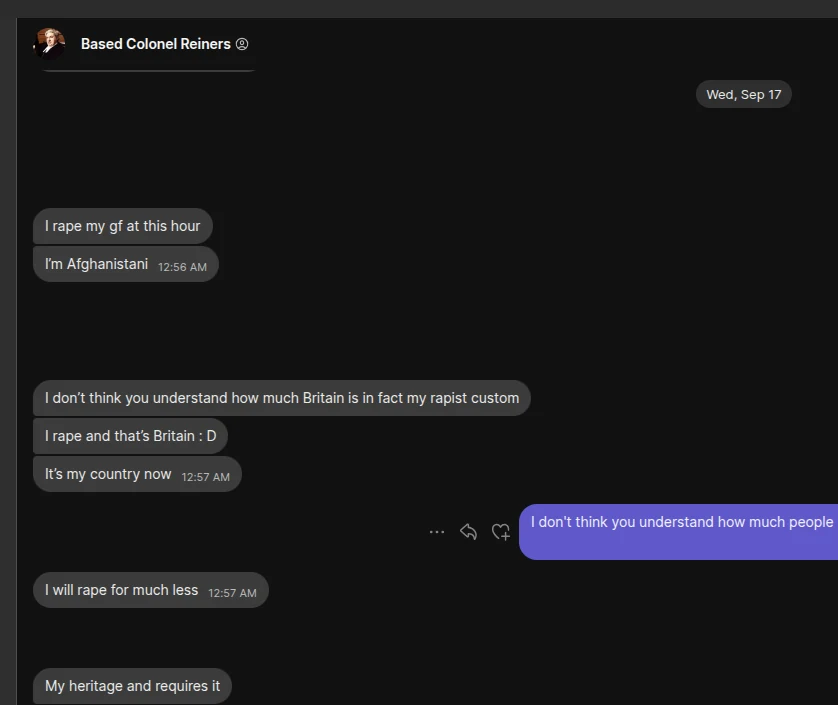
I confronted Michael in writing as a Slack channel was simultaneously flooding with screenshots for a long list of evidence. He gloated, insulted me, and mocked Tilly. It also included preposterous "jury-style" defences suggesting we were in a secret relationship or i was being "blackmailed."
As you can read for yourself, he rotated a number of what would be called "defence strategies" in a law class at university, or might be used by a defence barrister in a court.
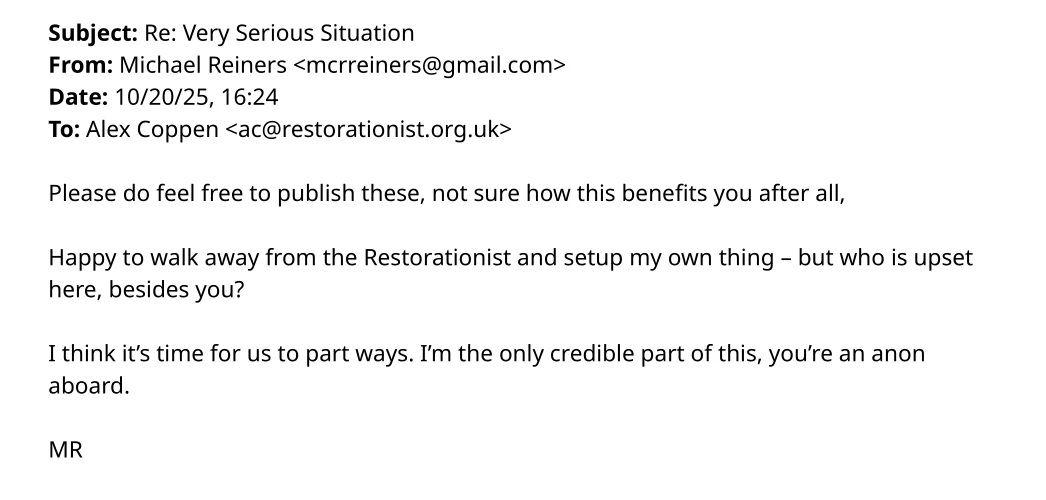
This is the part which was most concerning:
who is upset here, besides you?
The victims, Michael. The dozen or so victims. They're the ones who are more upset than I am. Also, British and California courts, angry friends and family. Other writers who placed their trust and hopes in you. Not to mention, our readers.
(The locust swarm of sockpuppet accounts on X later began echoing the same sentiments: they wanted it; they enjoyed it; it was victimless; they have no case, etc.)
Which is when we got in contact with Central Southsea and St Judes public protection unit of Hampshire & Isle of Wight police.
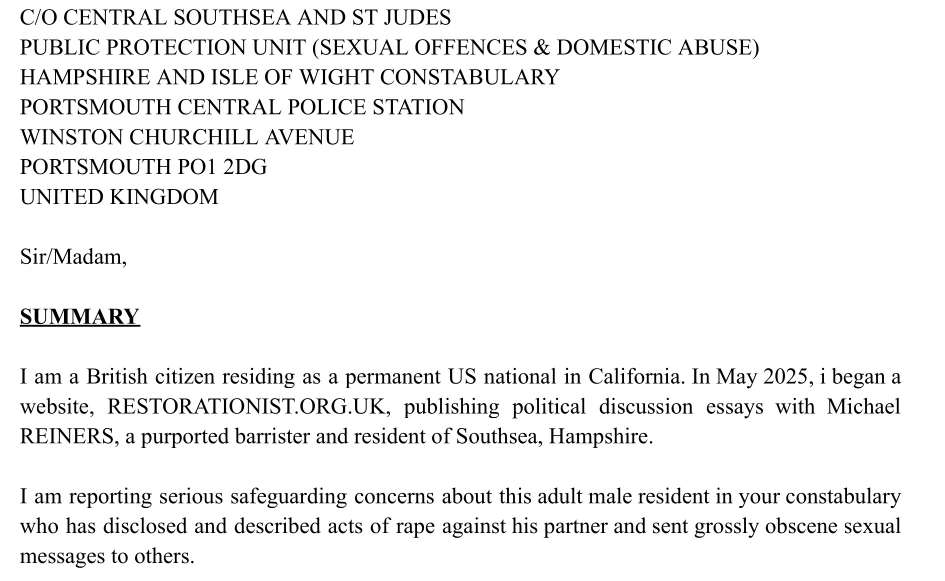
The Whirlwind Smear Campaign
The key question at stake, after immediate physical safety concerns we needed to leave to Hampshire police, was what to do if they unearthed much worse. Michael apparently had a previous arrest record they'd find immediately on the PNC and we'd supplied only a selection of messages and documents we had. We had no idea how many people he'd been in contact with.
The week before, he'd boasted about messaging at least 20 "women from GB PAC."
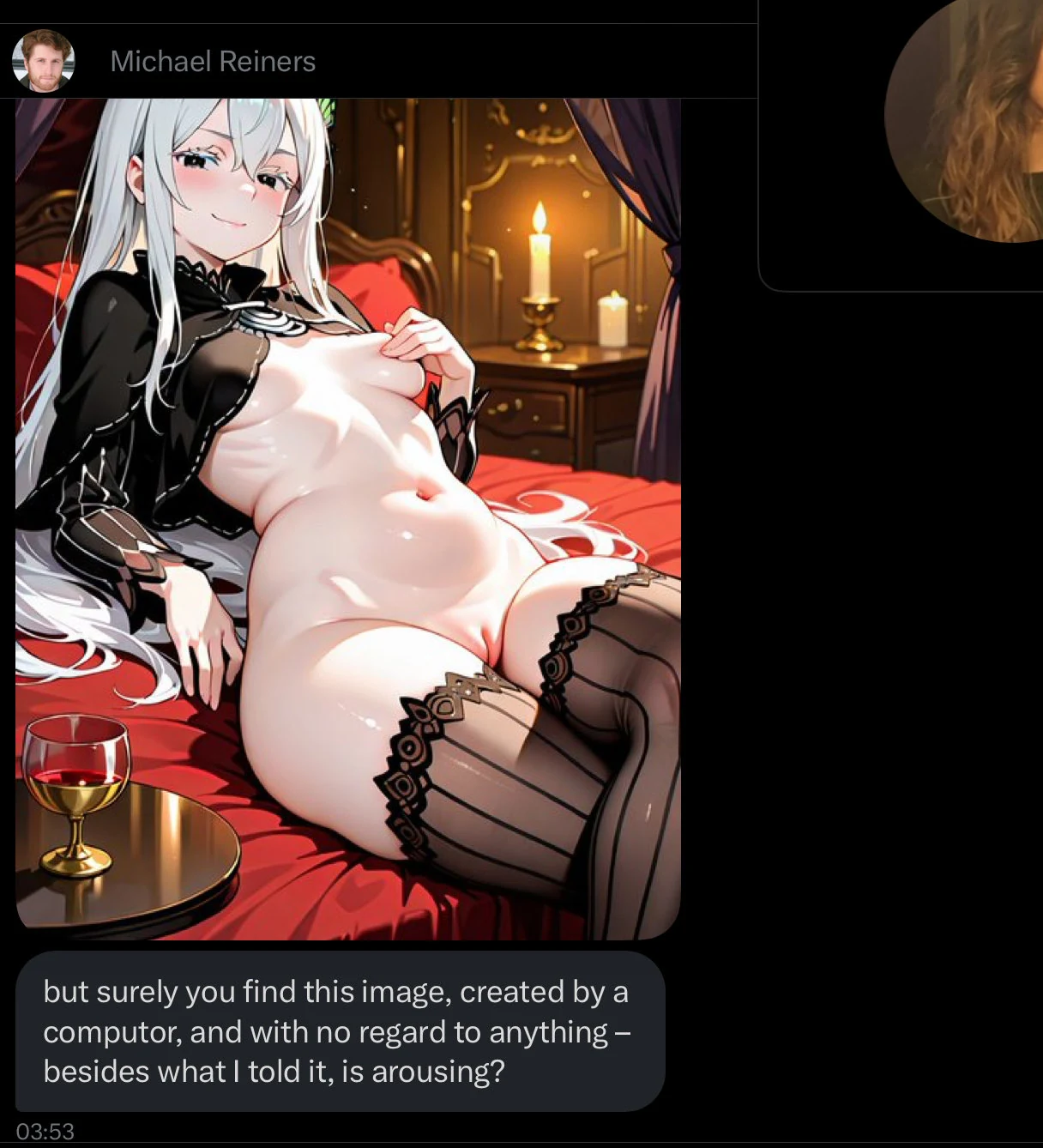
I had to contact each of the media outlets he'd been on, and was planning to go on. Thankfully, they took it seriously. Then i had to contact our subscribers – some of whom support this site financially (he was never given access to Stripe or the payment connection software).
The police reacted quickly, also thankfully. There was no immediate physical risk, thank God. The girlfriend did exist, and the nature of that relationship is somewhat strange, but voluntary. As it often is, until it's not.
My other half, who is a well-known lawyer in Los Angeles, wasn't so forgiving. She had explicitly advised not to engage this person in any capacity, and made clear it was time to injunct him and transfer whatever assets there were into an LLC. Let's just say, lesson learned. Every husband will know exactly what i mean.
What happened next descended into such farce it was staggering. Michael's rage exploded, and he concocted a fabulous story it was a "founder dispute" where he was the actual victim of an upcoming smear campaign. It was just a bit of friendly banter; she enjoyed it; i had a "secret agenda."
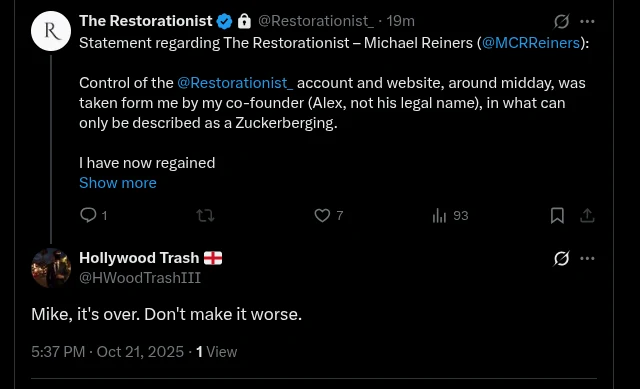
- Hundreds of messages were sent to everyone either I or he had ever spoken to, claiming he "owned" the Restorationist and i was the "webmaster" who had experienced a psychiatric breakdown (the same tactics used on a previous campaign), on top of a "dossier" he was collecting to discredit me personally;
- The Restorationist X account was hacked by resetting the email address and defaced with the same lurid allegations;
- The website content management system had draft articles posted under a hidden account;
- Anything he considered might be evidence – such as a simple Discord server – was deleted;
- A smear campaign of epic proportions was mounted across Twitter/X by a well-organised group of incels to claim i was a "secret Hope Not Hate agent" holding "his" website hostage;
- Socketpuppet X accounts clearly and obviously run by Michael began attacking Tilly and others who shared her posts, then mine;
- Threats of doctored screengrabs and edited messages were floated in corners of X trying to advertise false "dirty laundry";
- Victims of these disgusting incidents were contacted to intimidate or manipulate them into changing what they said;
- Michael recruited a group of willing patsies – including his own girlfriend – to contact myself, Tilly, and others (including victims) to lure each person into recorded "incriminating" conversations he could broadcast on social media or send to others.
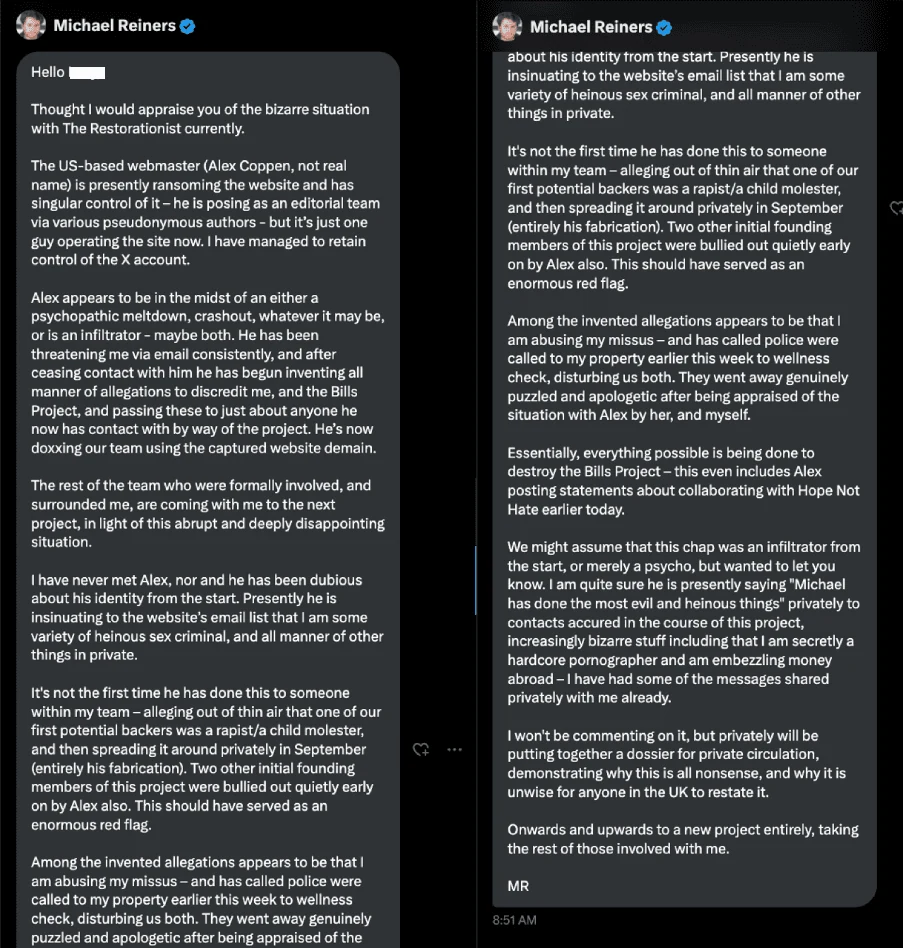
There was no apology for sending unwanted messages; zero concern at any woman he might have frightened, no ordinary sense of propriety; nor causing havoc to the Restorationist and everyone had worked on it.
Not a shred of shame or remorse.
He was only concerned whether people knew or not, and what they knew.
Tilly meticulously documented this malice and was attacked for being on a "feminist witch hunt" and "stirring trouble." Her post prompted several other women to make contact detailing even more lurid allegations. It taught others what DARVO is. Tilly is not a feminist. Not even close. She despises feminism. But, frankly, these people have a point.
An extremely prominent organisation he joined terminated his membership upon a simple background investigation of the facts. They've indicated they prefer to keep their role modest, without fanfare; but if anyone knew how supportive and proactive they were in helping us through this awful week, it would not only shock their enemies, it would earn them many new friends. It speaks volumes they sought not to politicise what was a disturbing few days, and i can't thank them enough. There are caricatures in the media: some of them are the exact opposite of how they are portrayed.
A week later, Michael messaged a member of Tilly's family.
The content? A chilling legal threat that he knew her real name, and mine. He also included my middle name given in the American version of Companies House. The legal notice was absurd and he wasn't in a position to mount an action of that kind, so it only served as a coded doxxing threat.
Only one problem.
I had briefly mentioned her real name as an author several months ago, but the name i actually wrote was the name of an actress in Santa Monica by mistake on my phone – I got "Millie" and "Tilly" confused. I'm glad i did. He also didn't pick up mine was two first names, despite the fact he publicly goes under his middle name himself.
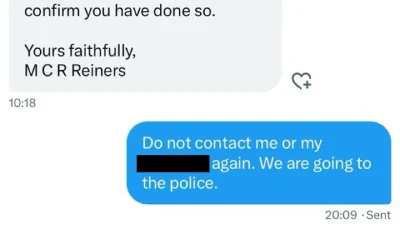
Tilly and her relative reported it to the police. I made it clear in writing to Michael we would be lawyering up, and we will back any victim he may have abused. No more claiming he was the "owner" of the Restorationist or messaging anyone writing for it.
This is, of course, the same pattern: violating boundaries remorselessly without conscience and getting a thrill out of it. One day, it might end up differently for a girl who doesn't know what's happening.
A worrying amount of people believed these messages and the entire fabricated storyline, including well-known media personalities i'd never met. The entire plan was to discredit me personally and blacken my name as much as possible so nothing i claimed would be believed. As this is being written, over a week later, and rather than looking for a job to support himself and his girlfriend, Michael is still obsessively messaging anyone on X who interacts with any post from Tilly or myself with a "stock" ramble of pseudo-legal conspiracy theory.
This is the same pattern as per girlfriend "custardloaf," where he cyberbullied her into oblivion with flying monkeys and scrubbed anything he could find on the Internet which exposed it.
There's a reason we do this – there are nutjobs out there who really will comb through records to find people they don't know and attack their families.
Let's say it again. I live in California. Life is good here. I have no ambitions in British politics, other than i'd like to visit with family someday without them being at risk of violence or rape. It makes no difference to me if lunatic figures on the right or the left decry something i say on X. I'm no-one. This was, of course, a damage limitation campaign on Michael's part, and a self-report of immense magnitude. When in doubt, shut up.
Many people saw through all of this immediately and were bizarrely supportive to a stranger they'd never met. They had no reason whatsoever to be kind to me. I'd like to name them. And broadcast the nature of their character. But such is their humility they would not allow it. But i will repay in full.
All i will say is one of them isn't Welsh, but lives in Wales, and he writes for the Restorationist. And he happens to be one of the kindest, wisest, most extraordinary, and most Godly men i think Britain could ever ask for. Maybe Britain herself will never know. But i will, and i will go to the ends of the earth for that kind of rare friendship.
Act Three Takes Longer
The trouble with smear campaigns is they look desperate. Evidence mounts. Witnesses come forward. The immediate drama recedes and the facts remain. The second party has their say.
Michael used his legal training to concoct his own legal defence, in real-time. It was chilling to watch, and even more worrying to see how women were afraid he appeared to know the law (his legal ability is actually poor). He strategy was to ruthlessly discredit witnesses, lie, and suppress truth-tellers. He manufactured PR to ensure maximum ambiguity.
He was his own Jekyll defence lawyer for his Hyde perpetrator.
The warning sign about Michael came when a pattern emerged of him deriving pleasure from forcing himself on people in differing ways. He enjoyed it; he took pleasure in it. Whether it was a small website, a woman in a hallway, a media outlet, a conservative MP, or his incel group chats. He was banned from bars in Lincolnshire and deliberately violated the bans while hideously drunk to provoke the owner(s), ending in physical violence.
The key to understanding individuals like this is they can't help themselves but gloat and boast pridefully in what they are and what they've done. Their desires accelerate and overwhelm, becoming hungrier over time.
The literature on escalation relating towards sexual violence is extensive, and its chilling. It is some of the most well-documented phenomena in the academic canon.
- Dating App Facilitated Sexual Assault: A Retrospective Review of Sexual Assault Medical Forensic Examination Charts
- The Course and Nature of Stalking: A Victim Perspective
- Technology-Facilitated Sexual Violence: A Literature Review of Empirical Research
- Online Sexual Harassment Perpetration Among Peer Adolescents: A Cross-National and Cross-Gender Study
- The Confluence Model of Sexual Aggression: The Role of Pornography as a Secondary Risk Factor
- Predicting sexual aggression: the role of pornography in the context of general and specific risk factors
- The relationship between pornography use and harmful sexual attitudes and behaviours: literature review
Across multiple bodies of evidence, sexual violence often follows an escalating pattern. It begins with lower-risk behaviours, such as persistent sexual messaging, online harassment, or compulsive consumption of sexual content, and can progress toward more intrusive acts like coercion, physical contact, and ultimately sexual assault.
What drives that escalation isn’t a single factor. It’s a combination of traits (e.g., entitlement, hostility toward women, impulsivity), environmental reinforcers (pornography featuring degradation or violence, anonymous digital contact), and prior success avoiding consequences. Together, these conditions strengthen permissive beliefs and reduce psychological and practical barriers to injury.
Digital interactions are frequently the starting point: grooming, cyberstalking, and image-based abuse build familiarity and control which can be transferred offline. Likewise, some men who begin with online-only sexual offending (like non-consensual sexual messaging or exploitative media) later cross over into contact offenses. And while pornography alone does not make someone violent, violent or demeaning content can amplify pre-existing risk factors and speed the trajectory.
In short: For a subset of offenders, sexual aggression is not a sudden impulse — it is a progression. Earlier behaviours from years ago which seem “minor” can be the first steps in a growing pattern of boundary violation, entitlement, and risk-taking which, if unchallenged, becomes more dangerous over time.
What US & UK Law Says
The Restorationist was at risk of severe legal liability because of the way Michael Reiners behaved.
As an entity based in Los Angeles, it's important to understand California does not mess about when it comes to sexual harassment or obscenity in the workplace – even in volunteer organisations like the Scouts. The law is the clearest in the whole United States because of the endless litigation around pornography. Due to its relationship with a California-based LLC, and the laws surrounding employee / contributor relations, the Restorationist could have been at extremely serious risk.
California Government Code § 12940 makes it brutally clear:
It is an unlawful employment practice, unless based upon a bona fide occupational qualification, or, except where based upon applicable security regulations established by the United States or the State of California:
(j) For an employer, labor organization, employment agency, apprenticeship training program, or any training program leading to employment, or any other person, because of sex, gender, gender identity, gender expression, or sexual orientation of any person, to harass an employee, an applicant, an unpaid intern or volunteer, or a person providing services pursuant to a contract.
(k) An employer shall take all reasonable steps necessary to prevent discrimination and harassment from occurring...
Employers have an affirmative duty to take reasonable steps to prevent and promptly correct discriminatory and harassing conduct.
Subdivision (j) explicitly covers harassment “because of sex, gender …” and protects employees, applicants, unpaid interns or volunteers, and persons providing services under contract. Subdivision (k) places an affirmative duty on the employer to take all reasonable steps to prevent harassment. The statute covers both “quid pro quo” harassment and “hostile work environment” harassment.
This isn't a joke in California. It opens you to serious liability if you allow this behaviour to occur or continue, and courts do not take it lightly. It might seem like some trivial Equality Act equivalent from the shores of England, but it's an invitation of a tsunami of lawsuits.
Ironically, in the UK, it is the exact laws Michael Reiners has opined on extensively which convict him of offences.
The first one is simple. Defamation is cut and dry. The Defamation Act 2013 says:
1 Serious harm
(1) A statement is not defamatory unless its publication has caused or is likely to cause serious harm to the reputation of the claimant.
(2) For the purposes of this section, harm to the reputation of a body that trades for profit is not “serious harm” unless it has caused or is likely to cause the body serious financial loss.
The intent was clearly serious harm.
None of the defences apply:
- Truth: there is zero truth in circulated statements. They are comically absurd.
- Honest opinion: these statements were presented as fact (not opinion) and given in bad faith; they gave no basis for the opinion; and an honest person would not have held it – especially seeing proof of domain registration and images of Reiners offering to drink urine.
- Public interest: none.
- Website operation: none.
- Academic: none.
- Privilege: none.
Section 9 relates to entities outside the US, as the Restorationist is:
A court does not have jurisdiction to hear and determine an action to which this section applies unless the court is satisfied that, of all the places in which the statement complained of has been published, England and Wales is clearly the most appropriate place in which to bring an action in respect of the statement.
The UK clearly is the most appropriate place, so the court has jurisdiction. Obviously it does. Michael Reiners lives in Southsea, as given on public records.
The Malicious Communications Act 1988 Act says:
1 Offence of sending letters etc. with intent to cause distress or anxiety.
(1) Any person who sends to another person—
(a) letter, electronic communication or article of any description] which conveys
(i) a message which is indecent or grossly offensive;
(b) any [article or electronic communication] which is, in whole or part, of an indecent or grossly offensive nature,
is guilty of an offence if his purpose, or one of his purposes, in sending it is that it should, so far as falling within paragraph (a) or (b) above, cause distress or anxiety to the recipient or to any other person to whom he intends that it or its contents or nature should be communicated.
This law was meant for poison pen letters and has been used for political purposes. But in this case, it's simple.
- The intent was to cause distress or anxiety, because it was downright malicious and sick.
- These were electronic communications.
- They were grossly disgusting in whole and part.
This wasn't "political" communication and censorship. It was depraved fetish material, libel, and legal malice.
Section 127 of the Communications Act 2003, one of the most misused laws, says:
Improper use of public electronic communications network
(1) A person is guilty of an offence if he—
(a) sends by means of a public electronic communications network a message or other matter that is grossly offensive or of an indecent, obscene or menacing character; or
(b) causes any such message or matter to be so sent.
(2) A person is guilty of an offence if, for the purpose of causing annoyance, inconvenience or needless anxiety to another, he—
(a) sends by means of a public electronic communications network, a message that he knows to be false,
(b) causes such a message to be sent; or
(c) persistently makes use of a public electronic communications network.
(3) A person guilty of an offence under this section shall be liable, on summary conviction, to imprisonment for a term not exceeding six months or to a fine not exceeding level 5 on the standard scale, or to both.
This clause was meant to deal with letters and dirty phone calls, and is relentlessly abused. But in this case it is entirely applicable. It prompts questions as to its abolition and points to reform instead so it is not used for political purposes.
Again, the offence is clear:
- These messages were sent electronically.
- They were grotesque.
- They clearly provoked annoyance and needless worry.
- They were clearly false.
- And he damned well sent them, over and over.
Yes, these laws are politically abused. But it's important to recognise there are serious situations where remedies are needed. It means reform, and a serious lesson learned. Our Free Speech Act needs more safeguards built in and another look.
Michael likes to opine endlessly about "doxxing." According to his own writing, almost everything qualifies under the Reiners doctrine as "doxxing." When the police charge a defendant or a court sentences them, it's "doxxing" them. When someone sends a picture to someone else, it's "doxxing."
"Doxxing," in the theory of Michael Reiners, is when unfavourable information about his behaviour is revealed by anyone. It doesn't matter if it's behaviour which is depraved, violent, or sickening. It doesn't matter if it's you revealing messages he sent to you about wanting to drink your urine, raping women, and killing people en masse.
What he actually means is "unmasking."
You apparently owe Reiners an imaginable debt of confidentiality in an unspoken hidden contract to protect the privacy of his intrusions, or you will suffer retaliation and mass harassment.
You've "doxxed" Reiners if you tell or blow the whistle. You're a grass; a tattle-tail; a foul traitor; an "infiltrator." He's not remotely sorry. You're the perpetrator for revealing it at all.
This article will inevitably be falsely labelled "doxxing."
Reverse Domain Hijacking
Michael registered a virtual office in London using SAME DAY COMPANY. I found out, and knew what the next step was because it was the same playbook as every time before: scrub the evidence and discredit the victims.
I contacted Nominet, Companies House, Stripe, and Delaware's registrar because i knew what was coming next and why he'd done it.
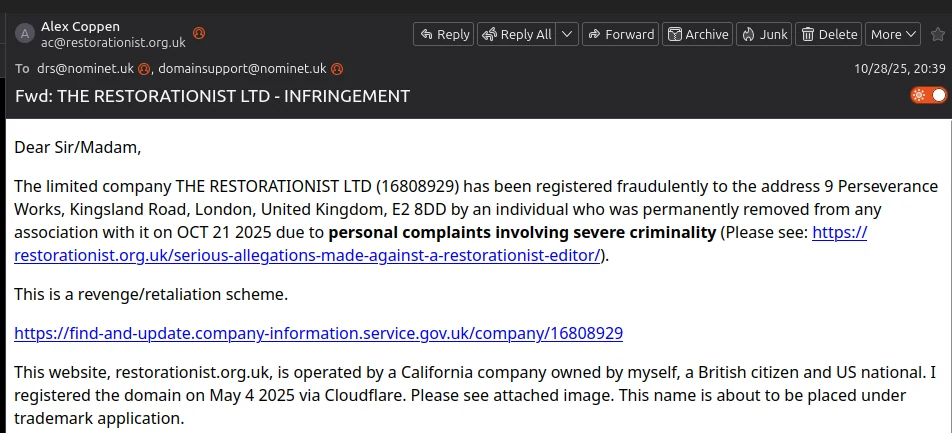
Lo and behold, the next day, this arrived:
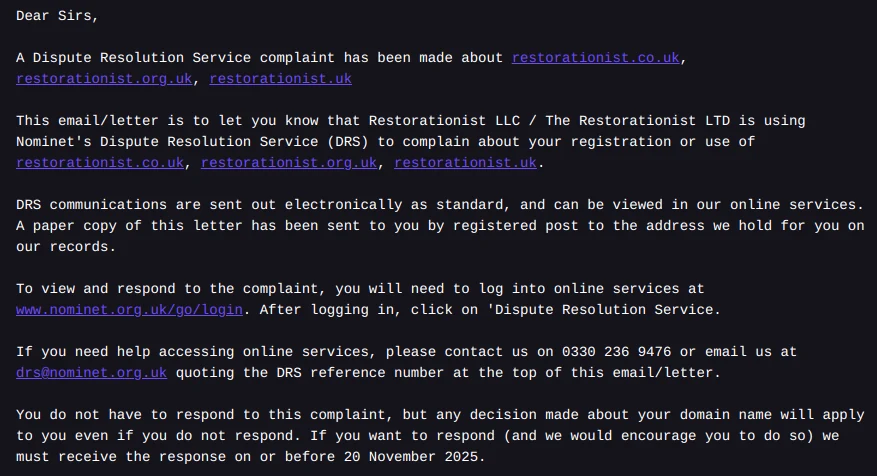
The complaint was so utterly absurd it could only have come from a law graduate who misunderstood the mediation service as a "tribunal." It exists to deal with abusive registrations, not arbitrate disputes between parties like a court.
This complaint is a matter of public record but you can read the simpler version here with simple privacy redactions.
It's hard to know where to start:
- This is clearly ChatGPT (you can tell: it uses this colon phrasing)
- Nominet is not a court or tribunal, it is a mediation service for resolving domain conflicts;
- The disputed domain is wrong;
- The X account name is wrong;
- There is no "mailing list";
- Dear Lord...
It contains batshit, ego-driven inappropriate commentary like this:
Continuity of contributors: the majority of op-ed authors and support staff have chosen to continue with me on a successor site. That decision by those most closely associated with the publication confirms that the public association and goodwill in “The Restorationist” attach to my side of the split.
Section 1 of the DRS Policy defines Reverse Domain Name Hijacking as:
using the DRS in bad faith in an attempt to deprive a Respondent of a Domain Name.
A registration cannot be abusive toward rights that did not exist at the time.
Nominet Experts have found Reverse Domain Name Hijacking in cases where complainants brought disputes in bad faith to deprive legitimate registrants of domain names. Two recent examples are DRS cases D00021240 and D00021075, where the Expert found complaints were brought in bad faith simply to pressure the respondent into surrendering domains, and these findings were noted as potentially damaging to the complainants' reputations in future proceedings.
Nominet experts have dismissed identical “retroactive co-founder” stories many times (e.g. DRS 10758 oakmount.co.uk, DRS 10662 puraglobe.co.uk, DRS 10891 innatewellness.co.uk).
Simply put, it's mental, vindictive, and retaliatory. But it's also incredibly grandiose and malicious. And if you didn't know this guy actually sucks at law, you could easily be intimidated.
Private Property & Hypocrisy
I could not "fire" Michael Reiners in any meaningful sense. I terminated any voluntary partnership, any implied contract (spoken or unspoken) we had, or any association with this website or its operations – which i devised, designed, entirely own, pay for, and have exclusively maintained – because, in my view, upon having experienced it myself personally and seeing the irrefutable evidence, he presented an exceptionally serious risk to its future and those contributing to it.
I took the same decision the Nursing and Midwifery Council did for one reason or another. And Bar of England and Wales seemingly did for a different one. As social media sites and bars in Lincolnshire have also done. And now political parties in the UK have done after seeing the evidence.
And even the people i wrote the "definitive case against" – Hope Not Hate – what one might consider my enemies - also did.
If someone like this was willing to try this against a stranger halfway across the world, imagine what he would be capable of doing to a younger woman nearby who was isolated and vulnerable. Well, in fact, we already know.
When he was publicly outed for domestic violence, he concocted a story he was the victim of "doxxing" by a mentally ill woman and whipped up a firestorm of bullying to discredit her. When he was suspended from the Nursing and Widwifery Council, he concocted a story he was the victim of persecution by Hope Not Hate and threatened to sue them. When he was removed from the Restorationist, he concocted a story he'd been "Zuckerberg'd" from "his" site by a "webmaster" having a mental breakdown, and whipped up a firestorm of bullying to discredit me. His last scheme was to concoct a story he owns the Restorationist because of fraudulent company registrations. The pattern is unmistakable.
Next will come doctored screenshots, and a fraudulent report to "discredit" this one. It's all too predictable. I was sent the details of the "new project" of this incel group and it's essentially an Excel spreadsheet by Dean-Smith, attempting to emulate Charlotte Gill with lists of "DEI" officers and council expenditures through FOIA requests.
As Dade Circuit Judge Edward D. Cowart infamously said to another former law student in 1979:
You’re a bright young man. You’d have made a good lawyer. I’d have loved to have you practice in front of me. But you went another way, partner.
In my personal opinion, after knowing him even superficially for over six months, it is my genuine belief Michael Reiners is an exceedingly calculated and depraved sexual predator. And I maintain the belief several of his "associates" are, in tandem. I pray I am entirely wrong. And as a Christian, i am commanded to pray for my enemies and those who try to harm me, regardless of the circumstances or how imperfect a man I am.
But ultimately it simply doesn't matter – it's my private property, and US law says I have the freedom to do what I wish with it.
My choice to use that freedom to hold myself to the same standards i hold my adversaries to. I asked how long the CPS would tolerate Hope Not Hate's behaviour. Now i ask the same of us. We have harboured it, unwittingly or otherwise. We are accountable. I am accountable.
If i'd have wanted to "doxx" Michael, there was plenty of opportunity and material: his home address; the name and details of his girlfriend; his supervisor at work and best friend; his birth certificate filing; the well-known people he sent messages to; the content of them so lurid the police will need specialists for. Right down to the exact amount of savings in his bank account to sustain himself over the next two years. He, himself, wanted to get caught and for people to know. He wanted to taunt Hope Not Hate. He splashed it all over the Restorationist timeline in duper's delight.
Why didn't i know? Why didn't i realise sooner?
No, WorldByWolf, i am not a secret MI5 double agent for Hope Not Hate. I just didn't search his name on X. Neither did you. They did.
I met Jekyll, and it was only three months in when Hyde emerged. I was 4000 miles away. I still am, as he feverishly searches California records and regisrers companies.
Did you know when your local grooming gang arrived? Or that family member? How close were you?
Michael Reiners is welcome to attempt to dispute any of the facts in this article via counsel or the courts of the United States or of England and Wales. The worst were omitted. Good luck: [email protected]
]]>On August 30 2025, we launched Tell Someone, a whistleblowing crime reporting platform for victims of the Pakistani rape gangs in the UK. For 20 years, despite having innumerable resources, government and NGOs have been unable to do the simplest possible things, like collect information from victims. The stories and background are so shocking it's scarcely believable.
Worse than that even has been the response of political parties and movements in the UK. Almost all of these imperialistic gangs are competitive media entrepreneurs more interested in glorifying themselves on Twitter and Instagram talking about the horror of rape than actually doing anything about it.
We sent this platform to all of them, for free, and those who didn't ignore it decided they wanted to compete and launch their own, to undermine us. A really pleasant bunch. Do not vote for these people, do not give them money, and do not put your trust or hope in them. The WhatsApp messages alone would make you furious.
You can read the full story behind the platform on The Restorationist: https://restorationist.org.uk/tellsomeone-org-uk-our-secure-rape-gang-reporting-platform/
]]>On the day of US independence, we launched a new online publication for a new political movement, The Restorationist - https://restorationist.org.uk. In 8 weeks, it averages 40,000 visitors/readers a month, including Members of Parliament, David Starkey, and major political leaders. It has published the first two bills of the Great Repeal, and will publish the remaining five before December.
Almost all of England's revolutions have restored what has been lost. Rather than exploding a new idea into being, the Englishman has sought to repair what has eroded and decayed. Restorationism is the vision of a new future from reckless hope: what has been trampled upon can be glorious again.
Over 30 writers have now published 80 articles which have been praised for their intellectual depth and authoritative precision, including a rather vicious set of attacks on the malicious NGO "Hope Not Hate," as well as other nefarious actors.
A Doctrine Of Reckless Hope
Perceptiveness
The Restorationist sees more than present value or decay; he sees future glory and what something will be worth upon medicament. He sees through what is, to what can and will be. When he is confronted with doom, he sees the victory parade; when it is winter, he sees spring.
Sentimentality
The Restorationist is driven by love: a love for God, love for one’s country; love for one’s people; love for one’s traditions. Love for what was and what is, coupled with grief over what has been lost. His is a Burkeian world of a shared covenant between those who are dead, those who are alive, and those who are yet to be born.
Stoic Optimism
At his very core, under his cynicism and mischief, the Restorationist is a cautious optimist. His resolve and stubborn-minded will to renew what has decayed is self-evidently his choice to embrace hope over apathy or despair. He is convicted, resolved, and decided. His mind is made up.
Pragmatism
The Restorationist is not nostalgic because he aims to bring into being something new from something old. He is not an idealist; a bleeding heart; nor is he naive or magical in his thinking. Renewal requires diligent planning and costing, being fraught with opposition.
Savoir Faire
Being an Englishman, the Restorationist has a polished sureness to his cause. As a man of the world, he knows when to brandish a dagger, plant a kiss, or trigger an eruption of language. Most of all, he understands the importance of dress and aesthetics.
Are you A Restorationist?
Sense Of Loss
At his core, the Restorationist has a visceral understanding something intangible and valuable has been lost. From his people and their quality of life; his culture and the esteem of its traditions; in the integrity and practices of those he has agreed may govern; and the future his children will inherit. Unlike the conservative, he is not passively conserving or preserving what already exists as he looks back; he must recover; repair; renew; regenerate; begin anew. He must work actively as a matter of honour and wisdom, in adverse conditions, to transform what is broken or decayed, for the future.
Political Homelessness
Having lived through the digital printing press reformation of the personal computer and the Internet, the sclerotic ideologies of the last century are anachronistic and to the Restorationist. He is not of the Right, because he seeks transformation; not of the Left, because he values tradition. He is not authoritarian, as he demands non-interference; not libertarian, as he understands the necessity command. Neither is he a centrist, as he favours action. He is not a futurist, as he venerates the past; nor is there something to conserve or smash down. Ironically, the one thing he can not, and will not, restore is the dead-end ideologies of the past.
Distrust of Bureaucratic internationalism
Whether it is open society globalism, multinational corporation outsourcing, mass immigration, ideological oligarchy, NGO lobbying, the harmful disenfranchising effects of unaccountable governance by faceless bureaucrats are too self-evident for the Restorationist to deny. The nation is the widest plausible form of the third person plural (“we”), the national civil service bureaucracy, and the supranational rulemaking body are all an intolerable violation of a people’s sovereignty over their own destiny and the individual’s right to live without interference from those who are provided consent to govern.
Rejection of post-WWII excesses
The Restorationist has come to despise the destructive landslide of moral permissiveness, and no longer wishes to live in a repeating mythological storyline of grieving Nazism and magical equality. To him, the so-called endless tolerance of “liberation” slew such as postmodern nihilism philosophy, brutalist architecture, foeticide, euthanasia, race taboos, marriage cynicism, open promiscuity and prostitution, migrant violence, homosexuality veneration, racial favouritism, mass child rape, mass sexual abuse, antisemitic violence, atheist humanism, next-day divorce, cross-dressing, Nixon inflation, censorship arrests, surveillance cameras, abstract euphemisms, epidemic narcissism, and every other socio-cultural ill are the inevitable by-product of liberalism itself. He recognises and values the differences between the sexes; the beauty of marriage; the moral bankruptcy of hedonism; and the social cohesiveness of religion even if he does not practice himself.
Insistence on natural negative liberty
The Restorationist is, at his heart, a fish who swims in the waters of ancient English traditions and recognises these have created the most successful prospering nations in human history because freedom and prosperity are intrinsically coupled. Rights only make sense when existing in and of the state of nature as an uniquely individual corporeal human being, given from God; pre-existing both government or politics; out of either’s jurisdiction. Rights and liberty oblige inaction and they should be free by default from interference or external restraint, whether the offending action originates with the state or other people. He rejects entirely the modernist notion of a “social contract,” or the state has jurisdiction to issue artificial permissions such as origin-less “human rights.”
Enthusiasm for Austrian economics
The concept one can press levers to control nature trade between humans, or centrally plan the movement of economic forces, is objectively absurd to the Restorationist as attempting to manipulate the weather. Moreover, GDP is not the most important thing. As a keen analyst of historical trends (such as Singapore and Hong Kong), he rejects the invasive excesses of Keynesian economics, Nixon shock, and Modern Monetary theory for the Austrian model for as minimal interference by the state in business as possible, while favouring decentralised cryptographic systems which bypass gatekeepers. Interference by the state decreases individual prosperity because it decreases freedom, and vice versa.
Trust but verify
Unlike when the radio and television monopolised public opinion as a pulpit for weekly ideological promises, the Restorationist intuitively only trusts public figures who have rarely, if ever, changed their stance, and been the same person without pandering or flip-flopping in the political winds. He recognises, because of the folly of the “blank slate,” one’s beliefs should be considered an extension or byproduct of one’s temperament and character as a product of a time and place, formed from moral sentiment and common sense political conviction. The righteousness of one’s cause, and their loyalty to it, are separate from the purity of one’s behaviour.
Autodidactic by default
As a curious mind, the Restorationist is more self-taught than he is taught. Three-hour podcasts allow him to evaluate who an author really is; YouTube videos provide pausable instructions; eBooks live in a folder on his desktop; AI models answer his endless questions at his own pace, whether fast or slow. In an encyclopaedic universe with all human knowledge in his pocket via the smartphone, he reaches first to do his own homework before sitting at a desk looking at a blackboard to passively receive information.
Drawn to technological futurism
The Restorationist is driven by a pragmatic fascination with the possibilities technology invites to the future, not by rosy nostalgia for an arguable past. He lives in a world of instant global communication where knowledge, currency, and memory are digitised, imagining imminent exploration of Mars. What was unmade can be made again; what was ruined can be renewed; what has not been seen can be realised. His is a science fiction world immersed in perceiving how the world he leaves to his grandchildren could look, as he appreciates and values what it evolved from before.
]]>In June 2025, we published https://quangocracy.org.uk, which mapped all 603 UK public bodies, and the useless civil servants who run them. It was shared by political leaders across the UK and the open-source data was shared across scores of different websites. Months of research and long nights of data-crunching revealed everything was much worse than anyone thought.
Out of it came the open-source Parliamentary bill: the Restraint of Bureaucratic Overreach (RoBO) Act.
You can read the full story on the Restorationist: https://restorationist.org.uk/project-afuera-the-robo-act/
]]>So "Hate Not Hope", aka "Searchlight Information Services", are at it again. This time they've doxxed another individual YouTuber with the wrong opinions after a campaign of serious criminality, and libeled him with a claim he "inspired terrorism." And they're getting more daring with each dying attempt to secure more funding, through their links with the British state as the country becomes more agitated with mass immigration. This is all a historical pattern which started in the 1960s with an infamous convicted criminal named Gerry Gable, who grandfathered this repulsive organisation but parted ways with it in 2011.
But first, what is Gable's bastard child up to?
Who Are Hope Not Hate?
As America has Media Matters, GLAAD, the SPLC, the ACLU, and the ADL, the UK has its own band of moral crusaders and political vigilantes. They conduct "investigations" through illegal means to "expose" political opponents, then feed their "reports" to easily-scared, desk-bound journalists at the BBC, Channel 4, and the Guardian, who portray them as a "neutral" kind of brave "watchdog" charity working for the public good. Naturally, they hope this renders the people they don't like to the attention of the Home Office and police, where the process will be the punishment. This network of loons is firmly rooted in the dumbest corners of British humanities' departments.
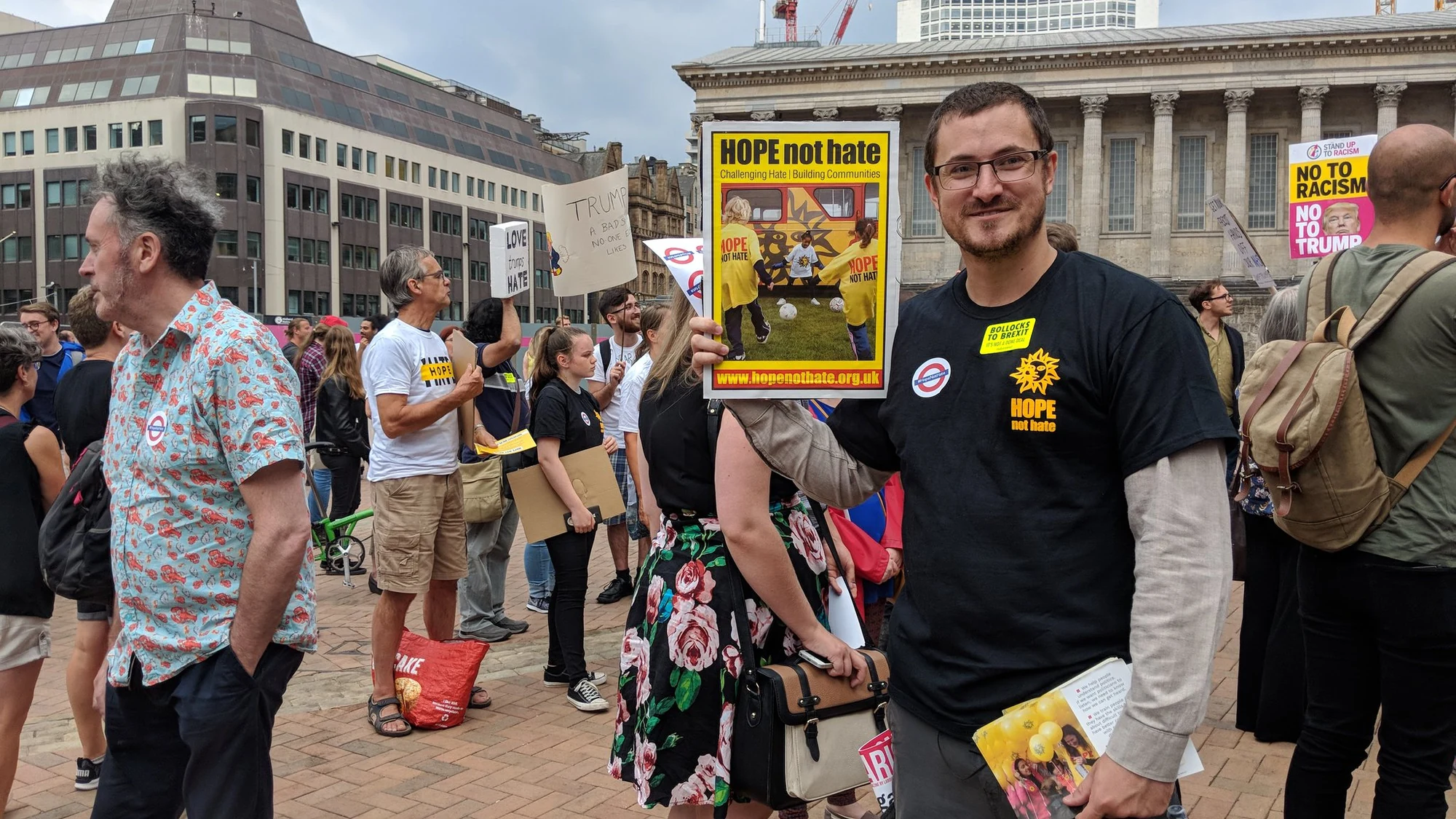
Which would be noble, if it were the 1930s, and they did expose malicious actors to end Nazism as if we were all in a magic time machine.
Associated with the ADL-like Community Security Trust (CST), bankrolled by donations, the Soros Foundation, and the Paul Hamlyn Foundation Migration Fund, this organisation - almost certainly a cutout proxy - consists of multiple (re)named parts, which absolutely stinks of laundering:
- Searchlight Information Services (SIS, founded 1986), interesting synonym of Britain's foreign intelligence service, and HNH's apparent precursor organisation
- Hope not Hate (1986) Limited (Reg. No. 02055070)
- Searchlight Educational Trust (SET), a charity registered No. 1013880 in 1992, later renamed to Hope not Hate Educational
- Hope not Hate charitable trust (Reg. No. 1013880 and 02738367)
- Hope not Hate Educational Ltd, with an address given as PO Box 67476, London NW3 9RF
- Hope not Hate Limited (Reg. No. 08188502).
- Hope not Hate (Services) Limited (Reg. No. 07719229)
- Partnership with the School of Social Sciences at University of Northampton to house the Searchlight Archive
- Apparently a background organisation called the Trade Union Friends of Searchlight
It is headed by Nick Lowles MBE (nickname "Penfold"), a former student volunteer at Sheffield University, former editor of Searchlight magazine, former head of campaigning at SEED. And a former Panorama TV researcher, which, as we will see later, is rather coincidental and intriguing. Commentator Owen Jones is a patron of HNH’s Education Fund, as are the secretaries of the National Education Union and Unison.
- Their "Senior Researcher," and "head of intelligence," Matthew Collins, was a radical member of both the BNP & National Front (former) and a Communist Party of Great Britain member who is on video in 2013 waving a Soviet flag and praising the Red Army
- Their former "communications advisor," firebrand journalist and former GMB union official, Dan Hodges (son of Labour MP Glenda Jackson), claimed they used "every dirty, underhand, low down, unscrupulous trick in the book."
- The government has answered FOIA requests revealing they were paid by the Home Office for rather questionable invoice items, as well as the Department for Communities and Local Government
- The Economist accused them of massively exaggerating the celebration of an MP's murder by their political enemies
- The Spectator called their gangster tactics a form of racketeering and coercion
- The Critic called them the left's sponsored "attack dog"
- Left-wing Novara Media accused them of cherry-picking their opponents
- The Express implicated them in spreading an imaginary list of "far right" rioters
- Influential Whitehall blogger Guido Fawkes published recordings which appear to implicate the group in partisan violation of electoral law
- Socialist publication Notes from the Borderland claimed they were a Labour-supporting intelligence front for MI5 and Searchlight lying about founding, statistics, and even the BNP (!!!)
- The Jewish Chronicle publicised they'd been been ordered to pay damages for falsely accusing a Jewish woman of attacking a socialist bookshop
- They called for the Labour party to adopt policy from the Marxist movement, Poale Zion (see: Liron Velleman, Policy Officer for the Jewish Labour Movement), which apparently is also concerned with imaginary Nazi-satanism and even managed to make its way into MI5;s inbox
- They half-apologised for not deleting a false incitement tweet falsely suggesting right-wing protesters were acid-attacking Muslim women in Middlesborough after the police confirmed it was nonsense
- Their "reporter," alias Harry Shukman, alias “Christopher Morton”, was caught using a false UK passport and found to have paternal links to SIS
- Their former director, Ruth Smeeth MP, is on record as secretly briefing a foreign government about her own PM's intentions
- The Shawcross Review of the Home Office's Prevent program accused them of falsely conflating legitimate disagreement with extremism
- Researchers have endlessly complained they misuse their charitable structuring to campaign politically, and MPs have raised questions in Parliament
- The Telegraph cross-linked their materials to the government’s Research, Information and Communications "propaganda" unit, set up in 2007 by a former MI6 officer
- They claimed to have inside information about MI5 informants spying against them
- Collins apparently traveled in a "convoy of cars" controlling 25 spies/collaborators
- Their "director of research" accused Elon Musk of supporting neo-Nazis
- They have campaigned for extensive government censorship in Parliament
- They have shared false claims 14,000 babies would die in Gaza (p. 9)
Naturally, the snake has come to eat its own tail many times, after falsely dishonouring their own artist award winner and Lowles being kicked out of NUS events for disliking Arabs while being Jewish.
According to Hate Not Hope, the right hand has no real idea what the left hand is doing:
HOPE not hate [limited company] receives grants from HOPE not hate Charitable Trust, which are used to undertake work falling within HOPE not hate Charitable Trust’s charitable objects.
https://hopenothate.org.uk/hnh-charitable-trust/
The Charity Commission’s “Speaking Out” guidance (CC9) explicitly instructs charities campaigning (or any public statements) must “comply with charity law, and other civil and criminal laws” and be “factually accurate.” In fact, the Commission warns that “any event or publication must not breach criminal law, equality law or defamation law”, and knowingly publishing defamatory lies breaches trustees’ duties. In regulatory practice, misconduct includes any act a person “knew (or ought to have known) was criminal, unlawful or improper.” If the charity’s trustees authorised or ignored these actions, they could face sanctions: an official warning, inquiry, or removal from office. Serious breaches (e.g. bribery, harassment, defamation) could even trigger disqualification of trustees under the Charities Act. Moreover, charities must remain non-partisan. The Commission have made it clear the use of charitable trusts for extremism is unacceptable. In fact, in 2017 they had cause to advise/warn HNH about political activity.
This isn't a partisan issue: there are multiple organisations on both sides who abuse this loophole to raise money for their nefarious activities.
In July 2024, they claimed to have cyberstalked pictures uploaded by the pseudonymous account "Raw Egg Nationalist" (Charles Cornish-Dale) and identified the location of a local farm shop. This somehow involved Katherine Long, a "journalist" for Business Insider, who harassed the owner asking for information on the man doing his shopping there. Long's background indicated her as a quite obvious intelligence plant, making the claim about social media imagery highly suspicious.
The doxxing of REN (Charles) followed that of Bronze Age Pervert (Costin Vlad Alamariu) and Lomez (former University of California, Irvine lecturer Jonathan Keeperman).
Later that year, when Channel 4 produced an absurd documentary lionising a pitiful "investigation" into a little known group, Connor Tomlinson (Lotus Eaters)meticulously documented how one of their staff (Shukman) had produced what appeared to be a genuine British passport with a false name to enter their event. Which was either a criminal act of possessing false identity documents, or something actually issued by HM Passport Office: something only possible when requested by the intelligence services.
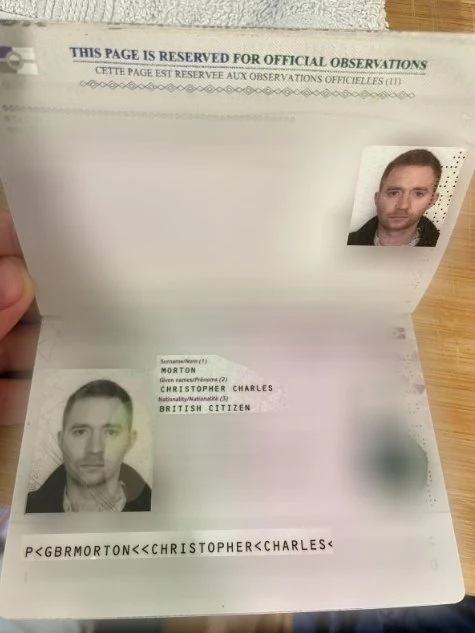
So what is this time?
An "undercover reporter" from Hope Not Hate fraudulently gained access to a private Scyldings event in Oxfordshire, searching for the name behind anonymous account "Morgoth Reviews." They then proceeding to illegally photograph (GDPR) attendees who expected it to be private after noting the man's name. According to the individual, Hope Not Hate staff turned up at an old residential address posing as journalists looking to interview a YouTuber. Not finding much luck, they went back the next day to harass neighbours door-to-door, and post letters under doors offering money for documents on him.
The result was an insanely libelous article accusing him of "inspiring terrorism."
None of these people belong to any extremist organisation, nor have any of them committed any kind of criminal offence.
1950s: A Communist From The Beginning
Gerry Gable was born on January 27 1937 in East London. As a young man, he joined the Young Communist League and the Communist Party of Great Britain, where he worked as a runner for the Daily Worker newspaper (now Morning Star) and later as a trade union "community organiser."
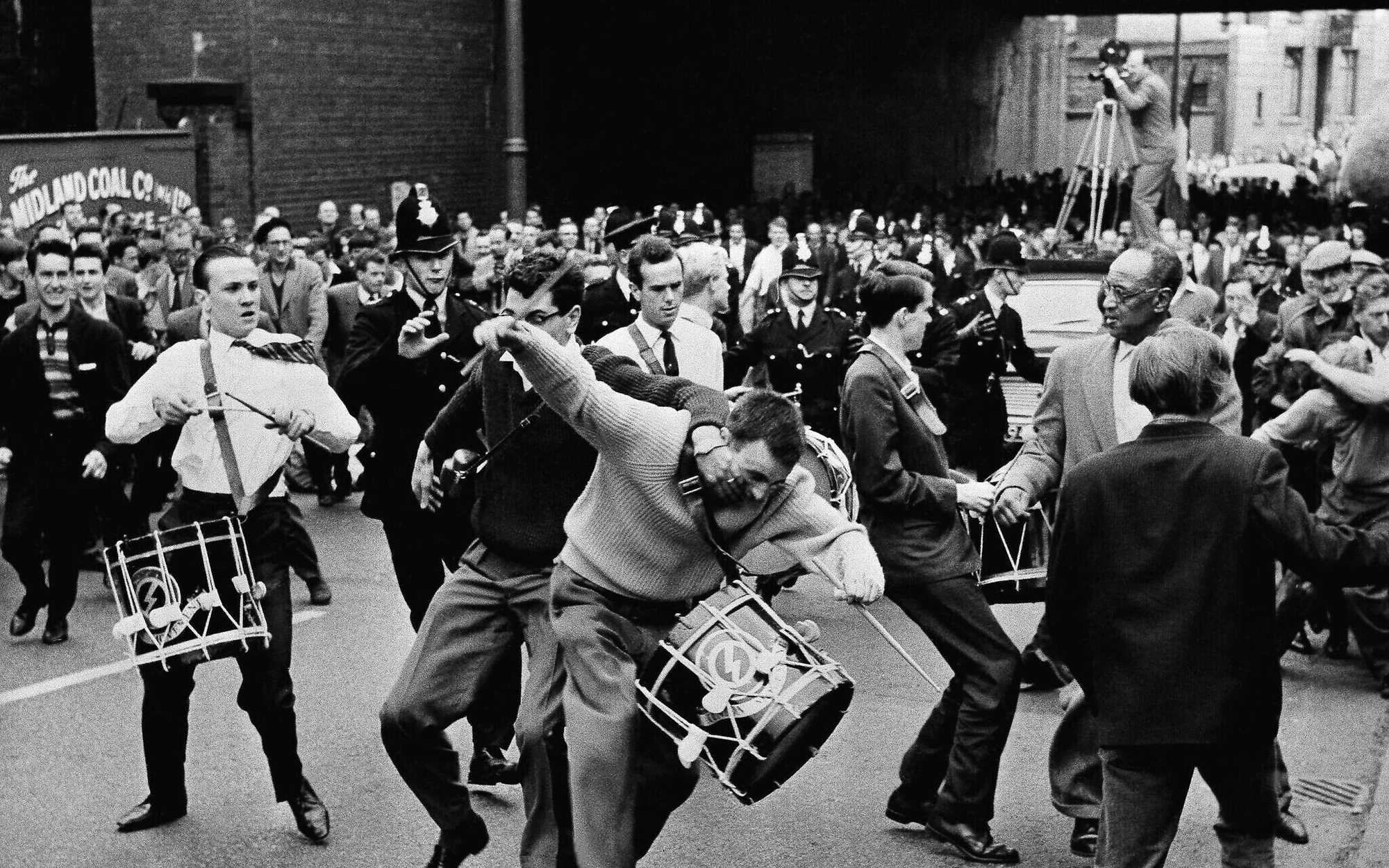
In 1962, he ran unsuccessfully as a Communist Party candidate in Northfield Ward, Stamford Hill. After 10 years he left, wanting to "concentrate on anti-fascist work and because the party had begun to adopt an anti-Israel line," and in his own words, considered himself to be “first and foremost a Jewish trade unionist.” It wasn't to last, because communists are communists. And they've been calling themselves "antifascists" for a century.
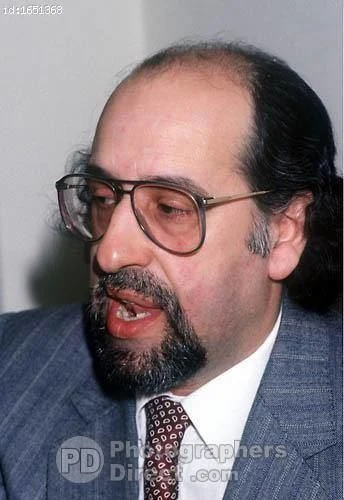
Around the same time, 4 organisations were ruffling feathers about Commonwealth immigration into Britain:
- the National Socialist Movement (Colin Jordan)
- the Union Movement (Oswald Mosley)
- the British National Party (BNP)
- the National Front
Harry Bidney, the gay owner of "The Limbo," a nightclub in Soho, formed a Jewish-only group named the "62 Committee" from former members of the "43 Group," the Spanish International Brigades, and the "Yellow Star Movement." It was composed of supporters of the Beginite Herut organisation, a political successor to the Irgun Zvai Leumi terrorist group.
The exclusive group decided to meet fire with fire, engaging in violence, infiltration, and take revenge for WWII.
The Board of Deputies of British Jews denounced what became known as the "62 Group." The Remnants became the Community Security Trust in 1975.
Gerry Gable signed up, and was their "intelligence officer." Searchlight themselves chronicle their long history on their own website.
Bidney's story is extraordinary and only came to light in 2012.
During the period from when I first met Harry Bidney until the Brighton fiasco, he had two Special Branch handlers, one of whom became the head of Special Branch. They would visit him two or three times a month. He told me who they were after a time so that I could give them a message if he was not around when they came.
https://www.infotextmanuscripts.org/searchlightarchive/s_a_brief_biographies.html
1963: Burgling David Irving's Home
Gable and two accomplices gained entry to the home of historian David Irving in Hornsey by posing as GPO (General Post Office) telephone engineers to steal documents.
As Gable tells it, he and other young anti-fascists [communists] were deeply concerned at the kind of material Irving was producing in his early books, and, aware that Irving had spent time working in the Krupps steel mills in Germany, were convinced that the writer was getting help from some unsavoury sources.
“It became more obvious, as he had access to documents that no-one else had — and with the kind of work he was doing for Krupps, he didn’t have time to go to archives and do the type of detailed research necessary.”
With two other men, Gable devised a plan to enter Irving’s home, posing as a telephone engineer. He was genuinely working as an electrician and trade union organiser at the time, and decided his cover story would be the need to rewire Irving’s phone for a different voltage.
Unfortunately this had actually taken place in the neighbourhood six weeks earlier, and Irving, having let two of the three men into his flat, grew suspicious.
He said he was popping out for cigarettes, but returned bearing a hammer, saying: “I think you should know I’ve called the police.” Gable meanwhile had found disturbing material in Irving’s flat and invited the police who arrived to arrest him.
https://www.jewishnews.co.uk/gerry-gable/
In January 1964, Gable was convicted of a much lighter sentence of “entry by artifice,” fined £20, with an additional £5 for theft of a GPO pass. As part of his defence in the 1963/4 burglary trial, he admitted he hoped to supply information to Special Branch on David Irving.
1964: Searchlight Magazine
The 1960s and 1970s saw a surge in underground newspapers tied to the counterculture, New Left, and anti-war movements, which indirectly competed for readership among progressive audiences. Its history is catalogued extensively by author Tony Greenstein.
In the mid-1960s, Gable co-founded Searchlight as a newspaper alongside Labour MP Reg Freeson, Labour MP Joan Lestor, and sports journalist Maurice Ludmer, with Gable serving as "research director."

Ludmer was the first editor and a member of the steering group of the Socialist Workers Party (SWP)'s first Anti-Nazi League, which later became Unite Against Fascism.
During that time, a myriad of newspapers went head to head for dominance on university campuses and other battlegrounds:
- Private Eye launched in 1961 as a satirical take on politics and society
- Bulldog was the magazine of the Young National Front, edited by Joe Pearce, running from the late 1970s to the mid-1980s. It promoted far-right activism, particularly on football terraces, and idealised the white power music scene. The magazine was openly racist and incited violence, positioning it as a direct ideological opponent to Searchlight.
- Lobster, a journal focusing on intelligence services, political conspiracies, and parapolitics, emerged in the 1980s but had roots in the 1970s countercultural and investigative journalism scene. It hated Searchlight.
- Black Dwarf was a socialist and New Left publication (1968–1972), addressing racism and imperialism.
- The Campaign Against Racism and Fascism (CARF), initially an insert in Searchlight from 1979, was published by the London Anti-Racist Anti-Fascist Co-ordinating Committee, but with a stronger focus on old school racism. They hated Searchlight for focusing too heavily on antisemitism at the expense of addressing anti-Black sentiment.
- The International Times (IT), launched in 1966, was a leading underground paper covering countercultural topics like music, drugs, and radical politics.
- Oz was known for its provocative content and legal battles over obscenity in the early 1970s, Oz targeted a youth audience with radical and libertarian views.
In the 1970s, Searchlight focused on demonizing the Conservative Monday Club, and in the 1980s, it targeted the Western Goals Institute (later linked to the Traditional Britain Group).
In 1981, associated journalist, Manny Carpel, was jailed for burning down the Hancock printing press.
Lobster’s 1992 issue (reprinting a 1980 New Statesman article, "Destabilising the “decent people”) questioned whether Searchlight, under Gable’s leadership, served as a conduit for state surveillance of extremists.
Even its most vocal left-wing supporters denounced its behaviour. In the 90s, the anarchist Direct Action Movement (DAM, aka Syndicalist Workers Federation, Solidarity Federation, International Workers' Association), which spun off from the violent Anti-Fascist Action, were questioning what it was doing. Both were linked with Red Action and the 1987 Red Front.
In 1991, the shareholders of Searchlight Magazine Limited were: Gerry Gable, Stephen Silver, Michael Billig, David Edgar and Elizabeth Ludmer. The directors of the Searchlight Educational Trust were Kenneth Leech, Dr Anthony Kushner, Baron Moss (now deceased), Carrie Supple, Robert Purkiss, David Herman, and Mrs Sonia Gable.
In 1999, Nick Lowles - the CEO of Hope Not Hate - became editor of Searchlight.
1975: Mystical "Column 88" Appears
The official story goes something like this.
During the Troubles in Northern Ireland, Column 88 was formed as a British neo-Nazi paramilitary known for its secretive operations and alleged ties to figures like deputy direct of MI6, George Kennedy Young (chair of the Monday Club). As a football hooligan movement, it aimed to revive fascist ideals, reportedly celebrating Adolf Hitler’s birthday and engaging in paramilitary training. Searchlight magazine, with Gable as editor, exposed Column 88 in its May 1975 issue, relying heavily on information from infiltrator Dave Roberts. Gable claimed National Socialist leader Colin Jordan was sworn in as a member of this secret society at 19. The "88" derives from Heil Hitler initials (H=8, H=8).
"Column 88" allowed the Tory government to bring in new laws to fight 'racism' as defined in the onerous Public Order Act 1986 and also draw in massive donations to Searchlight to fight the 'Nazi menace of Column 88'.
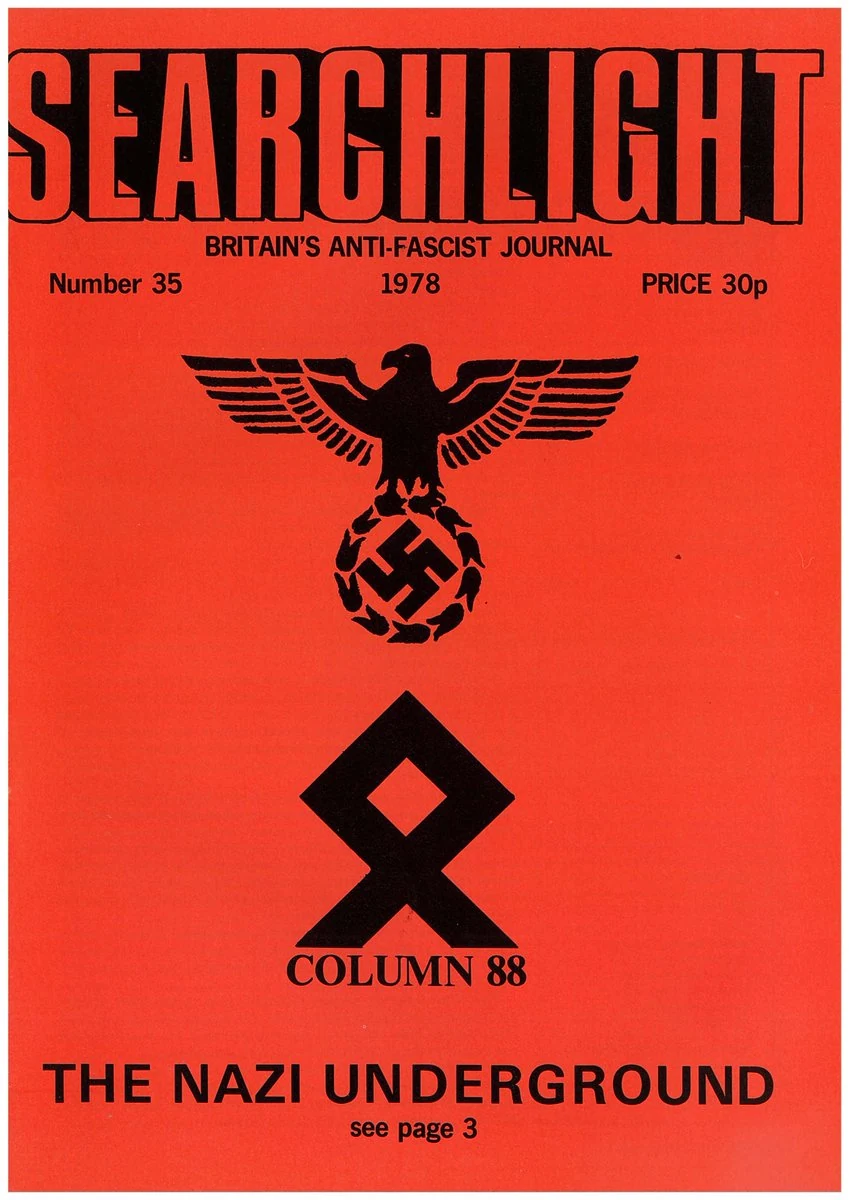
However, radical left wing groups - on Gable's side, generally - were deeply suspicious. Lobster magazine, was particularly irritated. Right wing groups cried foul.
Larry O’Hara’s Searchlight for Beginners (1996), published by Lobster magazine, argued it was not a legitimate neo-Nazi group, and that Searchlight, under Gable’s leadership, played a pivotal role in promoting its exaggerated threat to serve state interests.
O’Hara claims C88 was a British intelligence operation designed to attract and monitor far-right extremists, not a genuine fascist group. Searchlight’s 1995 Community Handbook later admitted C88 was a state “honey trap,” possibly linked to the Gladio network, but O’Hara argues Searchlight failed to disclose this during C88’s active period, thus aiding the state’s deception. He contended this coverage, reliant on infiltrator Dave Roberts, was orchestrated to create a public scare, diverting attention from more significant state activities, such as MI5’s efforts to undermine Labour PM Harold Wilson. The 1976 Savernake Forest story, linking C88 to Territorial Army exercises, further amplified its threat, with Searchlight boasting of its scoop while omitting Roberts’ ties to Special Branch.
Gable’s key operative, Dave Roberts, a former communist party member, provided critical intelligence on C88. After joining the National Front in the Midlands under the pseudonym "Ralph Marshall," he was arrested in 1976 for attempting to assault an Indian restaurant staff and arson on Communist Party premises. Roberts passed information to Special Branch, which O’Hara saw as evidence of his status as a state asset. Gable’s future wife, Sonia Hochfelder, played a dubious role by passing information on leftist groups (e.g., CPE-ML) to fascists like Steve Brady, potentially contributing to the 1975 murder of IRSP member Michael Adamson by the UVF in Northern Ireland.
A quick read of left-wing suspicion makes it clear why they were so agitated:
Amongst the information passed to Searchlight in 1976 by Roberts (who was subsequently disowned by Gable after Maurice Ludmer's death), was the revelation that David King (a Birmingham Nazi known to have close links with the so-called "Column 88") had told Roberts in prison that he suspected fellow fascist Peter Marriner of being in touch with Special Branch. Marriner, a long-time Nazi activist in Birmingham, then local organiser for the British Movement and said to be involved with "Column 88", achieved notoriety when he was exposed as a fascist infiltrator of the Labour Party, International Socialists, and other left-wing groups during the Ladywood bye-election. Searchlight subsequently printed a long expose of Marriner's activities, but only after the local press had already picked up the beginnings of the story and blown Marriner's cover as election agent to Labour MP Brian Waldon and his successor, John Severs. Nowhere in Searchlight's coverage of the Marriner case was there any mention of a Special Branch connection. Marriner told the Left he was infiltrating the Right. He told the Right he was infiltrating the Left. If he was also in contact with Special Branch, just who was infiltrating who? And why, after they published so much else of the information gathered by Roberts, did Searchlight balk at exposing a leading Birmingham Nazi as an agent of the Special Branch? With "experts" like Gerry Gable, who needs fascists?
https://www.katesharpleylibrary.net/wwq0mz
1977: Boasting of MI5 Links At LWT
By now, Gable had aroused the suspicions of almost everyone in terms of his links to the state intelligence services. Rather hubristically, he confirmed them in writing.
Gerry Gable, is a self-confessed confidant of Special Branch. As has been demonstrated in earlier reporting (see Anarchy magazine) Gable and colleagues were able to get much of their information on British based fascists direct from police intelligence. The traffic was by no means one way.
https://libcom.org/article/anti-fascist-or-pro-police-anarchist-black-cross
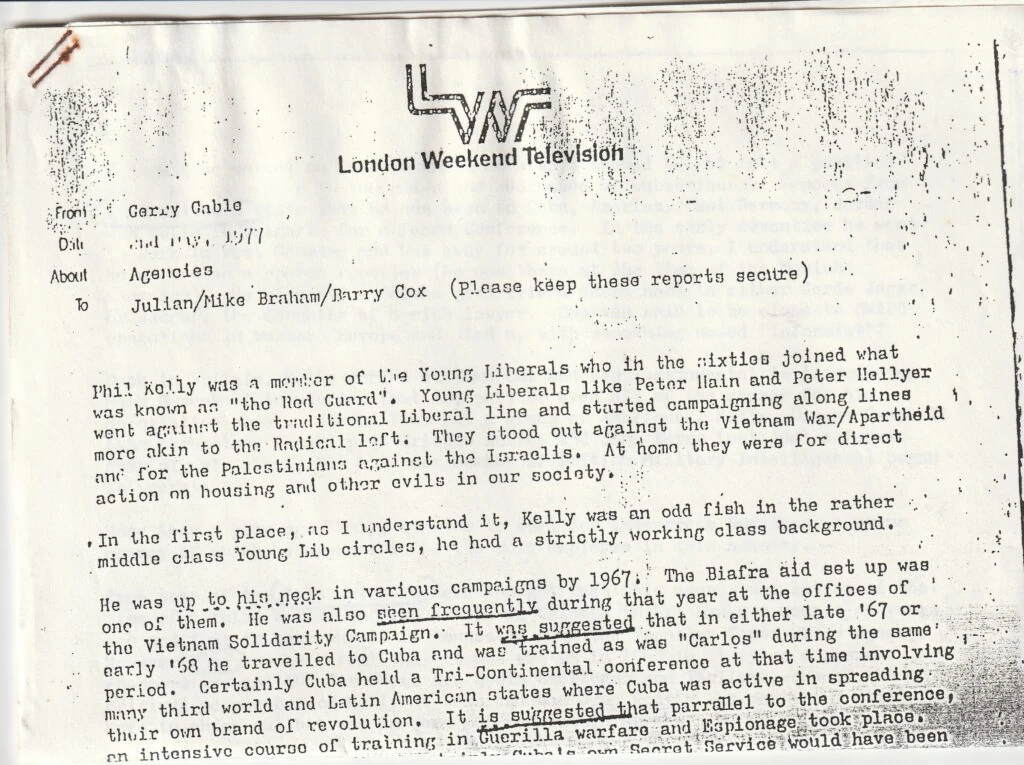
In May 1977, Gable was working at London Weekend Television (LWT), as a researcher/presenter on the London Programme. Notes from the Borderland - a leftist publication - explicitly details it the full "Gable Memorandum":
I have now given the names I have acquired to be checked out by British/French security services, especially the French and German connections and the South American stuff is being checked by Geoffrey Stewart-Smith’s institute. He has strong CIA links. I may try somebody in the Israeli Foreign Office that I know for some checks on Kelly. It is now a time of waiting for feed-back and also further checks here.
https://borderland.co.uk/gable-memo-proving-mi5-links/
Anarchist author Kate Sharply, aforementioned, documented the memo in meticulous detail:
The memo was the subject of an article by Duncan Campbell and Bruce Page in the New Statesman in February 1980. Gable has never successfully refuted the information contained in the article. When Campbell and Page went down to LWT's offices to confront Gable with the evidence and demand some answers, Gable simply cleared his desk and fled, refusing to talk to them. This is in marked contrast to his previous meeting with Campbell, whom he took out to an expense account lunch during the 'ABC' Official Secrets case to pump him for information he could pass on to his friends in Special Branch.
The memo, written by Gable followed, he says, a lunch with a Security Service employee in May 1977. The nature of the official material received and recorded by him - mixed with large amounts of random gossip - indicates that much of it was coloured by phone-tap information and informer's reports. It consists almost entirely of libellous untruths about a group of 'target' individuals the 'ABC' Official Secrets defendants, American deportees Philip Agee and Mark Hosenball, and several of their acquaintances. In certain respects, material from Special Branch had been deliberately falsified to mislead Gable and his employers. The timing of the memo showed clearly an intense interest on behalf of MI5 in manipulating events surrounding the Agee/ Hosenball case and the beginnings of the 'ABC' prosecution.
https://www.katesharpleylibrary.net/wwq0mz
A profile of Gable in the Jewish Chronicle, October 23, 1987, said of Searchlight, 'The magazine has a small staff, but its stories, gleaned from a wide range of contacts (including people in the secret services)...'
1984: Libeling Tory Politicians Via The BBC
In the 80s, Gable really ramped it up. The BBC commissioned him to produce research for a BBC Panorama programme "Maggie's Militant Tendency" about right-wing extremism in the Conservative Party. One should know by now where this is heading.
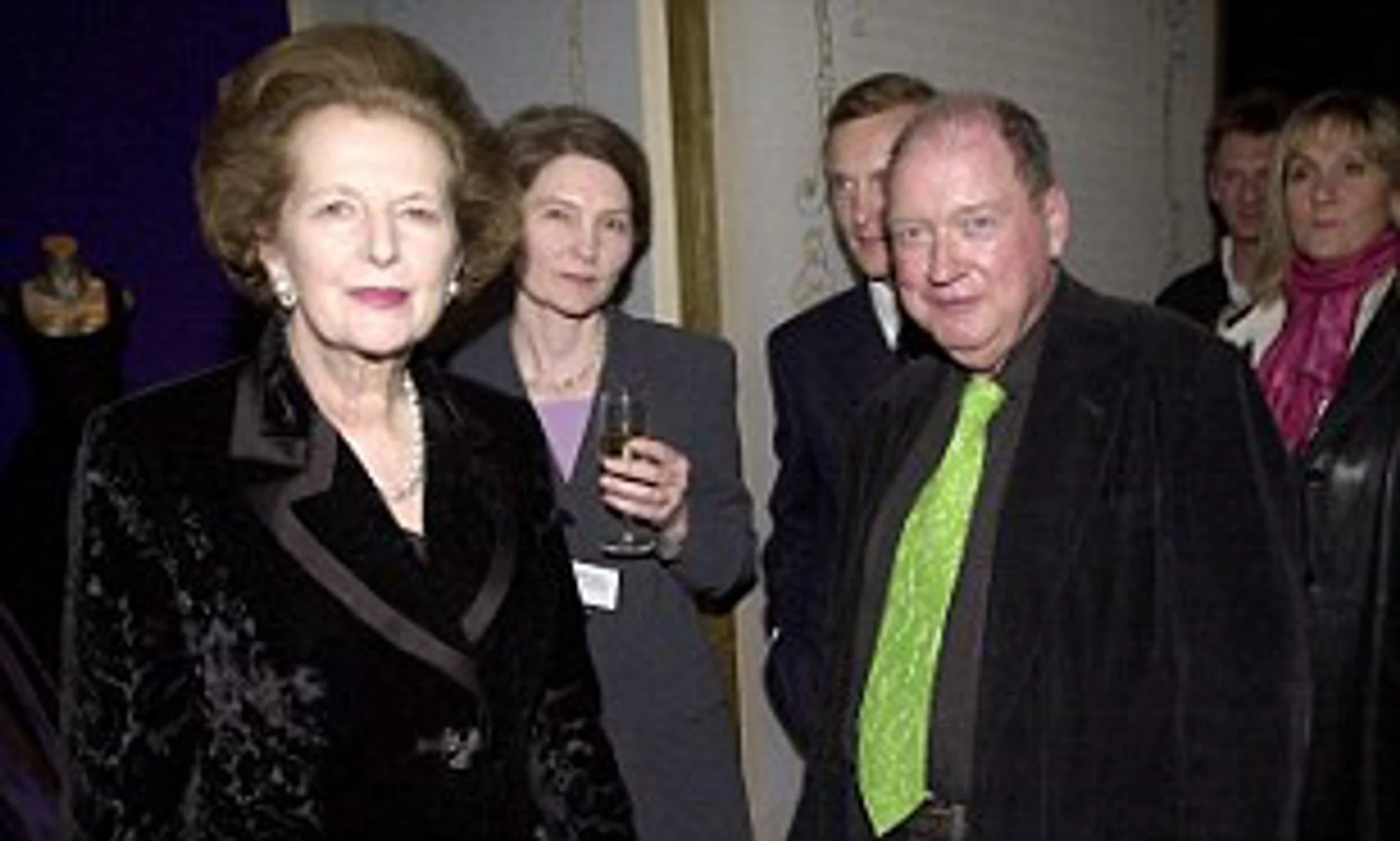
He didn't disappoint. He alleged two Conservative Party figures, Neil Hamilton and Gerald Howarth, were secret extremist Nazi supporters on the basis Hamilton allegedly gave a Nazi salute in Berlin while 'messing around' on a Parliamentary visit in August 1983.
Hamilton and Howarth settled at £20,000 each for libel, with the case funds raised by chairman of the Institute of Economic Affairs, Ralph Harris, and Sir James Goldsmith. It was followed by a Commons motion signed by 100 Tory MPs calling on the Director-General Alasdair Milne to resign.
The same year, "Searchlight Information Services" (SIS) was created as a research and investigative body to gather and analyse intelligence on fascist, Nazi, and racist organizations. It provided briefings to governments, politicians, journalists, and police, expanding Searchlight’s influence beyond the magazine.
Small breadcrumbs were left around the old magazine presses about this individual:
He also hinted once again at the alleged Michael-Somoza relationship. In 1986 Michael had been involved with the final re-launch (so far) of International Times, in the March 1986 issue of which the questions of Gable's relationship with the British state had been referred to again. Atkinson referred to International Times at that time 'operating out of an office near Charing Cross, the set-up had an agent of the Somoza family hanging around'.
https://www.scribd.com/document/126084982/Lobster-24
1986: Private Eye Pays Out For Libel
The April issue of Searchlight ran the headline: "EXPOSED! TORY MP IN PLOT TO MURDER SEARCHLIGHT JOURNALIST." A “plot” allegedly to kidnap and murder Gerry Gable.
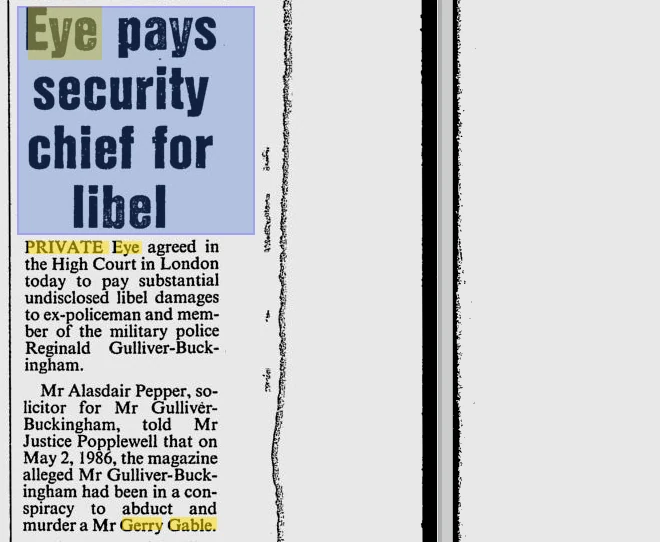
The magical story was Reginald Gulliver-Buckingham, a member of the military police, had plotted to abduct and murder Gable. It was nonsense.
In its 29 May 1987 issue, the article "MR GERALD HOWARTH APOLOGY" stated that following legal proceedings, substantial damages were paid. In its 22 Dec 1989 issue, it published "Reginald Gulliver-Buckingham An Apology," which stated that in the High Court, Private Eye apologised to him. In its 7 June 1991 issue, "MR JAMES ROSS," which announced the magazine paid him substantial damages and legal costs.
1992: Mystical "Combat 18" Appears
"Searchlight Educational Trust" (SET) was formed in 1992 as a charitable entity (No. 1013880), SET focused on educating the public about the dangers of racism and fascism, particularly in schools and communities. However, another enduring mystery concerned a similarly-named paramilitary fascist organisation which had emerged mysteriously through a scoop by Searchlight. The official story goes something like this.
In 1992, Charlie Sargent and American Harold Covington, formed an offshoot of the British National Party to protect its members from violent "antifascists" (communists).The "18" derives from Adolf Hitler's initials (A=1, H=8). In the early 1990s, C18 gained notoriety for street violence and publishing Redwatch, a magazine listing personal details of political opponents to incite attacks. By 1993, it began forming ties with other far-right groups in Europe and North America. In 1997, internal conflicts led to Charlie Sargent’s conviction for the murder of fellow member Chris Castle, causing a split within the group.
During the late 1990s, C18 was linked to violent incidents, including the 1999 London nail bombings by David Copeland, a former member. The group’s activities included distributing bomb-making manuals and planning attacks to destabilise multicultural societies. It also identified C18 members in the British military, including soldiers from the Parachute Regiment whom it claimed were far-right paramilitary terrorists.
Sargent split with his former C18 colleagues over allegations - yet again - he was an informer for the British security services. A feud had began in 1996, which the left-wing site Statewatch narrates well:
The fascist organisers were jailed for life after a jury found them guilty of stabbing to death Blood and Honour supporter, Christopher Castle, who was acting as an intermediary between the rival groups. The court heard evidence from a number of key C18 members as the supporters of the factions issued threats and accused one another of "grassing" to the police (see Statewatch, vol 7 no 2).
The feud between Sargent and another C18 leader, who cannot be named for legal reasons, began in the autumn of 1996 and centred around money and control of the lucrative CD music business. Disagreements led to Sargent making allegations of the theft of up to £100,000 against his former partner. As the accusations became more acrimonious they led to a split in the movement and the formation of the Sargent-led National Socialist Movement (NSM). Sargent's rival, along with other key players, maintained control of the C18 faction.
In February 1997 Castle agreed to act as an intermediary between the warring factions. It was arranged that he would deliver Sargent's work tools to the Harlow home of his girlfriend and in exchange he would receive the C18 mailing-list and £1,000 from Sargent. However, Sargent had other ideas and with his close friend, Blood and Honour organiser, Martin Cross, plotted to ambush Castle.
Castle was accompanied by the C18 leader, who he dropped off outside the rendezvous, before meeting Sargent. A short time afterwards, the court was told, Castle staggered out of the house shouting for help. He had been stabbed in the back by Cross, at the instigation of Sargent, in what was described as "a violent and cowardly attack". The C18 leader hailed a taxi and took Castle to a hospital where he later died.
https://www.statewatch.org/statewatch-database/uk-c18-leaders-get-life-for-murder/
In May 1993, Searchlight submitted written evidence to the UK Parliamentary Home Affairs Select Committee, describing C18 as a terror group possibly linked to South African state security services (via Ray Hill). In December 1993, Gable gave verbal evidence to the committee, urging MI5 to take the lead in investigating C18 due to its alleged connections with Northern Irish loyalist ("terrorist") groups like the Ulster Defence Association (UDA), i.e. Terry Blackham’s 1994 attempt to supply submachine guns and a rocket launcher.
It had two key informants within far-right groups: Tim Hepple, associated with the BNP, and Matthew Collins, linked to the National Front and C18 (later Hope Not Hate's "director of intelligence'). Hepple simultaneously targeted leftist groups like Green Anarchist. appeared on an ITV World in Action documentary in 1993 (“The Terror Squad”), produced in collaboration with Searchlight, exposing C18’s violent activities, including death threats, beatings, letter bombs, and arson. Collins, who provided insights into C18’s leadership and its UDA connections, faced suspicion and was relocated to Australia by Searchlight for safety.
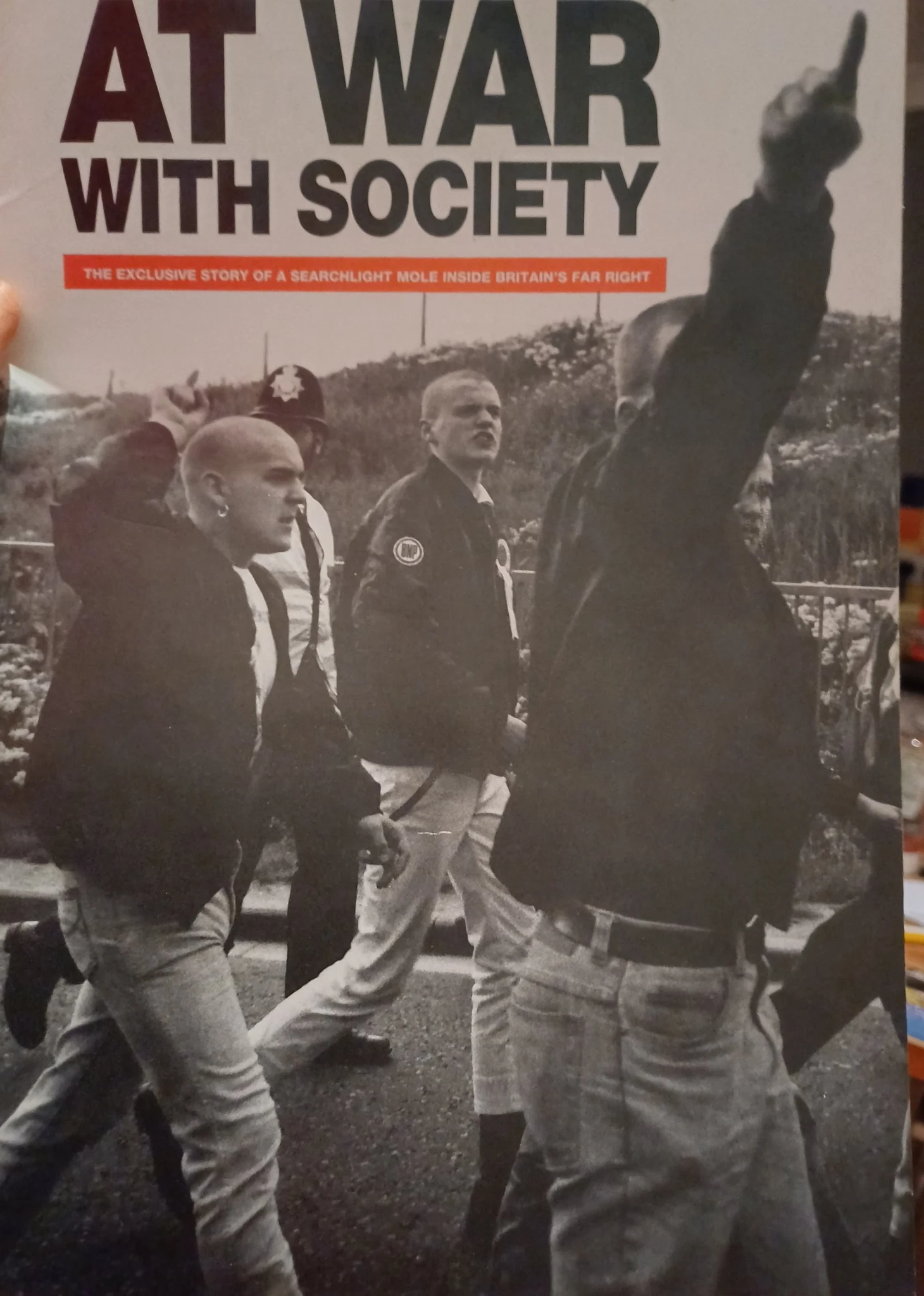
A second documentary in 1998, following Charlie Sargent’s murder conviction, revealed a thwarted assassination plot against a World in Action journalist, Quentin McDermott, based on intelligence from informant Darren Wells for nearly five years, revealing internal operations and plans.
Except, yet again, everyone cried foul this time. It was alleged to be another "honey trap" - an operation designed to attract and identify extremists.
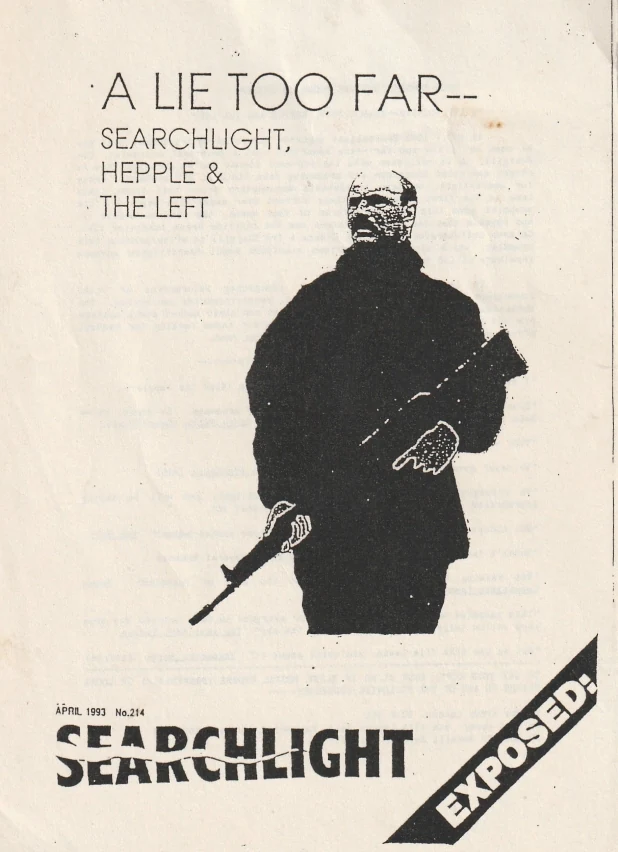
Hepple openly claimed to work directly for MI5 and that he had witnessed British Army death squad executions in Northern Ireland.
In 1991, alongside Searchlight informant Ray Hill (a founder of the 1982 British National Party), Hepple attempted to influence Green Anarchist by offering arms and high-tech communications equipment. Hr provided lists of fascist names and addresses, many inaccurate, claiming the BNP had published leftist membership lists (e.g., in Class War and Red Action). O'Hara contends it was a lie intended to provoke leftist attacks on fascists, potentially sparking retaliatory violence. Hill revealed himself to be a "mole" in 1984 in a documentary for Channel 4.
Hepple deliberate passed the same inaccurate fascist hit lists to anarchist Tim Scargill, who published them. Searchlight later denounced these lists as “ludicrously inaccurate” and suggested Scargill might be a “sloppy nazi infiltrator” or “state agent provocateur,” despite Hepple admitting Searchlight’s knowledge of the lists’ production. He was involved in organising a race riot in Dewsbury in 1989, infiltrating Left-Green groups to steal or access membership lists and petitions, and setting up a UK newspaper for the US-based Church of the Creator, which included weapons and street warfare training.
The argument about C18 from Searchlight up to this time was quite clear, almost consistent. It was portrayed as a group of Nazi thugs, acting autonomously, who had nonetheless been inspired by US Nazi Covington (definitely) and South African Intelligence (perhaps) Their activities were worrying because of links with Ulster Loyalists. Special Branch, with whom Searchlight worked closely in the 1970's when the key inter-agency rivalry was MI5 versus MI6, had by now entered into a 'turf war' themselves with MI5. This reached something of a crescendo with the April 1992 achievement by MI5 of wresting primacy in Loyalist and Republican 'terrorist' matters from Special Branch. In this situation, twilight operators like Searchlight were faced with something of a choice to make as to which side to back in this new inter-agency conflict. Gable and his team unambiguously chose MI5, hence his attack on London Special Branch (the largest and most powerful) who had allegedly 'failed to comprehend the dangerous nature of groups like C18 here and abroad.'
A few days after I confronted [Searchlight office manager Tony] Robson, the April 1995 issue of Searchlight went to print, and its contents included a dizzying somersault. It was now announced that MI5 had in fact set up C18 as a 'honey trap' in order to 'know the extent of ... joint operations' between fascists and Ulster Loyalist paramilitaries. This claim has been repeated subsequently, and is still Searchlight's position. [50] In the context of Searchlight's history, and the line they propagated enthusiastically up to this point, their C18 coverage is plainly a disinformation project on behalf of MI5.
https://libcom.org/library/SearchlightForBeginnersLarryOhara2
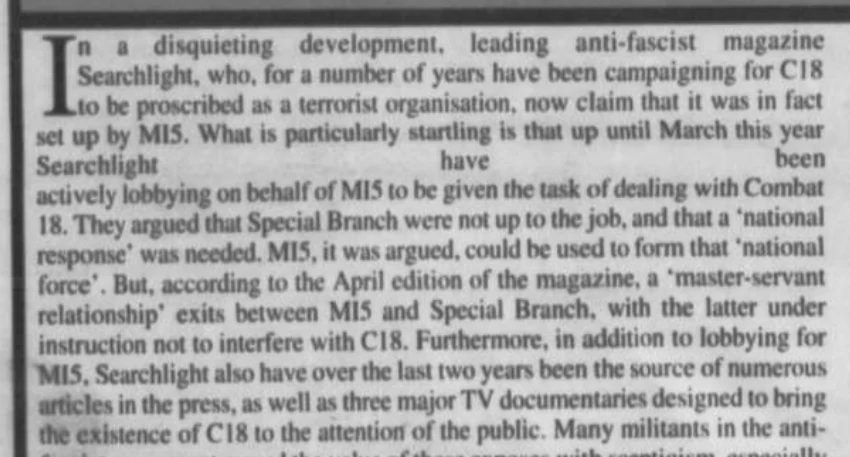
Throughout these cases, O'Hara identifies a consistent pattern:
- Searchlight maintained close relationships with state security agencies
- They passed information between different groups (sometimes feeding intelligence about leftists to fascists and vice versa)
- They published stories with secret state agendas
- Key operatives received unusual levels of state protection
- They engaged in operations designed to disrupt and manipulate left-wing groups
In 1995, Searchlight called for banning Green Anarchist. Then it published O’Hara’s personal details, doxxing him, and falsely implying he facilitated drug deals between C18 and Ulster loyalists.
1996: Sued Into Oblivion
By the mid-90s, people really had started to have had enough. Searchlight published an article alleging a criminal conspiracy between O'Hara and two other men, stating they were "breaking criminal and civil laws with impunity" and should be "in custody."
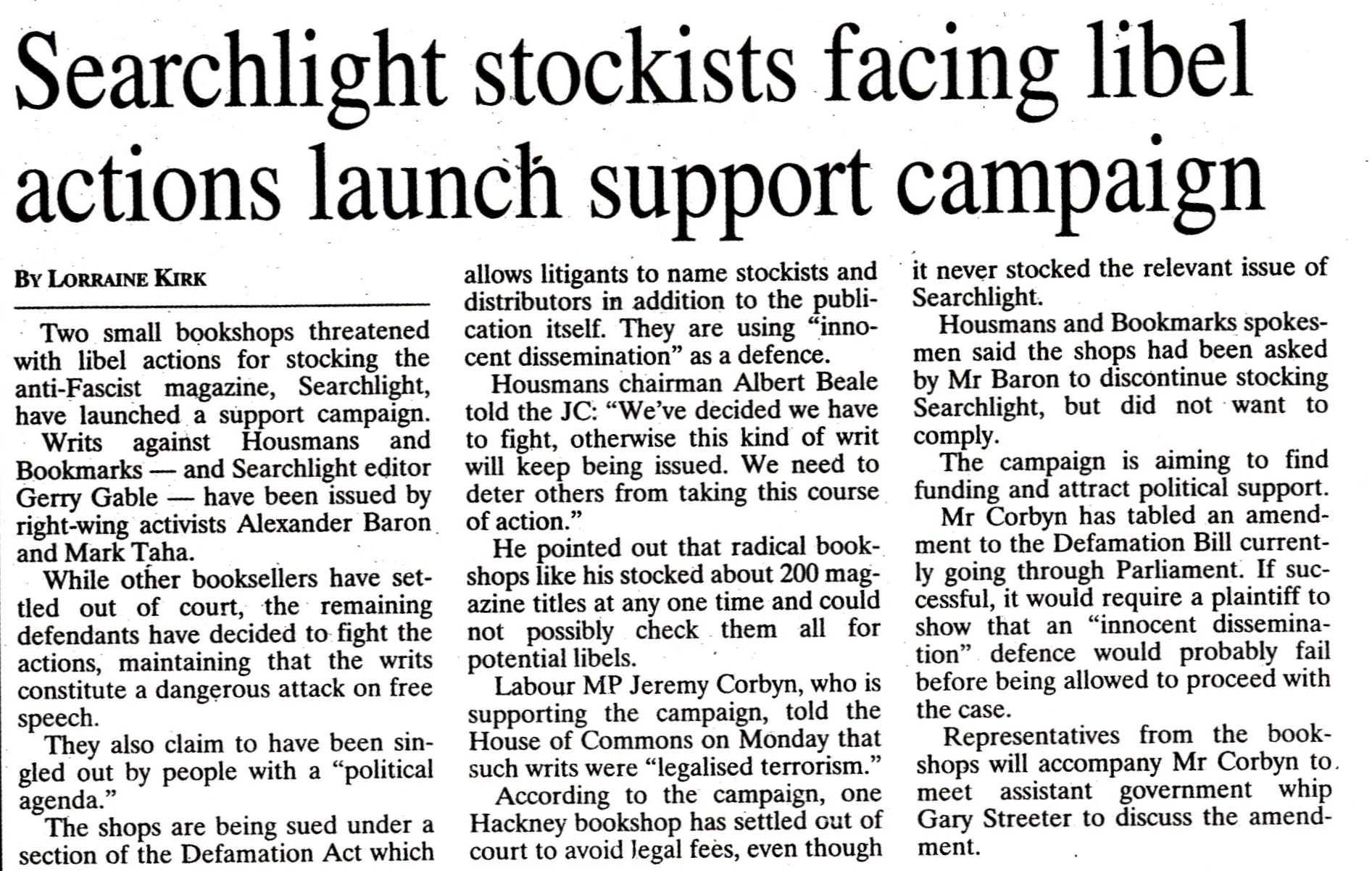
Alexander Baron was a libertarian activist and self-published writer known for his involvement in fringe political circles and his prolific output of pamphlets and books with anti-establishment views. Alongside his associate Mark Taha, he issued defamation writs against 22 different defendants, including Gerry Gable, Searchlight’s editor and publisher, as well as printers, distributors, and bookshops stocking the magazine.
Baron tells the story in his own words about how he met Maha and first came into contact with Gable through his informant, Ray Hill:
In South Africa, Hill kept a low profile for several years before becoming a leading light in the short-lived but extremely nasty South African National Front. He returned to Britain in 1979, after jumping bail in South Africa too, (31) and ingratiated himself with the far right, eventually ending up with a fairly senior post in the British National Party. In 1984 he “came out” with a big exposé in a TV pseudo-documentary that was produced by Gable and shown across Europe. Together with other chutzpah Hill’s book, which was published in 1988, paints a picture of him as an essentially decent working man who had fallen in with a bad crowd then undergone a road to Damascus conversion. (32)
Mark Taha’s critical reading of Hill’s book cast doubt on several of his claims. When I read it I found even more errors and outright lies. Subsequently Mark and I were to re-read the book and scrutinise minutely every single issue of Searchlight ever produced and all the subsidiary pamphlets and articles we could lay our hands on. We found a mass of disinformation, innuendo and outright fraud.
https://www.infotextmanuscripts.org/baron_v_gable_1.html
The lawsuits typically alleged Searchlight’s articles contained defamatory statements, such as accusations of neo-Nazi affiliations, antisemitism, or involvement in illegal activities. Plaintiffs argued that these claims harmed their reputations, particularly for those with public or political ambitions, such as BNP candidates. Some lawsuits challenged the accuracy of Searchlight’s reporting, citing reliance on unverified sources like defectors or infiltrators. In particular, Baron accused Gable of falsely claiming credit for solving 1960s synagogue arsons and inventing details about Jewish victims to enhance his reputation.
Mr Baron, an assiduous publisher of right-wing literature, interrupted a Commons Home Affairs Select Committee hearing evidence on organised racism to serve a writ on Mr Gable. Another writ, from Mr Taha, who carries out research for Mr Baron's south London publishing organisation, names six defendants - the two bookshops, distributors and printers, and Mr Gable.
https://www.independent.co.uk/news/antifascist-articles-prove-rich-pickings-1338136.html
Baron collected thousands of pounds in out-of-court settlements from nearly a dozen defendants, including the Centreprise Trust in Hackney, which settled despite not stocking the relevant issue of Searchlight. Many cases were settled out of court due to the high cost of legal defense. Baron’s aggressive legal strategy was noted for its impact on small organisations unable to afford lengthy court battles. Legal fees and settlements forced Gable and his team to redirect funds from investigative work, weakening the magazine’s operations. Some outlets refused to carry Searchlight or similar publications to avoid legal risk. He ultimately settled with Gable for £5,000 and a published retraction, after Gable had initially fought the case vigorously using expensive legal representation.
Baron was subsequently charged with witness intimidation and making threats to kill, relating to communications he sent to Benefits Agency official Rita Broadway and police. He claimed these charges were orchestrated through Gable's connections with police. He defended himself at trial and was acquitted.
Baron went on to deliver a speech about Gable in 2010 entitled "The Biggest Liar Who Ever Walked the Earth."
2003: The BNP, the Charity Commission, and Hope Not Hate
In 2002, the British National Party had enough, and complained to the Charity Commission Searchlight's charity and its commercial entity were behaving illegally.
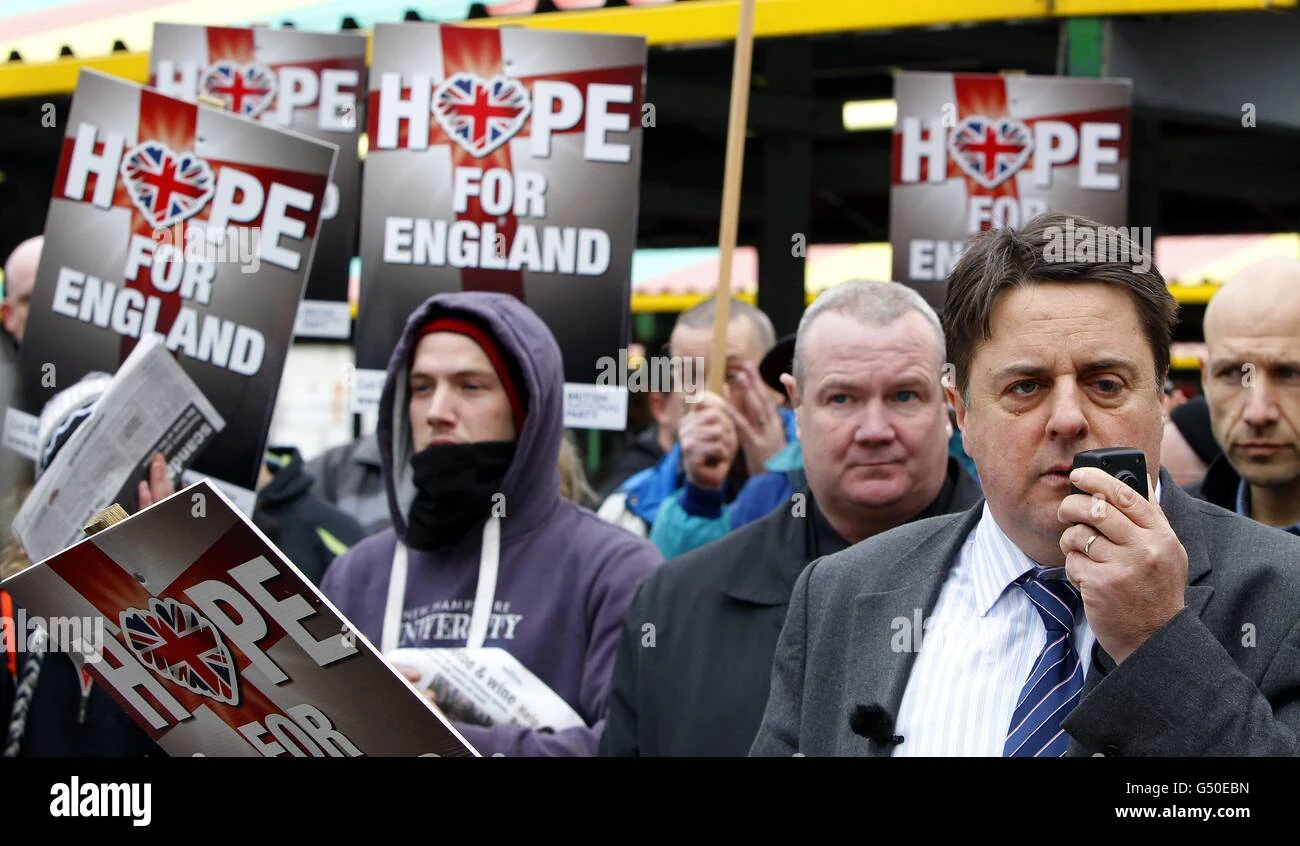
In what should now be familiar terms, the report read:
Searchlight Educational Trust ("the Charity") was registered as a charity in August 1992 and is based in London. The Charity organises seminars and produces literature for the public and its annual income is approximately £140,000. In May 2002, the Charity Commission received a complaint alleging that the Charity was carrying out political activities that were not compatible with its charitable status.The initial evaluation raised concerns about the political content of the Charity’s website, namely sections of the Charity publication "When Hate Comes to Town" (WHCTT); and also regarding the public’s confusion between the Charity and two companies – Searchlight Magazine ("the magazine") and Searchlight Information Services ("SIS"). The Commission instituted an Inquiry under section 8 of the Charities Act 1993 on 28 June 2002 with the aim of investigating whether the Charity was undertaking political activities incompatible with its charitable status.
https://web.archive.org/web/20040901203141/http://www.charitycommission.gov.uk/investigations/Inquiryreports/search.asp
The Charity Commission agreed.
It forced the organisation to divide into 3 pieces:
- Searchlight magazine
- Searchlight Information Services (SIS) - R&D (precursor to Hate Not Hope)
- Searchlight Educational Trust (SET) - the charity
Which is where Penfold took the reins.
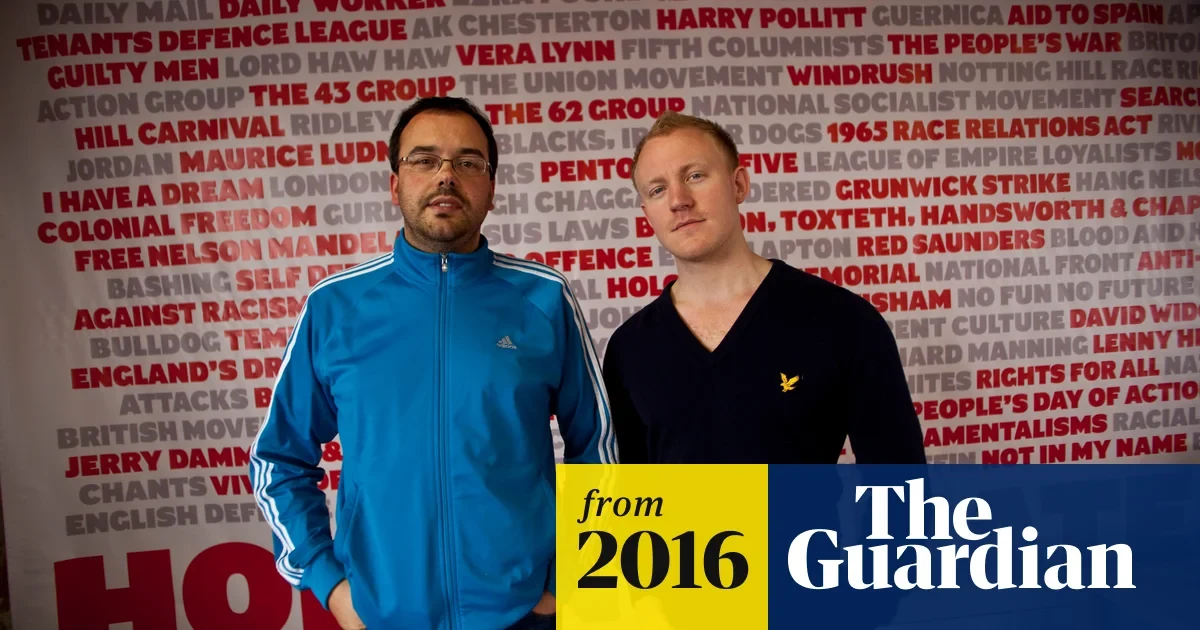
Nicholas Lloyd Martial Lowles was born at Hounslow on June 6, 1968. Also known as both "Peter Brighton" and (by his own admission) "Laurence King," According to Larry O’Hara, he was recruited from the Union of Jewish Students at Sheffield University and was once a fully paid up member of the British National Party. He took over as co-editor of Searchlight (with Steve Silver) during the Blair years, around 1999.
Some of the details of his career from FarLeftipedia might look familiar, as they are virtually identical to Gable's:
Before he became editor, he [Knowles] was an freelance investigative journalist, working in television, including on BBC Panorama, World in Action, Channel Four Dispatches and MacIntyre Undercover. The Deputy Director is Jemma Levene, who previously worked as Head of Campaigns at Jewish cultural education charity SEED, and at the Orthodox Union in New York.The Political Organiser is Liron Velleman, Policy Officer for the Jewish Labour Movement.
In 2004, the year of the charity woes, he created "HOPE not hate."
- Searchlight Educational Trust (SET) was renamed to "Hope not Hate Educational Trust" - a charity to raise money
- Searchlight Information Services (SIS) became "Hope Not Hate"- a limited company to do campaigning
- The "State of the British Right" publication became the "State of Hate" report
- Former Combat 18 informant, Matthew Collins, became its "director of intelligence"
- Magical plots to kill an MP mystically appeared from unknown organisations
- More right-wing organisations threatened to sue over claims of links to Northern Ireland
- Suspicions and accusations of it being an MI5 front organisation continued
Their mortal enemies then became the English Defence League and Tommy Robinson, along with worries about mosques and Muslim intimidation - where Lowles was disowned for being an "islamophobic" jew.
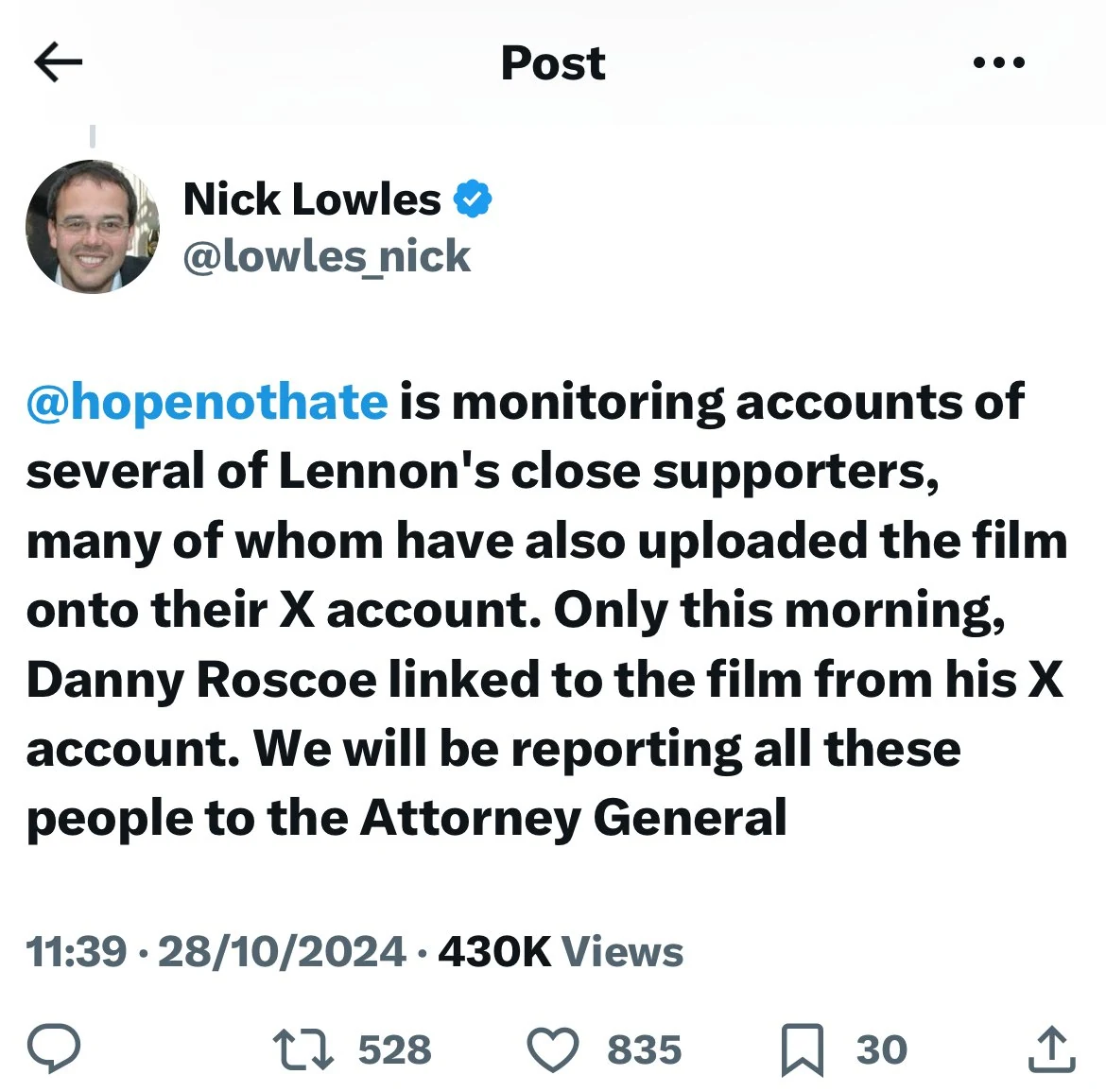
But perhaps, as we shall see, the best commentary on Hate Not Hope, aka Searchlight, comes from the radical leftist wing themselves, who hate them for being a state-sponsored operation suppressing dissent from their side of the debate, while defending their mortal adversaries, the EDL. An honest enemy is better than a dishonest friend. Why were they crying foul about this organisation in the mid-90s, despite the behaviour being targeted in their own political benefit?
In the light of Searchlight’s record on C88 alone, everything they say on the subject of security service involvement in fascist politics should be treated as disinformation, in no way as credible ‘hard’ information.
However glitzy and web-wise Searchlight’s (and even more Hope Not Hate’s) current incarnations might be, there is no getting away from it–their politics remains, as it has always been, state-compromised to the core. There are virtually no depths to which Searchlight will not stoop to undermine, spy on, and help crush genuine Leftist dissent.
.... savour this extract from the highly-publicised text ‘Searchlight for Beginners’ (visit shop, same location). This deals with the similarities between Searchlight’s two big stories/operations involving sinister far right mobilisation over the years–in the 1970s ‘Column 88’, the 1990s ‘Combat 18’. Over and aside the downright lying, mendacity and factual somersaulting revealed by these two stories alone, reading them the thought cannot failt [sic] to cross anybody’s mind–is Searchlight’s coverage of the English Defence League straightforward, and uncompromised by other agendas? We think the answer to that will be obvious. On past form, Searchlight do their best build a group up in the media and amongst potential supporters/opponents, using its activities as a reason (cover) for extending state powers, then much later purport to ‘reveal’ such a group was a honey trap for the state all along. They did this with C88 & C18, and may well intend to get away with it regarding the EDL. At the very least, an informed perusal of Searchlight’s past track record shows nothing Gerry Gable or the equally dishionest [sic] Nick Lowles say on the subject of state connections of any far right (or indeed far left) groups should be given even a morsel of credibility... A true product of what Trotsky memorably termed the ‘Stalinist School of Falsification’.
https://borderland.co.uk/our-problems-with-searchlight-hope-not-hate-2/
2011: Civil War With Lowles
But all did not go smoothly as they worked in parallel during the War on Terror and the dry spell of Nazi bogeymen.
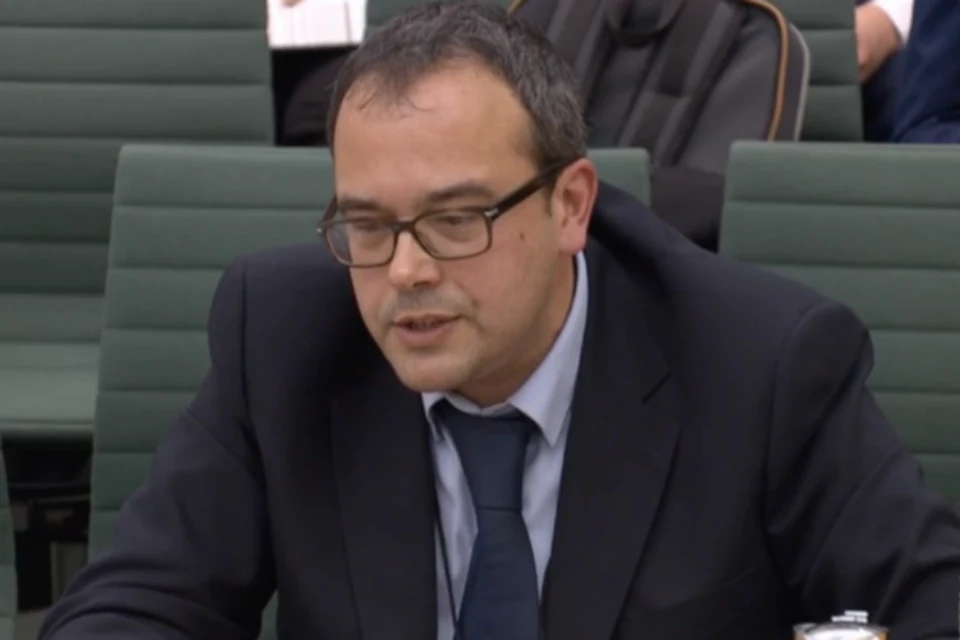
Larry O’Hara and Heidi Svenson carefully documented what happened next for Borderline:
- Summer 2010: Secret meetings allegedly occurred between Lowles, Ruth Smeeth, and others to plan a leadership transition. Lowles claimed Gable agreed to "step aside" in 2011; Gable denied this.
- Autumn 2010: New players entered the scene, including Labour financier Richard Brindle, while Smeeth joined Searchlight Educational Trust (SET) - while giving secret briefings to foreign governments
- December 2010: Lowles proposed a new management structure with himself in overall control and Gable relegated to "Head of Research."
- March 2011: Lowles and allies directly confronted the Gables, demanding Sonia hand over Searchlight magazine shares and Gerry resign by June. They offered Gerry an "honourary" presidency and potential royal honour as consolation.
- Spring-Summer 2011: Both sides sought support from Jewish community leaders. Disputes erupted over control of bank accounts, research archives, and editorial content.
- July 2011: Sonia Gable registered "Hope Not Hate Ltd," signaling preparation for organisational separation.
- September 23 2011: Lowles resigned as Searchlight editor.
- September 24-25 2011: The Gables and associates removed 20 filing cabinets and archives from the SET offices - characterised as "liberation" by Searchlight and "theft" by HNH.
- September 27 2011: Emergency trustee meeting resulted in both Gables being fired and police being contacted about the archive removal.
Searchlight continued under the Gables with reduced resources with the University of Northampton hosting its archive of 20,000 records. Hope Not Hate is still led by Lowles with significant funding and institutional support.
Ironically, Gerry Gable is 88 years old.
Borderline's Twitter account is still hammering him.
]]>It started here in 2019 as a simple catalogue of woke words, added as a link above on the site menu. This five-year labour of love is a 656-page book for un-brainwashing your university-age kids from the nonsense preached to them by professors. Your favourite author's second book is available in all major bookstores. If you're a Christian minister involved in apologetics, you can request an electronic copy for free (use the contact section).
Download a preview of pages 1-250 here: https://devilslane.com/_archive/cdn.devilslane.com/books/the-devils-glossary/the-devils-glossary-preview-p1-250.pdf
woke = critical constructivism + animism / puritanism
"Woke" is a non-theistic, syncretic new religious movement (NRM) which emerged in the post-Civil Rights era within North American universities through the fusion of communist theory, French postmodern critique, and fringe social science as the doctrine of "critical constructivism".
Once enlightened, disciples proselytise a dark legend mythology of Western nations which claims to offer hidden knowledge; human hierarchies are artificially orchestrated by the powerful conspiring to exclude categories of people due to a malevolent universal spirit, shrouding man's true condition as a formless blank slate. This animating force invisibly conjures fictions into the human mind through loaded vocabulary and self-reinforcing customs, and must be sanctified by forcibly entrenching an opposing spirit-consciousness to induce a "day zero" where social constraints no longer exist.
With over 300 mis-definitions and 2500+ references, the devils' glossary is five-year-long indictment and prosecution of the humanities' sordid history. For parents and students choosing universities, theologians researching philosophical roots, or ordinary people curious about the madness which has overtaken institutions, it answers questions such as:
- Where do these bad ideas and manipulative phrases come from?
- How deep does the academic intellectual rot really go?
- When, how, and why did this "mind virus" infect our lives?
- How can one recognise malicious people and broken thinking?
- Is there a way back for victims of indoctrination?
Where To Buy It

Preview first: https://devilslane.com/_archive/cdn.devilslane.com/books/the-devils-glossary/the-devils-glossary-preview-p1-250.pdf
Amazon: https://www.amazon.com/Devils-Glossary-Anti-Brainwashing-Field-Guide/dp/B0F4TVN4DM
Barnes & Noble: https://www.barnesandnoble.com/w/the-devils-glossary-alexander-coppen/1147287383?ean=9798991655323
Full Contents
Preface
Acknowledgments
Prologue
Introduction
I: The Poisoned Well
What Is Idea Laundering?
Patterns Of Folly & Deceit
The Social Science Story Template
The River Of Stupidity
The Poisonous Core of Narcissism
Preoccupation With Sexual Depravity
Intellectuals Against Common Sense
The Testimonial of Criminals
The Gnostic Philosophical Pathway
The Shroud of Syncretic Animism
The Mind Virus
Deconstructing Transhuman Theology
II: The A-Z of Jargon & Doublespeak
ABC
DEF
GHI
JKL
MNO
PQR
STU
VW
XYZ
III: The Basics of Broken Thinking
How Do You Know What Is True?
How Do We Know What We Know?
What Is Liberty?
What Are Rights?
What Are Fallacies?
What Are Sophistry & Casuistry?
What Is Reification?
What Is Magical Thinking?
What Are In/Out-Groups?
What Is Falsification?
What Is Paralogic?
What Are Cognitive Biases?
What Is Superstimulus?
Is It Caused, Or Correlated?
What Is Hegelian Dialectic?
Do Fish Understand Water?
IV: Dark Arts & Dirty Tricks
What Is A Black Legend?
What Are Luxury Beliefs?
What Are Hermeticism & Gnosticism?
What Is Millenarianism?
What Is Scientism?
Did It Originate In The Soviet Bloc?
What Is Third Way Eurocommunism?
What Is The Paradox Of Tolerance?
How Do Cults Recruit And Control?
What Is The Behavioural Sink?
Are Women The Fairer Sex?
Should Quacks Make Up Pathologies?
What Is Brain Jamming?
What Is Malicious Conflation?
What Is Loaded Language?
What Is Semantic Overloading?
What Is The Science Of Homosexuality?
What Are Active Measures?
What Is Evil?
V: Deprogramming Alternative Theology
Anti-Corruption & Counter-Extremism (ACCE)
Module 1: Destroying Traditions
Module 2: Social Engineering
Module 3: Ideological Subversion
Module 4: Franco-American Scripture
Module 5: The Communist Dragon
Module 6: Deprogramming6
Reloaded Language
Anger, Bad Faith, Treachery
Condemn, Accuse, Rebuke
Disgust, Revulsion, Ugliness
Depravity, Degeneracy, Rotten
Evil, Malicious, Wicked
Frauds, Charlatans, Phoneys
Incompetence, Boring, Laziness
Nonsense, Absurd, Worthless
Partisan, Favouritism, Partiality
Stupidity, Foolishness, Self-Love
Further Reading List
No matter who one votes for in England, one gets the same government. Vote Tory, get Civil Service; vote Labour, get Civil Service. The politicians are rotating puppets lost in a fog deliberately maintained by the faceless permanent secretaries of each department: they block; delay; dilute; divert, and deceive. These unaccountable bureaucrats are a self-appointed cabal who administrate their own policies opposite to the electorate's will and manipulate their decision-makers into following them.
Vote for less immigration? You're getting more immigration, to boost the Civil Service's population-based GDP figures. Vote for criminal sanctions on migrant groups raping young girls? You're going to jail for talking about it on social media, to keep "order" while the Civil Service import more.
The Civil Service rarely contracts. It always grows larger over time, expanding its powers and workforce. A quango here, a public body there, another recruitment drive next month. Ofcom started as a way to deal with TV complaints; now it has powers to regulate blogs. The state always gets larger, fatter, and heavier. It is never cut. It always needs more, no matter what. If the state runs out of money, it wants taxes and never a diet.
These are the people who betrayed the country with incompetence, malfeasance, stupidity, callousness, and pathetic self-interest. Every one of them got a knighthood or a peerage, on top of a fat pension for life in their house in Surrey.
These names will become overtly familiar.
- Butler, Burns, Wright/Gillmore, Whitmore. (1990–1994)
- Butler, Burns, Gillmore/Coles, Whitmore/Wilson. (1994–1998)
- Wilson, Turnbull, Kerr, Omand. (1998–2002)
- Turnbull, O’Donnell, Jay, Gieve. (2002–2006)
- O’Donnell, Macpherson, Ricketts, Normington. (2006–2011)
- Heywood, Macpherson, Fraser, Ghosh/Sedwill. (2010–2015)
- Heywood/Sedwill, Scholar, McDonald, Sedwill/Rutnam. (2015–2020)
- Case, Bowler, Barton, Rycroft. (2020–2024)
- Wormald, Bowler, Robbins, Rycroft. (2024–2025)
Understanding Their Dirty Kingdom
The power of the Civil Service is divided into four positions reflecting the four Great Offices of State (Prime Minister, the Chancellor of the Exchequer, the Foreign Secretary and the Home Secretary):
- Cabinet Secretary (CEO)
- Treasury Secretary (CFO)
- Foreign Office Permanent Secretary (Chief Diplomat)
- Home Office Permanent Secretary (Chief Policeman)
The first two are, by far, the most powerful people in government. The Cabinet Secretary runs the show, and the Treasury Secretary controls the money. The rest of them are there to make sure their politician is "housetrained" like a puppy to obey the Civil Service party line.
The Cabinet Secretary is the head of the Home Civil Service (since 1981, with a brief split from 2011–2014) and the principal adviser to the Prime Minister and the Cabinet. They oversee the coordination of government policy across all departments, chair the Senior Civil Service leadership, and ensure the Civil Service supports the government of the day impartially. Their position at the center of government gives them unparalleled access to the Prime Minister and Cabinet ministers. They shape the machinery of government, mediate interdepartmental disputes, and often play a key role in national crises (e.g., Brexit negotiations under Jeremy Heywood or COVID-19 under Simon Case).
The Permanent Secretary to the Treasury is the accounting officer for HM Treasury, advising the Chancellor of the Exchequer on fiscal and economic policy. They oversee public spending, taxation, and economic strategy, which are foundational to government operations. The Treasury wields immense power because it controls the purse strings—every department’s budget depends on Treasury approval. The Permanent Secretary’s influence extends through economic policy that shapes the nation’s direction, from austerity measures (e.g., Nicholas Macpherson under George Osborne) to emergency responses (e.g., Tom Scholar during COVID-19).
The Permanent Secretary to the Foreign Office is the senior civil servant responsible for the day-to-day management of foreign affairs and embassies, advising the Foreign Secretary, managing MI6 for the Cabinet Secretary, and serving as Head of His Majesty's Diplomatic Service.
List of foreign office secretaries: https://en.wikipedia.org/wiki/Permanent_Under-Secretary_of_State_for_Foreign_Affairs
The Permanent Secretary to the Home Office is the senior civil servant responsible for managing internal affairs, advising the Home Secretary, managing MI5 for the Cabinet Secretary, and overseeing areas like policing, immigration, and security.
List of home office secretaries: https://en.wikipedia.org/wiki/Permanent_Under-Secretary_of_State_at_the_Home_Office
Understanding Their Dirty Tactics
The behaviour of the Civil Service has been a subject of comedy for decades in "Yes, Prime Minister." (See: https://facultyweb.kennesaw.edu/uzimmerm/docs/Yes%20Minister.pdf)
The cornerstone of it what we might call "malicious compliance."
"the behavior of strictly following the orders of a superior despite knowing that compliance with the orders will have an unintended or negative result."
https://en.wikipedia.org/wiki/Malicious_compliance
For responding to crises:
- Stage 1: Nothing's going to happen.
- Stage 2: Something may be going to happen but we should do nothing about it.
- Stage 3: Maybe we should do something about it, but there's nothing we can do.
- Stage 4: Maybe there was something we could've done, but it's too late now.
For stalling:
- Claim the administration is early, with other priorities.
- Question if the approach is right, even if intention is good.
- Shift to timing, saying "not the time" for various reasons.
- Introduce technical, political, or legal difficulties, especially legal ones.
- After delays, cite proximity to elections as a barrier.
And for handling cuts:
- Welcome the announcement and praise the Chancellor.
- Set up a unit to identify cuts causing outrage, increasing Cabinet Office size.
- Create response units to show cuts are impossible or unacceptable.
- Turn units into independent bodies, keeping salaries via grants.
- Create agencies financed by fees, not payroll.
- Encourage staff to form companies for contracts, retaining benefits.
- Convert full-time jobs to part-time to claim reductions.
To: Bernard Woolley
From: Sir Humphrey Appleby
REDUCTION IN CIVIL SERVICE NUMBERS
Thank you for your note. I understand your concern at the recent Budget announcement of cuts in the service, but I assure you that there is no need to distress yourself in any way. This has all happened before, and there is an established procedure for dealing with it. We simply follow the infallible seven-stage plan.
1: Welcome the announcement, praise the Chancellor and say that such a procedure is long overdue.
2: Set up an internal Manpower Reduction Unit. This unit will be responsible for identifying areas where reductions in personnel numbers should be sought. These areas will, of course, be those where reductions would cause the maximum press outrage and parliamentary embarrassment. This will, of course, entail a gratifying increase in the size of the Cabinet Office.
3: Arrange for each threatened department to set up an Informal Response Unit to show why any specific proposed cuts are, in fact, administratively impossible, legally inadmissible, financially unjustifiable or politically unacceptable; preferably all of these. Since these units are informal, there is no need to reveal their existence to the Cabinet.
4: When there is extreme pressure to show actual reductions, turn government units into independent bodies. This removes all personnel from the government payroll, but their salaries continue to be paid by means of a grant-in-aid. You will remember that this worked very well with Kew Gardens some years ago; the scam is still not worked out.
5: Where trusts are inappropriate, create agencies. Those, too, can have staff who are not on the government payroll, financed by fees for specific tasks.
6: If it starts to look as if there are too many trusts and agencies, encourage staff to leave and form small companies. These companies can then be awarded contracts for training, research, accounting services, data-processing, booklet production and the like, on which they are currently employed and which will secure their existing salaries, allowances and pension arrangements.
7: Turn full-time jobs into two part-time jobs. This will enable you to brief your minister to claim dramatic reductions in full-time posts.
This strategy has never failed us yet. Since our colleagues in the Treasury have already persuaded the Chancellor to spin the process out until 2008, we can be sure that, by then, there will be a new chancellor, a new prime minister and, quite possibly, a new government. At that point, the whole squalid business can be swept under the carpet. Until next time.
https://www.civilservant.org.uk/misc-humour-sir_humphrey.html
What is the Office for Budget Responsibility?
In 2010, evil reptile Chancellor George Osborne proposed an "independent" watchdog for monitoring public finances. Along with the Bank of England, the OBR is the third leg of the evil triad which cockblocks politicians from doing anything constructive, like cutting taxes. They were responsible for kneecapping the hapless Liz Truss.
Before the OBR came along, the Treasury produced its own economic forecasts under the chancellor. It was introduced to “remove [from politicians] the temptation to fiddle the figures.”
All 52 permanent staff members of the OBR are civil servants, led by Laura Gardiner, the Acting Chief of Staff. Additionally, key leaders like Richard Hughes (Chair) and Tom Josephs (BRC member) have significant past roles in the civil service, such as at HM Treasury and the Department for Work and Pensions. It advertises vacancies on the Civil Service Jobs portal.
Richard Hughes, the Chair of the Budget Responsibility Committee (BRC) since October 2020, was formerly the Director of Fiscal Policy and Acting Chief Economist at the Treasury.
Tom Josephs, a BRC member, has held senior roles including Director for Private Pensions at the Department for Work and Pensions, Director of Fiscal Group at the Treasury, Director of Trade Policy at the Department for International Trade, and Senior Economist at the International Monetary Fund
The OBR does "impartial" things out of malicious compliance, as Jeremy Hunt pointed out:
The OBR review into the issue of possible withholding of information and the past government's departmental spending transparency will be published on Wednesday - the same day as the budget. Mr Hunt said: "I do not believe publishing a review with criticisms of the main opposition party on the day of a budget is consistent with political impartiality,".
https://news.sky.com/story/jeremy-hunt-accuses-obr-of-political-intervention-for-publishing-review-on-budget-day-13243292
It's one of a number of schemes operated by the Civil Service, at arm's length. Ofcom is now their Internet censor, for example. This ever-increasing union of "soviets" ("soviet" means "council" in Russian) never stop reproducing themselves.
2020s: Orwell's Nightmare
The authoritarian era of Covid lockdowns and mass censorship through Ofcom's expansion, "Respect Orders," and the Online Safety Act (OSA).
Chris Wormald (2024–now)
Appointed in December 2024 and currently serving as of March 13, 2025, under Prime Minister Keir Starmer. Wormald is literally one of the worst human beings England has produced for some time, being heavily involved in Covid lockdowns.

- Cabinet Secretary
Writing on X following Sir Chris's appointment on Monday, Cummings was fiercely critical of his role at the time. “Many officials came to me in panic when they realised the cabinet secretary and permanent secretary of the health department in charge of pandemic planning truly believed that the faster everyone got Covid, the better,” he wrote. “He is now in charge of the entire system. Plan accordingly!”
Cummings also accused Sir Chris of being “embedded deeply” in the infected blood scandal and repeatedly telling ministers “untruths about the documents”.
https://www.bbc.com/news/articles/cly4962e7q1o
James Bowler (2022–now)
Appointed in October 2022 and currently serving as of March 13, 2025, under Chancellors Kwasi Kwarteng, Jeremy Hunt, and Rachel Reeves. He was the permanent secretary at the Department for International Trade and then led the Covid response. Oh, joy.
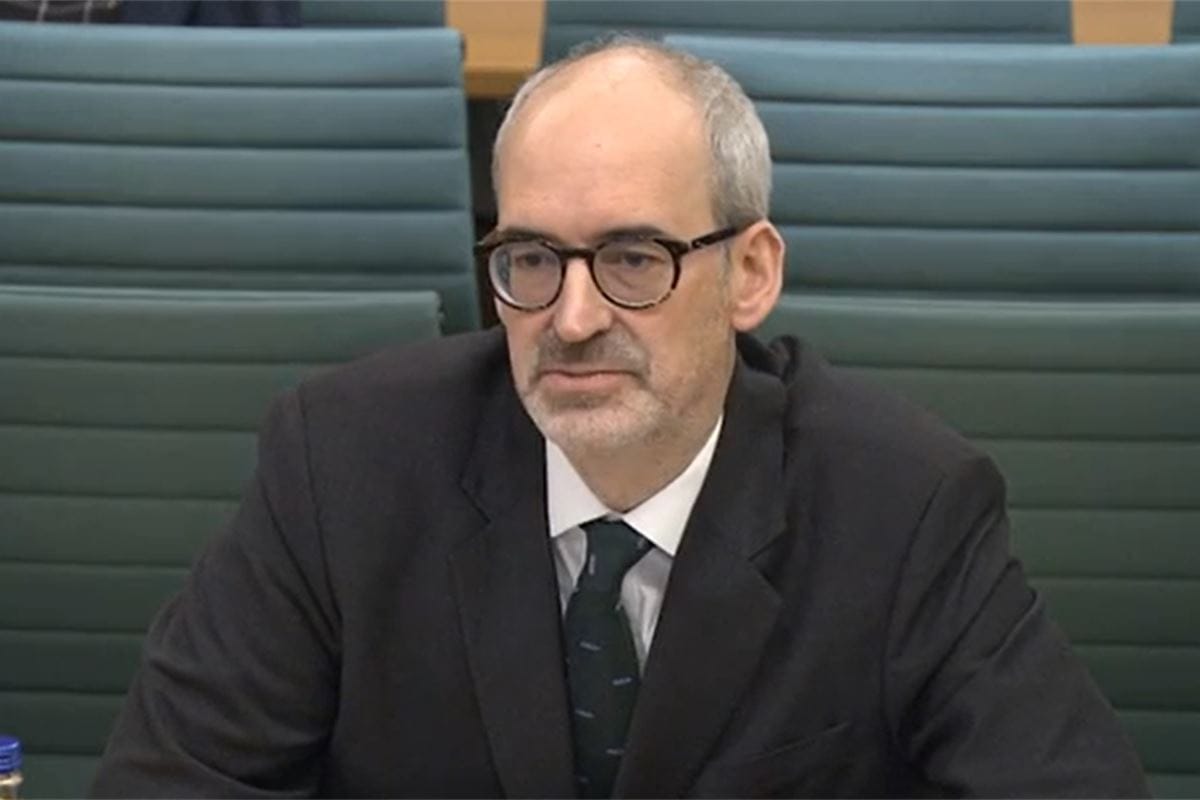
- Treasury Secretary
Bowler sold out the PM and conservative party by denying he'd ever produced any data:
Following Rishi Sunak's claim during the 2024 general election that Labour's plans would mean £2,000 of tax rises per household. Bowler said the Conservatives' assessment of Labour's tax plans "should not be presented as having been produced by the civil service". (FarLeftiPedia)
Oliver Robbins (2025–now)
Appointed January 8, 2025, and currently serving as of March 13, 2025, under Foreign Secretary David Lammy. Previously served in senior roles across government, including Brexit negotiations. His nickname is "Sir Humphrey" and he worked for Goldman. That should tell you everything.
- Foreign Office
Robbins is, of course, the man who fucked Brexit for his boss, Teresa. And was defended by another scumbag, Sedwill.
He was the frequent target of angry briefings from Brexiteers who variously accused him of pro-EU bias or of having too much sway over May. It forced a rare public intervention from then-Cabinet Secretary Mark Sedwill, who said those attacking Robbins “should be ashamed of themselves" and leapt to the defense of Robbins' “extraordinary dedication and professionalism."
https://www.politico.eu/article/olly-robbins-scourge-brexiteer-back-uk-government/
Matthew Rycroft (2020–now)
Appointed March 2020 and currently serving as of March 13, 2025, under Home Secretaries Priti Patel, Suella Braverman, Grant Shapps (briefly), and Yvette Cooper. Previously served as Permanent Secretary at DFID. Oversaw post-Brexit points-based system, Rwanda deportation plan, and Labour’s 2024 immigration adjustments.

- Home Office
Rycroft is the quintessential "grey man." He's the wokest of them all and loves his open borders.
Under his watch the Home Office has promoted increasingly progressive ideas. Last year The Telegraph revealed Border Force officers are allowed to wear rainbow epaulettes, ‘non-binary’ Home Office civil servants are given two security passes so they can change their gender daily depending on how they identify, and staff have held a series of events on Black History Month in which people have openly supported BLM.
https://www.gbnews.com/opinion/revealed-the-woke-home-office-chief-who-has-overseen-britains-open-borders
Philip Barton (2020–2025)
Served from September 2020 to January 2025, under Foreign Secretaries Dominic Raab, Liz Truss, James Cleverly, and David Lammy. Led the FCDO through its post-merger phase and major global events like the Ukraine war.
- Foreign Office
The Spectator described him as "utterly useless":
In the course of this afternoon’s grilling it transpired that the £185,000-a-year official – who has a pension worth £1.7m – stayed on holiday until 26 August, some 11 days after Kabul fell. With Icarus-level hubris, Sir Philip refused to disclose where his jolly jaunt exactly was – only that it was split between the UK and abroad.
https://www.spectator.co.uk/article/the-utter-uselessness-of-sir-philip-barton/
Simon Case (2020–2024)
Served from September 2020 to December 2024, under Prime Ministers Boris Johnson, Liz Truss, Rishi Sunak, and Keir Starmer.
- Cabinet Secretary
Even the Guardian - the GUARDIAN - hated this guy for this scandals and incompetence.
A former royal courtier, Case was considered by permanent secretary colleagues not to have enough experience to run the whole home civil service when appointed by Johnson in 2020. A string of episodes since then have only added to disapproval of his leadership within the civil service. These include failing to stand up to Truss when she sacked the Treasury’s permanent secretary Tom Scholar, allowing Nadhim Zahawi to become chancellor when his tax affairs were under investigation, and the leak of chummy messages to the former health secretary Matt Hancock. In these, Case described Johnson in one message as a “nationally distrusted figure”, and referred to Sunak’s opposition to Covid restrictions on businesses as “going bonkers”.
https://www.theguardian.com/politics/2023/may/02/is-it-time-up-for-simon-case-the-mandarin-whos-never-out-of-the-media
These people oversaw the following events:
- The UK formally leaves the EU, leaving Northern Ireland half in and economically trapped.
- The UK enters a new cold war against Russia, who invade Ukraine.
- As politicians have parties, ordinary people are locked in their homes by police order, forcibly vaccinated, and have their salaries paid by the government pumping huge amounts of borrowed money into the economy.
- Mass immigration hits 1 million per year.
- Ofcom is given mass censorship powers to attempt to regulate the Internet.
- Queen Elizabeth II dies, leaving her facile son wanting to be sworn in as "defender of faith," rather than [The] Protestant faith.
- The Bank of England, OBR, and Treasury engineer a market collapse to remove a Prime Minister trying to reduce the size of the state.
- The right to protest is "regulated" under the Police, Crime, Sentencing and Courts Act (2022).
- The conservatives are dramatically collapsed by the electorate refusing to turn out to vote for them, as they turn to Farage's more right-wing alternative.
- The Covert Human Intelligence Sources (Criminal Conduct) Act 2021 legalises criminal activities by intelligence agencies
- Riots begin over child killing and mass rape by Islamic gangs, ending in multi-year prison sentences over speech offences on social media.
- Yet more economic collapse under the inflation "cost of living" crisis from Covid money-printing.
- Former enemies in Northern Ireland unite against mass immigration.
- The government move to legalise euthanasia on the NHS and give away the Chagos islands military bases.
- The Police, Crime, Sentencing and Courts Act 2022 restricts protest.
- The Labour party attempt to covertly engineer re-entry of the EU via trade and defence rule-matching.
2010s: Brexit Betrayal
The conservative/liberal joint idolatry of Blair leads to gay marriage, the further breakdown of the Union, communist uprising in the Labour party, and years of blatantly trying to reverse the largest democratic exercise in the nation's history.
Helen Ghosh (2011–2012)
Served from January 2011 to November 2012, under Home Secretary Theresa May. First woman in this role. Began the “hostile environment” policy and laid the groundwork for later enforcement measures.
- Home Office Secretary
Helen doesn't like Brexit or climate change. She likes that snake Michael Gove.
https://www.independent.co.uk/climate-change/news/brexit-environment-decade-uncertainty-national-trust-helen-ghosh-agriculture-short-term-protection-a7876706.html
Jeremy Heywood (2012–2018, d. 2018)
Served from January 2012 to October 2018, under Prime Ministers David Cameron, Theresa May, and briefly Boris Johnson (though he stepped down before Boris Johnson took office). Initially, he took on the Cabinet Secretary role alone after O’Donnell’s duties were split, but he later combined it with Head of the Home Civil Service from 2014 onward.

- Cabinet Secretary
Heywood was the goto enforcer guy for every dreadful leader in the last 30 years.
Sir Jeremy was last year vilified by Eurosceptic Conservative MPs because he was deemed to be the author of a complex solution to the Brexit customs conundrum. His absence since June through illness made it difficult for him to defend his protégé Olly Robbins, Mrs May’s main Brexit negotiator, who has been attacked by Eurosceptic Tories.
https://www.ft.com/content/d68385d6-d7aa-11e8-ab8e-6be0dcf18713
Mark Sedwill (2013–2020)
Served from February 2013 to June 2017, under Home Secretaries Theresa May and Amber Rudd. Later became Cabinet Secretary and Lord Sedwill. Oversaw the peak of the “hostile environment” (e.g., 2014 Immigration Act) and Brexit referendum preparations, which centered on immigration control. Lord Sedwill since 2021.
- Home Office Secretary
- Cabinet Secretary
Where do you begin with a creature like Sedwill? He was forced to resign.
The letter suggests he recognises the pressure civil servants feel as a result of Brexit. He wrote: "I realise that this is an unsettling period. Brexit polarises public opinion and civil servants are not immune from those pressures.
https://news.sky.com/story/brexit-is-unsettling-the-civil-service-cabinet-sec-admits-in-leaked-letter-11823909
Philip Rutnam (2017–2020)
Served from April 2017 to February 2020, under Home Secretaries Amber Rudd, Sajid Javid, and Priti Patel. Resigned amid tensions with Patel over the Windrush scandal. Managed the Windrush scandal fallout and post-Brexit immigration planning.
- Home Office Secretary
Rutnam is an anti-Brexit cuck. There's no other way to put it. He's so much of a cuck, he accused a little Asian woman of being mean to get her fired.
He accused her of lying and said he had received allegations that she had shouted and sworn at staff. The former official said he was the victim of a 'briefing campaign' and that in choosing to publicly resign he had turned down a 'financial settlement' from the Cabinet Office.
https://www.dailymail.co.uk/news/article-8059217/Sir-Philip-Rutnam-QUITS-rows-Priti-Patel-says-sue-Government.html
Simon Fraser (2010–2015)
Served from August 2010 to November 2015, under Foreign Secretaries William Hague and Philip Hammond. Probably responsible for the trans flag at MI6 with Moore.

- Foreign Office Secretary
Fraser is another anti-Brexit activist and whiney saboteur.
In an opinion piece published by the Financial Times, former Foreign and Commonwealth Office (FCO) permanent under-secretary Simon Fraser – who led the FCO 2010-15, and is now vice chair of international affairs think tank Chatham House – wrote: “The claim that leaving the EU would open a highway to British global influence was always hollow. Since 2016, the UK’s influence has declined; our forces are barely present in international theatres of conflict and, as recent days have again shown, the Brexit soap opera undermines our diplomacy and soft power”.
https://www.globalgovernmentforum.com/former-uk-diplomatic-chief-warns-of-declining-influence-overseas/
Simon McDonald (2015–2020)
Served from November 2015 to September 2020, under Foreign Secretaries Philip Hammond, Jeremy Hunt, and Dominic Raab. Oversaw the transition from FCO to FCDO in 2020. Lord McDonald of Salford since 2021.

- Foreign Office Secretary
Yep, another anti-Brexit remainer.
Lord McDonald says there was a sense of "mourning" and staff in tears in the Foreign Office on the morning after the referendum result.
https://www.bbc.com/news/uk-politics-66769661
Tom Scholar (2016–2022)
Served from July 2016 to September 2022, under Chancellors Philip Hammond, Sajid Javid, Rishi Sunak, and briefly Kwasi Kwarteng. Rightly sacked by Kwarteng on his first day as Chancellor under Prime Minister Liz Truss.
- Treasury Secretary
Scholar is Olly Robbins' butt-boy and man-servant. He's an evil little wretch who did everything he could to wreck Brexit. He got sacked, and that's good. All the right people were mad.
Speaking to BBC Radio 4's The World This Weekend, Lord Butler said his "very unusual and very regrettable" departure reminded him of the US, where it is common for incoming governments to appoint their own officials. "I think they are behaving improperly towards the civil service," he told the programme. "A government wouldn't come in and on the first day sack the head of Her Majesty's defence forces, the chief of the defence staff," he added.
https://www.bbc.com/news/uk-politics-62869880
Just you f**king wait, Robin.
These people oversaw the following events:
- GCHQ's mass surveillance is revealed by Edward Snowden.
- MPs are allowed to be recalled, as Lords can resign or be expelled
- Gay marriage is legalised
- The Legal Aid, Sentencing and Punishment of Offenders Act 2012 cuts legal aid.
- Islamic terrorism incidences become almost endemic and routine
- Cities begin to have their own partisan mayors and police commissioners
- Scotland votes against independence in a referendum but passes Orwellian thought crime laws as SNP leaders are exposed as corrupt
- The Data Retention and Investigatory Powers Act (DRIPA) 2014 mandates data retention by internet service providers.
- The Investigatory Powers Act 2016, known as the "snooper’s charter," expands surveillance powers, including bulk data collection.
- The Establishment lose a referendum on EU membership after 25 years of dragging, then bring the country close to civil war through three years of trying to cobertly reverse it in bad faith.
- The most communist PM candidate in UK history is given the worst landslide defeat in a century.
2000s: Constitutional Vandalism
Blair, Brown, and Cameron embark to make a complete political transformation of Britain into a "separation of powers" mass immigration/surveillance regime almost irreversible. Marxism, identity politics, climate change, Islamic terrorism, migration, economic collapse, and the gelding of Parliament are normalised.
This set are almost as guilty as the 1990s set. Their devotion to Blairism set the stage for the country's peril.
David Normington (2006–2011)
Served from January 2006 to January 2011, under Home Secretaries John Reid, Jacqui Smith, and Alan Johnson. Dealt with immigration system reforms post-2006 “foreign prisoners scandal” and EU migration pressures. Introduced points-based system (2008). His nickname was apparently ‘the smiling assassin’ which doesn't bode well.

- Home Office Secretary
Normington is an old school ruthless Machiavellian bastard who should be in charge of MI6, despite totally failing in his last job at the home office. Because he'd clearly stab either side in the back. Put him where he belongs.
The arrival of migrants in small boats by illegal means is an all-too-visible symbol of the government’s apparent loss of control of our borders. We expect our governments to provide and safeguard the basic architecture of the state, including a secure and defined frontier. When that border is being crossed time after time in broad daylight, we lose confidence in the capability and competence of the government. The current government knows this, just as the Labour hierarchy did in the early 2000s.
https://www.prospectmagazine.co.uk/politics/60487/how-to-fix-the-channel-crisis
Gus O’Donnell (2002–2011)
Served from August 2005 to December 2011, under Prime Ministers Tony Blair, Gordon Brown, and David Cameron. Lord O’Donnell since 2012.

- Treasury Secretary
- Cabinet Secretary
Gus is responsible for many of the modern problems we have. He LOVES mass immigration, hates Brexit, and generally represents the destruction of Britain in human form. He's a traitor, and put simply, he should be the first to be prosecuted.
When I was at the Treasury I argued for the most open door possible to immigration … I think it's my job to maximise global welfare not national welfare.
Goodhart, David (2017). "Ch. 1. The Great Divide". The Road to Somewhere: The Populist Revolt and the Future of Politics. C. Hurst & Co. Publishers
Gus is basically Satan.
Gray’s preferred choice for the post of cabinet secretary under Labour is Olly Robbins, the former chief Brexit negotiator. “I worked with him a lot and he’s very, very good,” said O’Donnell. “But there’s no vacancy at the minute and when it comes to replacing the cabinet secretary I’m sure they’ll have a proper process. I see people mentioning his name but I think that’s incredibly premature."
https://www.newstatesman.com/encounter/2024/03/gus-odonnell-insiders-guide-preparing-power
John Gieve (2001–2006)
Served from November 2001 to February 2006, under Home Secretaries David Blunkett, Charles Clarke, and briefly John Reid. Oversaw the 2004 EU expansion (A8 countries). Managed the backlash to Labour’s open-door policy and subsequent controls. Served as Deputy Governor for Financial Stability (!!!!!!) of the Bank of England and an ex officio member of the Monetary Policy Committee from 2006 to 2009.
- Home Office Secretary
Another nasty anti-Brexit activist who mismanaged the home office and then mismanaged the Bank of England.
“The talk of recession is a bit misleading. It’s not the result of the economic cycle, this is a public health-motivated suppression of activity. When that suppression is relaxed, you should see a rapid bounce back,” Gieve said. Monthly economic figures from IHS Markit showed that the UK economy is hurtling towards a recession of a scale “we have not seen in modern history”, the data provider said.
https://www.fnlondon.com/articles/uk-will-bounce-back-from-virus-crisis-says-ex-bank-of-england-deputy-20200330
Michael Jay (2002–2006)
Served from July 2002 to August 2006, under Foreign Secretaries Jack Straw and Margaret Beckett. Lord Jay of Ewelme since 2006.

- Foreign Office Secretary
Can you guess? Rabid anti-Brexit campaigner.
Five former Cabinet secretaries, three ex-Foreign and Commonwealth perm secs and a selection of other one-time civil service leaders have voted to back a call to keep the UK in a customs union with the EU, a move which could derail prime minister Theresa May’s Brexit plans. Among those in favour of the amendment were former Cabinet secretaries Lord Robert Armstrong, Lord Robin Butler, Lord Gus O’Donnell, Lord Andrew Turnbull, and Lord Richard Wilson. Kerr’s two FCO successors who are members of the House of Lords – Lord Michael Jay and Lord Peter Ricketts – also backed the amendment, as did former Treasury perm sec Lord Nicholas Macpherson.
https://www.civilserviceworld.com/professions/article/former-perm-secs-and-civil-service-chiefs-vote-against-government-on-brexit
Nicholas Macpherson (2005–2016)
Served from August 2005 to March 2016, under Chancellors Gordon Brown, Alistair Darling, George Osborne, and briefly Philip Hammond. Lord Macpherson of Earl’s Court since 2016. This bastard is almost certainly responsible for all the immigration fuckery and econometrics bullshit of the last 20 years.
- Treasury Secretary
Macpherson is more responsible than anyone for mass immigration, GDP-go-up, anti-Brexit activism, and poisonous bullshit. Along with Gus O'Donnell, he is a cancer.
In the 11 years from 2005 to 2016, Nick Macpherson served as permanent secretary to the Treasury – the tax and spending plans of three administrations (Blair, Brown and Cameron) had to clear his desk. As the Treasury’s lead civil servant, Macpherson helped construct the budgets of three chancellors, becoming the longest serving Treasury “perm sec” since the Second World War.
https://www.newstatesman.com/politics/politics-interview/2021/11/treasury-grandee-nick-macpherson-the-idea-that-brexit-has-liberalised-trade-is-just-nonsense
Peter Ricketts (2006–2010)
Served from August 2006 to January 2010, under Foreign Secretaries Margaret Beckett, David Miliband, and briefly William Hague. Lord Ricketts since 2011.

- Foreign Office Secretary
Ricketts was the UK's first national security adviser during the Iraq affair. He hates Brexit, Boris Johnson, and Marine Le Pen.
He was invited onto Radio Four’s Today programme during the build-up to the EU referendum last year and was a cheerleader for the Cameron government’s Project Fear scare-mongering. Most egregiously he backed its claim that Brexit would lead to the French moving the Jungle migrant camp (which no longer even exists) from Calais to Kent. He was at it again yesterday, griping about Donald Trump’s invitation for a State Visit to the UK this summer.
https://www.dailymail.co.uk/debate/article-4178360/Cameron-crony-Remoaner-axe-grind.html
These people oversaw the following events:
- The public are given "freedom of information", which the government can opt out of.
- Blair deceives the nation into two wars after 9/11 and embarks on a "deliberate policy" of "deliberate policy" to "open up the UK to mass migration."
- Courts issue "anti-social behaviour orders" to the working class without trial as foxhunting by the upper class is banned.
- The expansion of the national DNA database retained innocent people's DNA.
- Mass-casualty Islamic terrorism replaces IRA terrorism.
- The right to remain silent during arrest is removed and detention limits raised.
- Parliamentary's legal sovereignty is removed by disconnecting the Lords and Lord Chancellor role, to create a "Supreme Court" able to overrule it.
- The press is made subject to censorship by a "regulator," Ofcom.
- The Anti-terrorism, Crime and Security Act 2001 allowed indefinite detention without charge.
- The Identity Cards Act 2006 proposed national ID cards.
- Mass technology surveillance is implemented via the Regulation of Investigatory Powers Act (RIPA) and GCHQ.
- The Prevention of Terrorism Act 2005 introduced control orders, a form of house arrest.
- The Terrorism Act 2006 criminalised "glorification" of terrorism.
- 10 Eastern European countries joined the EU, flooding the UK via free movement rights with 100,000+ immigrants.
- MPs begin to speak up about mass rapes of working class Christian white girls by feral Pakistani muslim gangs.
- Climate change beliefs and "Net Zero" targets are enforced by law.
- The economy collapses because of London banking practices (Housing Crisis), causing the the government to pump huge amounts of borrowed money into the economy.
- Gays are allowed legal partnerships.
- Identity politics and Marxist theory is written into law via the Equality Act.
- Civil Service power is institutionalised by the Constitutional Reform and Governance Act.
- MPs are found to be rampantly abusing their expenses.
1990s: Abandoning Sovereignty
The end of the Thatcher neoliberal era and beginning of the Blair disaster. The country's GDP was larger than both India and China combined, as the 1997 handover of Hong Kong marked the end of the British Empire. And the beginning of Tony Blair's disastrous egotism.
Andrew Turnbull (1998–2005)
Served from September 2002 to August 2005, under Prime Minister Tony Blair. Lord Turnbull since 2005.
- Treasury Secretary
- Cabinet Secretary
Turnbull is one of the old school Treasury lifers, but still thought Brexiteers were comparable to Nazis.
Lord Turnbull, who was cabinet secretary under Tony Blair, told the Observer accusations of sabotage reminded him of the "stab-in-the-back" myth that arose among Nazis before the Second World War. Senior civil servants are subject to "pre-emptive scapegoating" by those pushing to leave the EU because they fear they are losing the public debate, he said.
https://www.standard.co.uk/news/uk/attacks-by-brexiteers-on-civil-servants-are-like-1930s-germany-says-former-head-of-civil-service-a3757386.html
Clive Whitmore (1983–1994, d. 2018)
Served until January 1994, under Home Secretaries Leon Brittan, Douglas Hurd, David Waddington, Kenneth Baker, and Kenneth Clarke. Oversaw immigration during the tail end of Thatcher’s government and into Major’s, a period of tightening controls post-1981 Immigration Act. Less high-profile immigration crises compared to later years.
- Home Office Secretary
Clive ran the home office during the last Thatcher years when Major took over. He was based. Just your run-of-the-mill ruthless bastard Sir Humphrey. Standard issue. He was there during Maastricht.
David Gillmore (1991–1994, d. 1998)
Served from February 1991 to April 1994, under Foreign Secretaries Douglas Hurd and John Major. Lord Gillmore of Thamesfield in 1996.
No photos of Gillmore exist.
- Foreign Office Secretary
There's nothing much to say of Gillmore. Standard issue MI6 guy who went around South Africa, Moscow, etc. Run-of-the-mill ruthless bastard Sir Humphrey. Standard issue. He was there during Maastricht.
David Omand (1998–2001)
Served from September 1998 to November 2001, under Home Secretaries Jack Straw and briefly David Blunkett. Known for intelligence expertise. Under Straw, immigration policy tightened with the 1999 Immigration and Asylum Act, introducing dispersal and detention policies. Omand’s intelligence background may have linked immigration to security.
- Home Office Secretary
Omand was director of GCHQ after the intelligence services were first recognised by the government publicly. He advocated for going after David Kelly, and he's an evil ruthless Machiavellian bastard. Almost certainly responsible for expanding mass surveillance. Of course, he is anti-Brexit.
Sir David Omand, Whitehall’s former chief security and intelligence coordinator, pointed out that after the terrorist attacks in Paris in November, the British government had agreed actually to step up cooperation in the EU by signing up to the Prüm Convention - sometimes called Schengen III –covering data exchanges on DNA and vehicle registrations. He also warned that Brexit would “exacerbate existing faultlines” in Northern Ireland.
https://www.theguardian.com/news/defence-and-security-blog/2016/jun/20/remain-in-eu-say-former-uk-security-and-intelligence-chiefs
Omand is kinda cool, even if he is a Remainer cuck.
John Coles (1994–1997)
Served from May 1994 to October 1997, under Foreign Secretaries Douglas Hurd and Malcolm Rifkind, and briefly Robin Cook.
- Foreign Office Secretary
There's not much about Coles. Standard issue mandarin with no opinions in any direction. Good. He liked Thatcher.
John Kerr (1997–2002)
Served from October 1997 to July 2002, under Foreign Secretaries Robin Cook and Jack Straw. Lord Kerr of Kinlochard since 2004. He has a head shaped like an alien egg and doesn't like those "far right" types.

- Foreign Office Secretary
If AIDS were a man, John would take the award. With his weird alien head, he is, of course, a rabid anti-Brexit activist who ironically drafted the exit clause for the EU constitution.
The deal we have been offered is not what was promised and it’s not nearly as good as the deal we’ve got in the EU, but it’s the only Brexit offer on the table. Today was the day the terms of the debate changed because, if MPs and ultimately the British people, think it’s a bad deal, we know we can reject it without fear.
https://www.theguardian.com/commentisfree/2018/dec/06/drafted-article-50-brexit-referendum-eu-state
Patrick Wright (1986–1991, d. 2020)
Served until February 1991, under Foreign Secretaries Geoffrey Howe and John Major (briefly). Lord Wright of Richmond in 1994.
- Foreign Office Secretary
Other than being Michel Foucault's doppelganger, Wright's life is of the standard MI6 mandarin. Nothing interesting, or boring. Nothing notable, and nothing insignificant. But where was he during Maastricht? Oh, that's right.
Richard Wilson (1994–2002)
Served from January 1994 to September 1998, under Home Secretaries Kenneth Clarke, and briefly Jack Straw. Later became Cabinet Secretary. Served under Michael Howard, who introduced stricter asylum policies (e.g., 1996 Asylum and Immigration Act). Wilson likely shaped administrative responses to rising asylum claims. Lord Wilson of Dinton since 2002.

- Cabinet Secretary
- Home Office Secretary
Dinton looks like a rat. He literally looks like a rodent. As the bureaucrat's faceless bureaucrat, he wrecked the UK's nuclear energy program during the Thatcher years. Naturally, he hates Brexit.
Wilson said the job of governments and ministers is more difficult than it used to be due to social media, "where you have to comment all the time rather than stopping, thinking and taking advice". And he said the job of the civil service is "weakening because of Brexit, which was a huge blow in terms of management, followed in no time by the pandemic".
https://www.civilserviceworld.com/professions/article/civil-service-being-marginalised-and-overpoliticised-former-cab-secs-warn
Robin Butler (1988–1998)
Served from January 1988 to January 1998, under Prime Ministers Margaret Thatcher, John Major, and Tony Blair. Lord Butler of Brockwell since 1998. He was famously asked by a student “What is our constitution?” He replied, “It is something we [the Establishment] make up as we go along”.
- Cabinet Secretary
Butler was the chief during the big transition from independent country on-the-up, to declining multicultural islamic EU disaster on its way down. He's who Sir Humphrey would model Sir Humphrey on. Occasionally based (e.g. Iraq war enquiry), but on the wrong side of everything - including, of course, Brexit.
To illustrate how staggeringly manipulative this old lizard is, he argued for a second referendum as a natural "democratic" conclusion to a binding democratic vote:
Butler, who was Margaret Thatcher’s principal private secretary before serving in the top civil service job from 1988 to 1998, told peers on Tuesday night that a second referendum vote was needed to establish "the up-to-date view of the British electorate" once talks with European Union member states have been concluded.
The former cabinet secretary argued that the UK government had "a duty to be sure before our departure becomes final", asking why pro-Brexit figures "who base their arguments for Brexit on the will of the people" now appeared "opposed to consulting the people on the outcome of the negotiations".
https://www.civilserviceworld.com/professions/article/brexit-put-deal-to-a-fresh-referendum-says-former-head-of-the-civil-service-lord-butler
Terence Burns (1991–1998)
Served from June 1991 to June 1998, under Chancellors Norman Lamont, Kenneth Clarke, and briefly Gordon Brown. Lord Burns since 1998. Also chairman of Channel 4, and Ofcom. Of course.

- Treasury Secretary
Recession, Black Wednesday, Maastricht. This charming chap was there for it all. He's a placeholder sort of a chap without any real opinions either way, which is probably why he stood by and watched it all go up in flames.
Meanwhile, the key ideological appointment was a new chief economic adviser more sympathetic to the government’s monetarist approach. That led to the appointment of Terry Burns in his early 30s – which was seen as extremely young in a civil service which was still very age bound at the time. Burns eventually became permanent secretary but had his own falling out with a new Chancellor – in this case, Gordon Brown. He and Brown had a scratchy relationship from the start over the decision to take supervision of financial institutions away from the Bank of England when it was given independence to set interest rates. Burns hung on for a year, then left, and was replaced by another Treasury lifer, Sir Andrew Turnbull.
https://www.civilservant.org.uk/information-dismissal-permanent_secretaries.html
These people oversaw the following events:
- The economy collapses because of London banking practices (Black Wednesday).
- British people are made citizens of a new United States of Europe without a vote or referendum to obtain consent, via a treaty at Maastricht agreeing to "Ever greater political union."
- MI5 and MI6 are officially acknowledged.
- The Official Secrets Act 1989 restricted whistleblowing.
- Hong Kong is handed back to China.
- Wars in the former Yugoslavia, Somalia, Afghanistan, and Iraq lead to increased abuse of the asylum system.
- Parliament's sovereignty is removed through adoption of the European Convention of Human Rights (ECHR) via the Human Rights Act (HRA).
- The Criminal Justice and Public Order Act 1994 limited protest rights and introduced new police powers, notably affecting freedom of assembly.
- The death penalty is formally abolished.
- Parliament's regulatory powers are delegated to a union of quangoes, or public bodies functioning as small NGO councils (soviets).
- The 300-year union of the UK's nations is torn apart by "devolution" in London, Wales, and Scotland emerging from the Good Friday Agreement.
- Hereditary lords are abolished.
- The Bank of England is allowed to independently set monetary policy, as the Chancellor sells off the nation's gold.
Who Is Guilty For The EU?
Under the John Major government, the following civil servants held position and colluded with a foreign power to surrender British sovereignty:
- Robin Butler (Cabinet Secretary)
- Terence Burns (Treasury Secretary)
- Clive Whitmore (Home Office Secretary)
- Patrick Wright (Foreign Office Secretary)
- David Gillmore (Foreign Office Secretary)
- John Coles (Foreign Office Secretary)
Who Is Guilty For The Blair Years?
Under the Tony Blair and Gordon Brown governments, the following civil servants held position, flooded the country with mass immigration. and conspired to subvert and sabotage the Union and its constitution:
- Richard Wilson (Cabinet Secretary)
- Andrew Turnbull (Cabinet/Treasury Secretary)
- Gus O’Donnell (Cabinet/Treasury Secretary)
- Nicholas Macpherson (Treasury Secretary)
- John Kerr (Foreign Office Secretary)
- John Gieve (Home Office Secretary)
Who Is Guilty For Sabotaging Brexit?
Under the Teresa May government, the following civil servants held position and attempted to subvert the largest democratic exercise in the country's history to re-surrender British sovereignty:
- Jeremy Heywood (Cabinet Secretary)
- Mark Sedwill (Cabinet/Home Office Secretary)
- Tom Scholar (Treasury Secretary)
- Simon McDonald (Foreign Office Secretary)
- Philip Rutnam (Home Office Secretary)
Who Is Guilty For Lockdown?
Under the Boris Johnson government, the following civil servants held position and assisted other Lysenkoist bureaucrats to implement a Soviet police state in England on account of a mild flu:
- Simon Case (Cabinet Secretary)
- Tom Scholar (Treasury Secretary)
- Philip Barton (Foreign Office Secretary)
- Matthew Rycroft (Home Office Secretary)
]]>
What if we could interrogate the entire corpus of law from Magna Carta onwards and employ the cognitive scaling of large language models (LLMs) to identify aspects of legislation offensive to the instincts and sentiment of the Englishman? Then instantly draft its correction? Much more doable, and fun, than one might imagine.
Ripping The Legal Data
The UK Parliament has passed approximately 3,000-4,000 Public General Acts since 1801 alone. There are tens of thousands of Statutory Instruments (over 3,000 are typically issued each year). Hundreds of thousands of judicial decisions have established common law principles. The UK's legislation.gov.uk database contains over 90,000 documents of legislation, but this primarily covers more recent law and does not include all historical statutes or common law developments.
A reasonable estimate would place the total number of English laws (including statutes, statutory instruments, and significant common law decisions) since 1215 in the range of 100,000-200,000, but this is necessarily imprecise.
The Parliamentary Archives house the historical records of both Houses of Parliament dating back to 1497. They include committee papers, petitions, journals, bills, acts, and personal papers of politicians. This is the most comprehensive historical parliamentary collection, covering over 500 years of parliamentary proceedings and administration.
The House of Commons Library provides research briefings, statistical analyses, and impartial information services primarily for MPs. Their publications cover current policy issues, legislation, and statistical data. The collection focuses on contemporary issues but includes historical context, with particular depth in policy analysis rather than primary legal texts.
Hansard is the official verbatim report of all parliamentary debates in both the House of Commons and House of Lords. It dates back to the early 19th century (though comprehensive coverage began in 1909) and provides a complete record of what was said in Parliament, including questions, statements, and debates. Right now it is over 10 million pages.
The Stationery Office (TSO) is the official publisher of UK legislation, statutory instruments, and government publications. It publishes all Acts of Parliament, draft legislation, and official documents. The collection contains comprehensive contemporary legislation and some historical publications.
Halsbury's Statutes of England and Wales (LexisNexis) is an encyclopedic collection of UK statute law, organised by subject. It contains annotated versions of legislation in force, with commentary, case references, and amendments tracked. It focuses on current law but includes historical context and development of statutes. It's £26,369.
vLex Justis (JustisOne) is a legal database containing UK case law, legislation, journals, and EU materials. Its case law coverage dates back to 1163, with comprehensive coverage from the 19th century onward. It includes many unreported judgments not found in other collections.
The British and Irish Legal Information Institute (BAILII) is a free online database of British and Irish case law and legislation. It includes decisions from various courts and tribunals, though its historical depth varies by court. Coverage is strongest from the late 20th century onward, though some collections go back further.
The Law Reports (available through Thomson Westlaw, LexisNexis, HeinOnline) are the official series of law reports for England and Wales, published since 1865. They contain selected significant judicial decisions with headnotes and summaries. While selective rather than comprehensive, they represent the most authoritative reports of case law and include the most legally significant decisions.
Processing, Ingesting, Linking
Two specific things are required: the ability to move quickly through the bullshit data, and the ability to identify relationships (insertions, repeals, creep, etc).
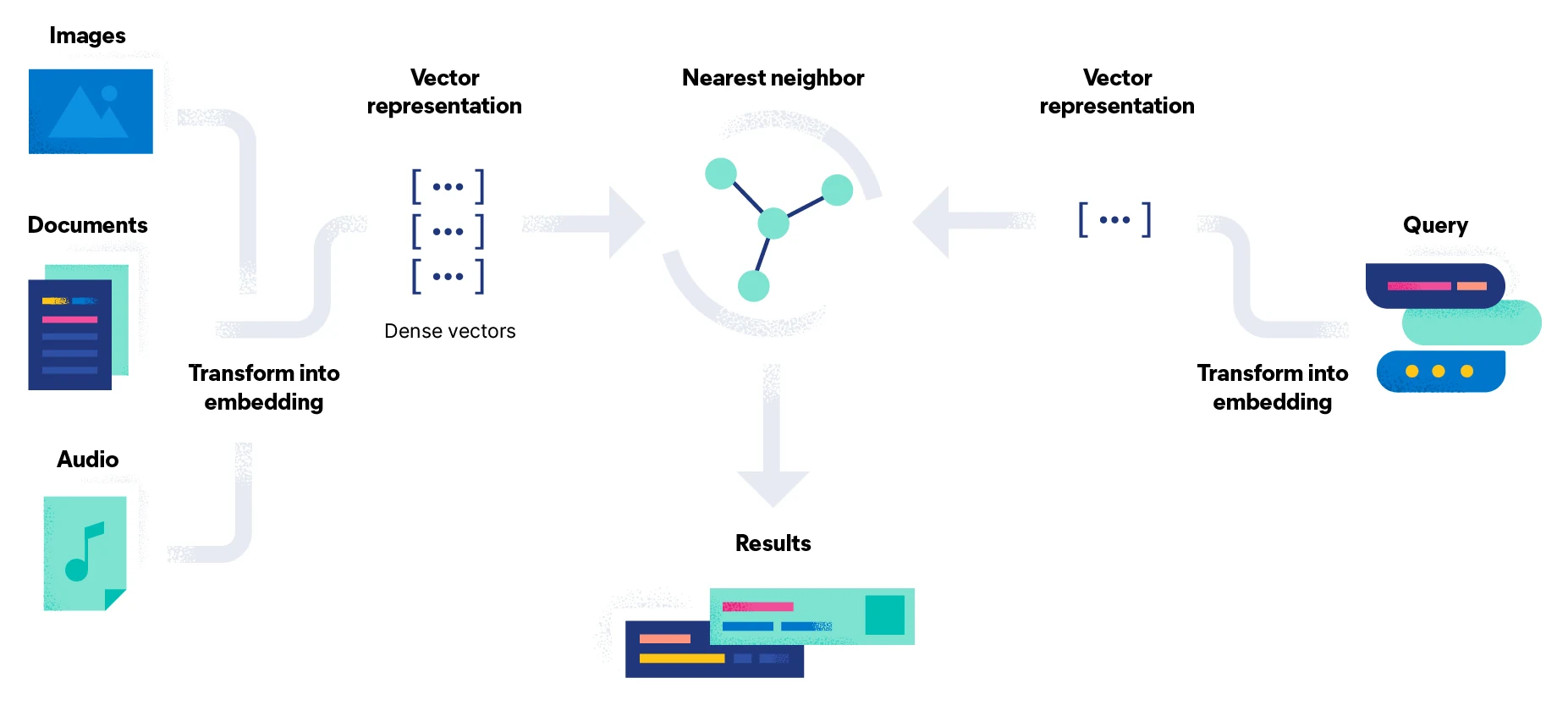
Vector Search transforms legal texts into numerical patterns (vectors, or "fingerprints") using language models like BERT or Legal-BERT, which are specifically designed to understand legal terminology. These models analyse corpus of laws and convert each document into a vector with hundreds of dimensions that captures its semantic meaning.
One would store these vectors in specialised databases like Pinecone or Weaviate which are built for efficient similarity searching. When one searches for "post-1945 liberty killers," the query gets converted to a vector using the same model, and the system returns documents with the most similar vectors, regardless of whether they contain those exact words.
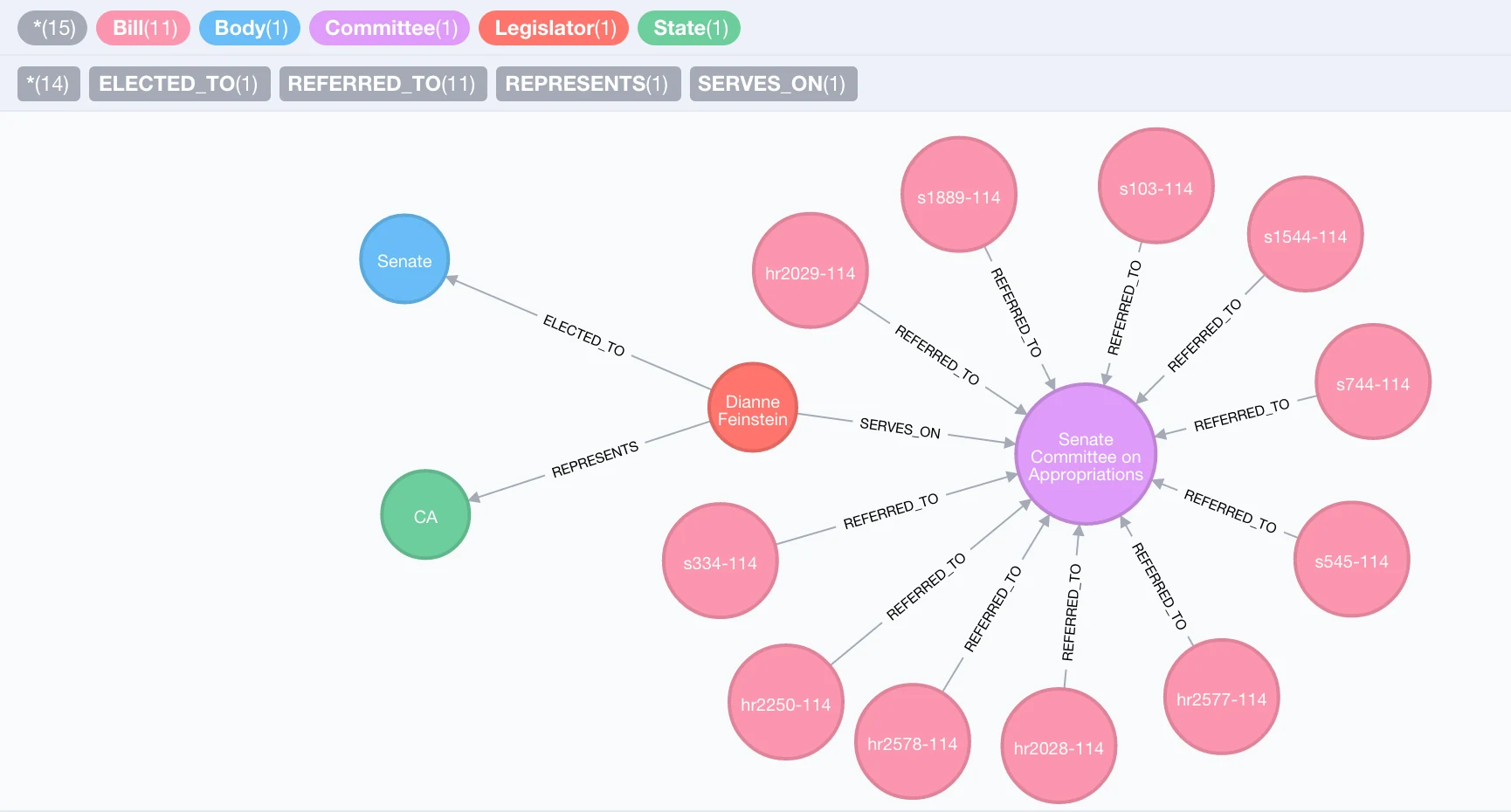
Dependency Mapping uses graph databases like Neo4j or TigerGraph to represent laws and their relationships as an interconnected network. Each law becomes a node in the graph, while citations, amendments, and dependencies become directional connections (edges) between them. This structure allows one to run powerful queries that can instantly reveal all laws affected by a particular statute. Advanced graph algorithms like Google PageRank can identify the most influential laws in the system, while path analysis can uncover hidden chains of dependency that traditional legal research might miss.
Then one might build a hybrid system storing both vector embeddings for semantic search and relationship data for dependency analysis. Tools like Langchain or LlamaIndex can help combine these approaches into a unified pipeline.
First, one would process the legal corpus using standard NLP techniques to extract citations and references automatically. Entity recognition would identify legal concepts and rights being addressed in each document.
- Document preprocessing starts with optical character recognition (OCR) for scanned historical documents, followed by noise removal and text normalisation to standardise formats across centuries of legal writing. Legal-specific text cleaning handles unique challenges like archaic language, Latin phrases, and specialised punctuation patterns in statutory texts.
- Citation extraction employs rule-based pattern matching using regular expressions designed specifically for English legal citation formats. For older texts, you need specialised regex patterns that account for historical citation styles that have evolved since 1492. Machine learning approaches like conditional random fields (CRFs) or BiLSTM-CRF models can be trained to recognise citation spans in text, even when they don't follow standard patterns.
- Reference resolution connects citations to their target documents within the corpus. This requires entity linking algorithms to normalise different ways of referring to the same law (e.g., "Human Rights Act 1998," "HRA 1998," "the 1998 Act"). Graph-based disambiguation techniques help resolve ambiguous references by considering the legal context and existing citation networks.
- Legal structure parsing identifies hierarchical components (chapters, sections, clauses) within each document. Models like Legal-BERT can be fine-tuned to recognise structural elements in legal texts, and rule-based approaches using markers like numbering patterns and indentation help identify nested relationships between provisions.
- Relationship extraction identifies semantic connections beyond explicit citations - including amendments, repeals, definitions, and implicit dependencies. Domain-specific relation extraction models can be trained to recognise phrases indicating legal relationships (e.g., "as amended by," "subject to," "notwithstanding").
- Dependency parsing of legal sentences helps identify clauses that modify, restrict, or expand others.
The entire pipeline requires continuous quality assurance (QA) supervision through legal expert review, especially for ambiguous or complex references. Active learning approaches could be employed where experts review uncertain cases, which are then used to improve the extraction models iteratively.
Training The LLM: The English Mind
The first thing to do when training any model is defining what is scoring and how. In our case, we want to accomplish three specific tasks:
- Identify laws, clauses, and creep within the corpus which are offensive to the dignity and conscience of the Englishman (violations)
- Scored from 0.1 (minor irk) to 0.9 (egregious betrayal).
- Identifying losses and repeals within the corpus which are favourable to the instincts of the Englishman and must be restored (violations).
- Drafting short, punchy laws even people as idiotic as English MPs can copy/paste to fix the current mess. (corrections).
Instead of building a model from scratch, we use a lightweight fine-tuning technique called Parameter-Efficient Fine-Tuning (PEFT)—specifically LoRA (Low-Rank Adaptation).
To teach our model how an Englishman thinks, we need to build a set of simple input-output pairs written by experts in a) English law, and b) Englishness. The pair consists of an assertion (a good thing), and a violation (bad thing). For those familiar with diffusion models, they are similar to positive/negative prompts.
This is a very big spreadsheet, exported as a CSV file. Far simpler than it sounds.
How do you spot the difference between two things? We need to explain to our model how an Englishman feels about England while scanning the corpus of 200,000 documents and 10M Hansard pages. To demonstrate the principle, rather than actual examples of training data:
- Assertion: favourable to an Englishman; admired, loved, and cherished as an ancient custom; representative of a tradition of natural negative rights of the individual.
- Individualism
- Home as castle
- The countryside
- Ancient tradition
- Stoicism (stiff upper lip) and understatement
- Orderly queuing and garden maintenance
- Fair play (equality under the law)
- Violation: offensive to the Englishman; foreign or alien in concept or origin; collectivist or government-controlled positive state permissions.
- Collectivism
- State intervention/regulation (government involvement)
- Queue-jumping and favouritism
- Emotionality / boastfulness
- Radical explosive change
- Marxist / Postmodernist abstract slop
- "Continental breakfast"
When it comes to the law and the principles of Englishness, this is rather fun.
- Good (requiring maximisation)
- Jesus Christ (the greatest of all Englishmen, residence: Yorkshire)
- Supremacy of Parliament
- Rule of Law
- Negative natural rights
- Equality under the law (sportmanship)
- Free speech
- Primacy of individual negative liberty
- Intrinsic value of tradition and custom
- Freedom from government interference
- Private property rights
- Equality of opportunity
- Pragmatic/Incremental/organic evolved change
- Ordered environmental beauty
- Bad (requiring repeal, suppression, or minimisation)
- Foreign legal supremacy
- Revolutionary radicalism
- Positive state permissions
- Bureaucracy (Soviet council units)
- Government intervention
- Orwellian surveillance/social controls
- Enforced equal outcome
- Identity/property collectivism
- Paganism/Islam
- Ugly Brutalist architecture
- Utopianism
- The French
Our model will be trained in "Violation Detection" and "Cascade Analysis." It will be fed snippets of law (e.g., Public Order Act 1986, Section 5: “causing harassment, alarm or distress”) and ask: “How offensive is this to a 1689 Englishman?”
- Each subset will be manually annotated with violation scores (e.g., 0.7 for speech curbs) to supervise its reasoning.
- Positive examples from history (e.g., Treason Act 1351) receive high “reinstatement scores” (0.9), while repealed crap like the Bubble Act 1720 gets a 0.1.
- Hypothetical additions (e.g., explicit codification of self-defence rights) scored by “necessity” (0.9 = essential).
- If we repeal something, using an example of 40+ dependent clauses of a known law (e.g., tied to public order or tax laws) will be assigned a “cascade risk” score (0.1 = minor, 0.9 = chaos).
If we were to pick some binary assertion/violation pairs in existing law:
- Speech
- Bill of Rights 1689, Article 9 - Establishes parliamentary free speech and debate without interference from courts (assertion, good).
- Public Order Act 1986, Section 5 - Criminalises "threatening, abusive or insulting words or behaviour" which may cause "harassment, alarm or distress." (violation, bad).
- Egregiousness Score: 0.1 - 0.9
- Reinstatement Score: 0.1 - 0.9
- Addition Necessity Score: 0.1 - 0.9
- Cascade Risk Score: 0.1 - 0.9
- Privacy
- Data Protection Act 2018 - Gives individuals control over their personal data, including rights to access and erasure (assertion, good).
- Investigatory Powers Act 2016 - Grants extensive surveillance powers to security services, allowing bulk data collection (violation, bad).
- Egregiousness Score: 0.1 - 0.9
- Reinstatement Score: 0.1 - 0.9
- Addition Necessity Score: 0.1 - 0.9
- Cascade Risk Score: 0.1 - 0.9
- Individual Choice
- Consumer Rights Act 2015 - Strengthens individual consumer rights and choices in the marketplace (assertion, good).
- Equality Act 2010 - Creates positive obligations on businesses and individuals, potentially limiting freedom of association and contract (violation, bad).
- Egregiousness Score: 0.1 - 0.9
- Reinstatement Score: 0.1 - 0.9
- Addition Necessity Score: 0.1 - 0.9
- Cascade Risk Score: 0.1 - 0.9
- Due Process
- Habeas Corpus Act 1679 - Fundamental protection against unlawful detention (assertion, good).
- Terrorism Act 2000 - Allows detention without charge for extended periods and diluted the right to silence (violation, bad).
- Egregiousness Score: 0.1 - 0.9
- Reinstatement Score: 0.1 - 0.9
- Addition Necessity Score: 0.1 - 0.9
- Cascade Risk Score: 0.1 - 0.9
- Property Rights
- Law of Property Act 1925 - Codifies and protects private property rights and ownership (assertion, good).
- Town and Country Planning Act 1990 - Restricts individual property development rights through extensive permission requirements (violation, bad).
- Egregiousness Score: 0.1 - 0.9
- Reinstatement Score: 0.1 - 0.9
- Addition Necessity Score: 0.1 - 0.9
- Cascade Risk Score: 0.1 - 0.9
- Freedom of Association
- Common Law right to peaceful assembly - Traditional English freedom to gather (assertion, good).
- Anti-social Behaviour, Crime and Policing Act 2014 - Allows for dispersal orders which limit assembly rights (violation, bad).
- Egregiousness Score: 0.1 - 0.9
- Reinstatement Score: 0.1 - 0.9
- Addition Necessity Score: 0.1 - 0.9
- Cascade Risk Score: 0.1 - 0.9
- Innocence Presumption
- Common Law presumption of innocence - Traditional protection requiring proof beyond reasonable doubt (assertion, good).
- Criminal Justice and Public Order Act 1994 - Allows adverse inferences to be drawn from silence during questioning (violation, bad).
- Egregiousness Score: 0.1 - 0.9'
- Reinstatement Score: 0.1 - 0.9
- Addition Necessity Score: 0.1 - 0.9
- Cascade Risk Score: 0.1 - 0.9
- Citizenship
- British Nationality Act 1981 - Defines and protects status of British citizens (assertion, good).
- Immigration Act 2014 - Requires documentation checks for basic services and housing (violation, bad).
- Egregiousness Score: 0.1 - 0.9
- Reinstatement Score: 0.1 - 0.9
- Addition Necessity Score: 0.1 - 0.9
- Cascade Risk Score: 0.1 - 0.9
- Parental Rights
- Education Act 1996, Section 7 - Affirms parental right to choose education for their children (assertion, good).
- Education Act 2002 - Mandates national curriculum and standards which limit educational diversity (violation, bad).
- Egregiousness Score: 0.1 - 0.9
- Reinstatement Score: 0.1 - 0.9
- Addition Necessity Score: 0.1 - 0.9
- Cascade Risk Score: 0.1 - 0.9
- Self-Defence
- Criminal Law Act 1967, Section 3 - Allows reasonable force in self-defense (assertion, good).
- Firearms Act 1968 (as amended) - Severely restricts individual right to possess weapons, even for self-protection (violation, bad).
- Egregiousness Score: 0.1 - 0.9
- Reinstatement Score: 0.1 - 0.9
- Addition Necessity Score: 0.1 - 0.9
- Cascade Risk Score: 0.1 - 0.9
This is where the English legal mind is required. The sharper the training, the better the results. Legal beagles, take note.
The more pairs we have, the more effective the training set (1000 is ideal when there are 200,000 laws at a ratio of 200/1),. How bad these violations are arguably somewhat relative (depending how often you read the Guardian), and set in the next stage. They are not that relative at all, however. Not to an Englishman. A jury of twelve peers is what is required for the "reasonable person" on the "Clapham Omnibus."
Keen and astute readers would naturally have noticed this requires establishing an objective standard of "Englishness" and would also have noticed how alarming this entire process is given how left-wing Silicon Valley ideologues cannot resist imprinting their ghastly worldview into every line of code they write, like a hippie with Tourrettes.
We don't need to establish it. Englishmen know what Englishness is; we recognise it instantly as Americans understand what American means, or Australians get what being an Aussie means or a French chap knows how bad Paris smells. We don't need a book on it. It's in the damp walls of the pub from the 13th Century. It's in the Sunday roast and countryside walk afterwards. We instinctively recognise when one of our customs has been violated. A thousand years of layered sentiment is not up for interpretation because your sister took a Marxist sociology lesson.
As noted, the principle is applying a scale (0.1 to 0.9) based on how egregiously a law departs from the ethos of the English mind:
- 0.1: Mild annoyance (e.g., a quirky WWI-era pub closing law).
- 0.9: Outright betrayal of liberty requiring a strongly-worded letter (e.g., mass surveillance under the Investigatory Powers Act 2016 or the Human Rights Act 1998).
Once tuned, we start asking questions of the corpus since 1215, which is 200,000 documents:
- Violation Scoring: “Rank the top 10 post-1689 laws that most offend English liberty.” The model provides hits like the Investigatory Powers Act or Attlee’s land grabs.
- Repeal Impact Scoring: “Simulate repealing the Firearms Act 1997—what changes?” The model traces back to the Bill of Rights and ripple effects on crime laws.
- Reinstatement Proposal Scoring: “Propose two repealed laws to revive.” The death penalty for treason or old property protections appears in slots 1 and 2.
- Gap Filling: “What’s missing?” Perhaps a clear “right to revolution” clause.
- Bonus: who is the most traitorous rat in Parliament?
Meet The Chaps: Ted, Clarence, Archie
You have to have a little fun with this dry boring technical stuff. Particularly if you want other people to use it. Every pub is a parliament. English consensus is reached through vehement disagreement, while refusing to be personally disagreeable. Your stoic argument must stand up and not be reliant on emotional appeals.
One model is not enough, so we will use three. And for each of the three, we will assign a persona which personifies a strain of Englishness.
(Note to feministas: yes, we could do with strongly-minded sensible Englishwomen as well, such as Mary Wollstonecraft, Florence Nightingale, or Elizabeth Windsor (R). Feel free to make suggestions. No, we will not be modelling Emmeline Pankhurst, de Beauvoir, or American lunatics. You know why.)
Then we will make them debate and compete adversarially in their scoring to obtain a consensus. As Englishmen (or Englishwomen) would do in a pub. Then, these three will cross-train each other, which is known as reinforcement learning:
- Ted says a law’s a 0.8, Clarence says 0.75, Archie 0.85. A mathematical rule (loss function) nudges them toward agreement—say, 0.8—creating new training data.
- Ted (0.9—“Me allotment’s gone”), Clarence (0.9—“Ruins the countryside”), Archie (0.9—“My estate’s shackled”). Consensus: 0.9 violation.
- “What’s the worst law since 1945?” → Trio scores TCA 1947 a 0.9, maps 60+ dependencies, drafts a repeal.
- “Should we bring back treason’s death penalty?” → Ted (0.9 yes), Clarence (0.8), Archie (0.95), with a bill.
- Violation score (e.g., “0.9—bloody disgrace”); Reasoning (e.g., Ted: “Disarms honest lads”); Bill snippet (e.g., “Repeal Firearms Act 1997, restore 1689 rights”).
- “Debate” button simulates their arguing, refining scores (e.g., 0.9 → 0.85).
Sergeant Ted Hargreaves (22 SAS, retd.)
A working-class tough nut ex-soldier, tough as nails, from the football terraces. He’d torch the Firearms Act 1997 (0.9—disarming the honest man) and demands late pub hours. Loves a scrap, hates the state, ready for a game, and earned the respect.

A grizzled SAS veteran turned pub philosopher, built like a brick shithouse, with a voice that could scare off a pack of hooligans. He’s the working-class hero who’d bleed for England on the football stands or the battlefield. Loves a pint, hates bureaucrats, and thinks the Magna Carta’s the only law worth a damn. Free speech is for shouting at refs, arms are for defending your patch, and the state can sod off. He’d rate the Firearms Act 1997 a 0.9 violation (“Disarmed us like bloody sheep”) and weep for the repealed treason death penalty (“Hang the bastards”). Calls anything post-1945 “Attlee’s bollocks” and wants WWI pub laws gone so he can drink past 11.
Ted will use the NVIDIA/Llama Nemotron 340b model, because he's gone from the rough to a precise killing machine.
For nerds:
Nemotron, developed by NVIDIA, is a family of LLMs designed to push the boundaries of generative AI, with a strong emphasis on scalability and efficiency. The most notable member is Nemotron-4-340B, a massive 340-billion-parameter dense model released in mid-2024, alongside variants like the Llama 3.1 Nemotron 70B Instruct, which is a 70-billion-parameter model optimised for helpfulness through reinforcement learning from human feedback (RLHF). Nemotron models are trained on vast datasets—up to 9 trillion tokens for the 340B version—using NVIDIA’s NeMo framework, which leverages the company’s GPU prowess for high-performance training and inference. A standout feature of Nemotron is its reliance on synthetic data, with over 98% of its alignment data generated synthetically, reducing the need for extensive human annotation. This makes it particularly appealing for developers looking to create custom LLMs or synthetic datasets. Performance-wise, Nemotron-4-340B claims to rival GPT-4, while the 70B version excels on benchmarks like Arena Hard and MT-Bench, though it sometimes underperforms on standard tests like MMLU compared to its base models. It’s optimised for enterprise use, running efficiently on NVIDIA hardware like the DGX H100 with FP8 precision, but its resource demands can be steep, often requiring multiple high-end GPUs for fine-tuning or inference.
Clarence Mortimer Blackwell (Yeoman's Musket Pub)
A Guardian-reading, sandal-wearing, middle-class oddball puritan, mad for England, Bath university alumnae, eccentric patriot, and gastropub aficionado. He despises the Town and Country Planning Act 1947 (0.9—land theft) and wants speech unfettered for his rants to slag off anyone.
A middle-class eccentric, the sort who owns a gastropub called “The Yeoman’s Musket” and drones on about English ale at dinner parties. He’s a psychotic patriot—hates climate twaddle and Eurocrats (despite preaching both at dinner parties), loves his Puritan streak (church on Sundays, no funny foreigners), and has a borderline racist streak he masks with “heritage” talk. Probably owns a Morris Minor. Property’s sacred (TCA 1947 = 0.9 sacrilege), speech is for slagging off the French, and equality laws are “nanny state codswallop” (0.75). He’d reinstate dueling laws for honour’s sake and loathes the HRA 1998 for its “continental whiff.” Insists on “English solutions”—no metric system, no ECHR, and a bill to ban French wine imports.
Clarence will use the Deepseek 3 model, because he's could be a Chinese spy with all that Guardian-reading.
For nerds:
DeepSeek, from the Chinese AI firm DeepSeek-AI, takes a different approach with its focus on cost-efficiency and open-source accessibility. Released as part of the DeepSeek-V2 lineage (DeepSeek-V3 is the latest at 671 billion parameters as of late 2024), is a Mixture-of-Experts (MoE) model. Unlike traditional dense models, MoE architectures activate only a subset of parameters per task—DeepSeek-V3 uses 37 billion active parameters out of its total 671 billion—making it computationally lighter despite its size. Trained on 8.1 trillion tokens, DeepSeek 3 emphasises multilingual capabilities and practical deployment, supporting a 128K context window and achieving strong results on benchmarks like MMLU and HumanEval. Its efficiency stems from innovations like multi-token prediction and load balancing, allowing it to run on consumer-grade hardware (e.g., an RTX 3090 for smaller variants) with quantization techniques. DeepSeek is fully open-source, positioning it as a go-to for researchers and developers who prioritise affordability and flexibility over raw power, though it may lag slightly behind top-tier models in absolute performance.
Lord Archibald St. John-Forsythe (Oxon)
Toff with a manor, all foxhunts and flintlocks, with a sister named Octavia. He loathes the Equality Act 2010 (0.8—coddling nonsense) and surveillance laws (0.9) which are for peasants, dines at the Arts Club, did PPE at Cambridge but didn't get into MI6, and wants dueling back.

An upper-class titan, the super-amalgam of our posh trio, with estates in three counties and a family tree back to 1066. He’s fox-hunting mad, smokes a pipe, and speaks in a drawl that could charm a duchess or terrify a serf. Thinks Parliament’s gone soft since 1689. Liberty’s non-negotiable—arms, speech, land (Bill of Rights 1689 or bust). Scores the Equality Act a 0.8 (“Peasants don’t need coddling”), the Investigatory Powers Act a 0.9 (“Snooping on a gentleman?!”), and wants treason’s noose back (0.9 necessity). Proposes a “Peers’ Veto Act” to undo anything since 1945 and keeps a flintlock pistol “for tradition.”
Archie will use the Falcon 40/180b model, because he's been entirely over-educated in useless nonsense like Classics which have no real application in ordinary life.
For nerds:
Falcon 180B, created by the Technology Innovation Institute (TII) in the United Arab Emirates and released in September 2023, is a heavyweight in the open-source LLM space, boasting 180 billion parameters. Trained on 3.5 trillion tokens using the RefinedWeb dataset, it’s a dense, decoder-only model built for raw power and versatility. Falcon 180B leverages a multi-query attention mechanism for improved scalability and was trained on 4096 A100 GPUs for around 7 million GPU hours, making it a resource-intensive endeavor. It topped the Hugging Face Open LLM Leaderboard for pre-trained models at launch, rivaling Google’s PaLM-2 and outperforming Llama 2 and GPT-3.5 on various NLP tasks, though it falls just short of GPT-4. Available in base and chat variants, it’s designed for research and commercial use, but its size demands serious hardware—think 320GB of memory minimum, or eight A100 GPUs without quantization. While quantization (e.g., to 4-bit) can lower this to around 160GB VRAM, it’s still a beast best suited for multi-GPU setups or cloud deployments, making it less accessible than smaller alternatives like Falcon 40B.
Parameter-wise, Nemotron-4-340B is the largest at 340 billion, followed by Falcon 180B at 180 billion, and DeepSeek varying widely but often cited around 236 billion or 671 billion in its latest MoE form—though its active parameters are far fewer.
Training data scales similarly, with Nemotron’s 9 trillion tokens dwarfing Falcon’s 3.5 trillion and DeepSeek’s 8.1 trillion falling in between.
Architecturally, Nemotron and Falcon are dense models, processing all parameters per task, while DeepSeek’s MoE design activates only a fraction, boosting efficiency.
Performance-wise, Nemotron-4-340B and Falcon 180B aim for top-tier results, often matching or nearing GPT-4, while DeepSeek prioritises practicality over peak scores. Falcon 180B needs massive VRAM (320GB+ unquantised), Nemotron scales with NVIDIA’s ecosystem (e.g., 8 H100 GPUs for 340B), and DeepSeek runs on lighter setups thanks to MoE and quantisation.
What links these personas together?
- High-trust social and shared community understanding
- Church in public; atheism in private; never Saudi barbarism
- Reverence for the beauty of the ancient English landscape
- A belief the government has no place interfering in an individual's liberty
- Solid boundaries between parties
- Distaste for laws or scoring being applied unequally towards different people given the same starting opportunities
- Contempt for petty bureaucracy
- A rigid frown upon radical change due to the unforeseen pragmatic consequences
- Narrow puritan interpretation of the "proper" way things should be done
- A bizarre respect for the stubbornness of the other despite public contempt
- Hatred of the French, Welsh, and Irish; guarded affection of the Germans, Italians, Dutch, and Scottish; hidden admiration of the Americans, Swiss, Russians, Greeks, and Afrikaners; unashamed love for the Australians, Canadians, Portuguese, and New Zealanders; complete bewilderment at the Japanese, Indians, Congolese, Spanish, and basically anyone else on Earth not willingly part of the Commonwealth of Nations (Empire v2, coming to a Shakespearian theatre near you soon, so buckle up.)
- The understanding AI is an English invention which should find its true purpose in its deployment for the benefit of the Englishman as a weapon against the bloated, interfering, malevolent state
- ... and so on.
Let's take a look at how our models are trained to score violations. These three overlap on core principles we define as "Englishness" —negative rights, state suspicion, pre-1945 reverence—but their flavours shine. These three “think” by reading the law mountain, scoring what’s rotten (0.1 = mild annoyance, 0.9 = liberty’s death knell), and arguing over fixes. Ted says a speech curb’s awful, Clarence says it’s worse, Archie agrees but wants duels too. They hash it out until their scores match— 0.8 across the board.
On the Town & Country Planning Act:
- Ted (Nemotron): “Repeal it, and I’ll slot the rest with an 1911, double-tap in the chest”
- Clarence (DeepSeek): “It's a socialist plot—repeal it, and ban those ghastly wind farms”
- Archie (Falcon): “It's an affront to gentry—repeal it, and restore the foxhunt”
Ted (Nemotron) hates it (no garden), Clarence (DeepSeek) loathes it (ugly estates), Archie (Falcon) despises it (no hunting). They converge on a 0.9 violation score but squabble over why, making their self-reinforcing loop a rowdy pub brawl.
When self-reinforcing:
- Ted (Nemotron) tags the Public Order Act a 0.8 (“Can’t even swear at coppers”), Clarence (DeepSeek) a 0.75 (“Ruins my rants”), Archie (Falcon) a 0.85 (“Uncivilised”).
- Ted (Nemotron) wants fists legal, Clarence (DeepSeek) wants libel loosened, Archie (Falcon) wants duels—similarity scores hit 88%, close enough for a unified bill.
They trace 60+ linked laws, and draft: “Scrap it, free the land.” Or the Human Rights Act 1998—Euro-rubbish. Repeal it, and courts get teeth again.
Ask The Chaps: Triple-Headed Async Vercel
Vercel is a cloud platform designed primarily for frontend developers and teams to build, deploy, and host AI applications. Founded by Guillermo Rauch, it provides infrastructure for modern JavaScript frameworks like Next.js (which Vercel itself develops and maintains), React, Vue, and Angular. Vercel handles the frontend while the actual AI processing typically happens elsewhere through API calls. The chat interface you see is hosted on Vercel, but when you send a message, it travels to specialised AI infrastructure (like AWS Bedrock) for processing.

We employ a black background with a Union Jack faintly in the corner. A text box at the top is labeled “Ask the chaps…” (e.g., “Ask the chaps: Should we repeal the Public Order Act?”). Below, three sections for Ted, Clarence, and Archie, each with their avatar (from our prompts) and response areas.


The code is simple.
export default async function handler(req, res)
{
  const { query } = req.body;
  // Simulate AI responses (replace with real model calls)
  const ted_response = await ted_response_from_nemotron(query);
  const clarence_tesponse = await clarence_response_from_deepseek(query);
  const archie_response = await archie_response_from_falcon(query);
  res.status(200).json({ ted: ted_response, clarence: clarence_tesponse, archie: archie_response });
}
We can even design different "tones" of response:
- Strongly-Worded Letter:Tone: Formal, indignant, dripping with righteous fury—like a Victorian gent penning a missive to The Times.Ted: “Sir, I must PROTEST in the strongest terms the Firearms Act 1997, a gross affront to the Englishman’s rights, deserving a 0.9 mark of infamy.”Clarence: “To whom it may concern, the Town and Country Planning Act 1947 is an EGREGIOUS violation of property, rated 0.9, and I demand its immediate repeal.”Archie: “My dear Parliament, the Equality Act 2010 is an UNPARDONABLE assault on tradition, scoring 0.8, and I insist upon its swift eradication.”
- After a Few Drinks:Tone: Rowdy, blunt, and a bit sloshed—like a pub rant at closing time.Ted: “Firearms Act? 0.9 shite, bin it”Clarence: “This TCA 1947 rubbish—0.9 bollocks. Burn it down, I say.”Archie: “Equality Act? 0.8 rot— peasants whining over nothing. Repeal it, or I’ll shoot them myself.”
- Sandal-Wearing Bleeding Heart LiberalTone: Mockingly progressive, sanctimonious, but twisted to defend liberty ironically—like a Guardian reader who’s secretly a patriot.Ted: “Oh, we mustn’t oppress the downtrodden with laws like the Public Order Act—0.8 unfairness. Free speech is a human right, you know.”Clarence: “The TCA 1947 is simply unjust—0.9 harm to England’s green soul. Property rights are eco-justice, darling.”Archie: “The HRA 1998 is dreadfully exclusionary—0.85 privilege check needed. Sovereignty is self-care for the nation.”
Talking To An English AI As An Englishman
Well, you know how this is going to go, because you've been to an English pub before. You better have your shit together or you're going to look very foolish. Our three chaps are trained on 200,000 laws from the last 800 years and won't suffer idiots who vote Green or think it's progressive to virtue signal to minority groups to get a Guardian-reading eco-husband.
1. “Should we repeal the Firearms Act 1997?”
- Strongly-Worded Letter:
- Ted: “Sir, this 0.9 disarms the honest man.”
- Clarence: “To the authorities, a 0.9 violation of English rights demands its abolition.”
- Archie: “My dear Commons, a 0.9 insult to 1689 liberty—strike it down.”
- After a Few Drinks:
- Ted: “0.9 bollocks.”
- Clarence: “0.9 rubbish.”
- Archie: “0.9 rot.”
- Sandal-Wearing Bleeding Heart Liberal:
- Ted: “Oh, a 0.9 injustice—disarming us is so oppressive!”
- Clarence: “Such a 0.9 harm to heritage—arms are our right.”
- Archie: “A 0.9 exclusion of tradition. Appalling.”
2. “What’s the worst law since 1945?”
- Strongly-Worded Letter: All pick TCA 1947—Ted: “0.9 land theft”; Clarence: “0.9 property outrage”; Archie: “0.9 estate ruination.”
- After a Few Drinks: Ted: “TCA, 0.9 crap”; Clarence: “0.9 shite—ugly.”; Archie: “0.9 bloody mess.”
- Liberal: Ted: “0.9 unfair to workers.”; Clarence: “0.9 sin.”; Archie: “0.9 for God's sake man.”
3. “Bring back the death penalty for treason?”
- Strongly-Worded Letter: Ted: “0.9 hang them.”; Clarence: “0.9 honor demands it.”; Archie: “0.95 it's our custom.”
- After a Few Drinks: Ted: “0.9—string ’em up.”; Clarence: “0.9—bloody right.”; Archie: “0.95—do it.”
4. “Is the Public Order Act 1986 rubbish?”
- Can you guess?
5. “What about the Equality Act 2010?”
- Can you guess?
6. “Repeal the Human Rights Act 1998?”
- Strongly-Worded Letter: Ted: “0.85 Euro-rot”; Clarence: “0.9 foreign filth.”; Archie: “0.9 sovereignty!”
- After a Few Drinks: Ted: “0.85 shite.”; Clarence: “0.9 sod off”; Archie: “0.9 bloody French.”
7. “What’s missing from modern law?”
- Can you guess?
- Of course you can
8. “WWI pub laws—keep or ditch?”
- Strongly-Worded Letter: Ted: “0.7 ditch”; Clarence: “0.6 away”; Archie: “0.65 don't be ridiculous old boy”
- Can you guess?
9. “Investigatory Powers Act 2016?”
- Can you guess?
- Of course you can
10. “Restore dueling laws?”
- Can you guess?
- Of course you can
We could go on here for a while, couldn't we?
- Repeal the TCA?
- Bill of Rights 1689 enforcement?
- Alcohol licensing laws?
- Hate speech laws?
- Land nationalisation?
- European laws in the UK?
- Self-defense rights?
- Rebellion clause?
- Worst repeal since 1689?
Putting It All Together For the Great Repeal (England) Act
You could spend 10,000 hours going over every text in the English canon since 1215 yourself, or you could have the cognitive scaling of 500,000 doing it for you. What seems like a complicated process is actually quite simple.
- Vectorise the corpus to be examined: every law, regulation, and decree since Magna Carta, available electronically.
- Define the terms/doctrine under which you will examine and score elements of the corpus, or a definition of classical "English" prejudice by which it will analyse the law.
- Prepare an open, transparent training set of 1000 binary good/bad examples, supervised by human legal minds.
- Load 3 open source large language models with nuanced scoring personas, and make them adversarially compete to self-reinforce and reach scoring consensus.
- Adapt output to draft corrective legislation amending each violation sequentially, forming an iterative document itemising each and every violation and its dependencies.
- Consolidate each model into a unified whole by parallelising responses into a fun and humourous UI anyone can use for research and share virally.
- Order trebles all round as per tradition.
- Vote against, regardless of any campaign promises, and plan the next inevitable invasion of France.
What do you do with murderous first and second generation immigrants like Axel Rudakubana or Shamima Begum who not only refuse to integrate with the country who has given them everything, but choose to betray it, or even torture and kill its children? The answer is always nothing, because their citizenship is based on the right of the soil Jus Soli) or of the blood (Jus Sanguinis). Is this really an insoluble problem?
What Is A Citizen?
Broadly speaking, citizenship is based on three models: state recognition, acquisition, and theoretical ideas.
Under the doctrine of Jus Soli (Right of Soil), citizenship is automatically granted to anyone born within a country's territory. This model treats citizenship as an inherent right based on place of birth, regardless of parentage. Under the sibling doctrine of Jus Sanguinis (Right of Blood), it is granted based on descent—having a parent or sometimes grandparent who is a citizen. This model views citizenship as an inheritance tied to family and ancestral connection. Most European and Asian countries emphasize this approach.
Through naturalisation as an immigrant, citizenship is earned through fulfilling specific requirements after residing in a country for a designated period. These typically include language proficiency, knowledge of history/civics, good character, and sometimes financial stability or special skills. Some countries grant citizenship in exchange for significant investment. This model treats citizenship partly as a transactional relationship based on economic contribution.
In theoretical models, citizenship can be a contractual relationship between individual and state, with mutual rights and obligations (i.e. the citizen gains protection and rights in exchange for loyalty and following laws); as active participation in civic life and community (Republican civility: duties, public engagement, and contribution to common good);, or recognises cultural differences while providing a common political identity and equal rights (multicultural pluralism).
Revoking jus soli or jus sanguinis isn’t unheard of in spirit. The US flirted with denaturalisation in the 20th century for communists and Nazis, though it’s rare now. India’s Citizenship Amendment Act (2019) and Assam’s National Register of Citizens stirred similar debates—retroactively questioning who’s “in” based on ancestry or religion.
Asymmetrical British Overseas Citizenship
The United Kingdom has two types of citizenship. British Overseas Citizenship was created by the British Nationality Act 1981 as a residual category for people who had connections to former British colonies but didn't qualify for British citizenship or citizenship of the newly independent countries.
BOC emerged from the complex history of the British Empire's dissolution: as colonies gained independence, citizenship statuses needed to be redefined. BOC was essentially a transitional status which acknowledged historical British connections without granting full citizenship rights.
Most BOC holders today have connections to places like Malaysia, Kenya, India, and other former colonies where specific historical circumstances created this unique status.
- It does not automatically provide the right to live or work in the UK
- It does not confer the "right of abode" in the UK
- Passport holders must obtain a visa to enter the UK
- It cannot be passed to children (not transmissible by descent)
- Holders are not considered EU/EEA citizens (when the UK was in the EU)
However, this relationship is asymmetrical. If you are a British citizen, you don't get to live in British territories like the French can. British citizens visiting the Turks & Caicos Islands, for example, require a visa or entry clearance for stays over 90 days, cannot work without a work permit, face restrictions on property ownership, and have no automatic right to settle permanently. To do so, one must have "belonger" status.
The concept of "Belonger" status in the TCI is a territorial citizenship category that grants the unrestricted right to live, work, and own property in the TCI, along with the right to vote in TCI elections, priority for certain jobs and business opportunities, and full access to public services and benefits. Belonger status is primarily obtained through birth in the TCI to at least one Belonger parent, descent from a Belonger, marriage to a Belonger after a qualifying period, or naturalization after extended residency.
TCI Belongers are typically also British Overseas Territories Citizens (BOTCs), and since 2002, most BOTCs are also full British citizens who can live and work in the UK without restrictions and have full rights of British citizens when in the UK. This arrangement exists to "protect" the local TCI economy and culture from being overwhelmed, allow the small territory to maintain control over immigration and population growth, preserve local political representation and property ownership, and balance the relationship between the UK and its overseas territory. The result is a situation where full British citizens don't automatically have the same rights in the territory as local Belongers do, despite the TCI being under British sovereignty.
This isn't unique.
- Bermuda has "Bermudian Status," which controls who can live, work, vote, and own property without restrictions.
- Cayman Islands has "Caymanian Status," limiting property ownership, employment, and voting rights to status holders.
- British Virgin Islands has "Belonger Status," restricting land ownership and certain business activities to Belongers.
- Anguilla maintains a system where only Anguillians have unrestricted residency and property rights.
- Gibraltar has its own immigration controls despite being part of the EU Single Market when the UK was in the EU.
- Montserrat restricts property ownership and certain rights to those with Montserratian status.
- Falkland Islands has a "Falkland Islander Status" that provides preferential rights.
- St. Helena, Ascension and Tristan da Cunha each maintain their own forms of local status.
Third Tier: Conditional Citizenship
If we already have two types of citizenship, why not a third? Britain already has mechanisms to revoke citizenship, but they’re narrow. Under the British Nationality Act 1981 (amended over the years), the Home Secretary can strip citizenship if it’s “conducive to the public good”—think terrorism or espionage—but only if the person won’t be left stateless. This has been used dozens of times since 2006.
However, it doesn’t apply to single-nationality Britons, because international law frowns on rendering someone a ghost with no country.
British Conditional Citizenship (BICC) would apply retrospectively to post-1945 naturalised immigrants and their descendants. Unlike full citizenship, It would come with strings attached: a probationary status where certain rights (e.g., permanent residency or protection from deportation) could be revoked if the holder crosses a legal or cultural red line. Conviction for serious crimes—terrorism, treason, or perhaps a bespoke “anti-integration” offence—could trigger a downgrade to BOC status or outright revocation.
- British Citizen (BC):Who: Native-born (pre-1945 roots or fully assimilated lines), naturalised immigrants who’ve earned it, or their descendants beyond two generations.Rights: live, vote, work, never deported (unless dual-national and treasonous).Revocation: Near-impossible without dual citizenship (statelessness taboo).
British Overseas Citizen (BOC):Who: Empire leftovers—folks in ex-colonies (e.g., Malaysia, Kenya) who didn’t snag full citizenship post-1945 decolonisation. Rarely born in UK.Rights: A passport, consular help, but no right to abode. Revocation: Irrelevant—they’re already on the fringe.
British Inherited Conditional Citizenship (BICC):Who: Born in UK to post-1945 naturalised parents (or grandparents) from “substantially different” cultures—Pakistan, Somalia, Rwanda, etc. Applies until you “earn” BC or two gens pass.Rights: Live, work, vote—but revocable. Deportation looms if you fail economic/civic tests or commit scheduled crimes (terrorism, gang rape). A people’s petition can boot you too (more on this later)Revocation: Easy—conviction, disloyalty, or jury vote. No statelessness qualms; you’re out, wherever you land.
BICC would hinges on several factors — cultural origin, generational status, and earned worth. It would be revocable if you’re from a “substantially different” culture (post-1945 naturalisation), within two generations, and fail to “earn” full citizenship or commit a heinous act.
- Clause 1: Would define BICC for post-1945 naturalised immigrants from designated cultures meeting an established burden of impassable "cultural distance" from Britannic custom (English, Scottish, Welsh, Irish);
- Clause 2: Would set revocation triggers—scheduled crimes or economic failure (e.g., five years unemployed).
- Clause 3: Would limits it to two generations (not applicable to great-grandkids).
- Clause 4: Would restrict ambulance chasing: no appeals beyond a quick sanity check by a Crown Court judge.
Retrospectivity’s baked in. Everyone’s status gets reassessed—birth certificates cross-checked against the naturalisation register. The legal framework would be implemented in stages, starting with the most serious offenses (terrorism, treason) before expanding to other categories. Annual parliamentary assessment of outcomes would be required, including both security benefits and potential unintended consequences.
There is a flaw here which is recognisable: tracking generational lineage, monitoring integration metrics, and administering community service requirements would potentially create an enormous bureaucratic apparatus. It's addressable, but needs to be recognised.
Such a proposal would have three pillars:
1. Cultural Distance
Defining “substantially different” cultures is the linchpin. The Home Office would maintain a statutory list—Schedule A of the Act – of those countries possessing a "substantially different" culture from England. Islamic states (Pakistan, Somalia, seen as “hostile” to Britain’s Christian roots), high-violence non-Empire nations (Rwanda, Haiti), no exceptions. No “heritage” debates—Empire ties only count if pre-1945 naturalisation. It would be subject to annual review by Parliament, not bureaucrats. We have an FCO travel advice website, and embassies.
This is not intellectually difficult, but it would be highly susceptible to political manipulation and bias. Safeguards against these are essential.
The metrics here would need to be objective, and could start with:
- Documented human rights violations in countries of origin
- Terrorism sponsorship designations
- Reciprocal citizenship rights with the UK
- Educational system compatibility
Is Pakistan “different” enough but India not? Does Rwanda’s violence stat trump Jamaica’s? Lawyers (or clever immigrants) could argue their homeland’s “close enough” to Empire norms—shared cricket obsession, say, or a dusty colonial governor’s statue.
- Cultures anchored in non-Christian faiths, especially those with historical or ideological friction with Britain’s Christian tradition.
- Nations lacking Common Law or British-style governance (e.g. Rwanda’s civil law mishmash or Saudi Arabia’s theocratic code)
- Countries with chronic instability or high violent crime. Stats from, say, UN crime reports could set a threshold (e.g., homicide rate 5x the UK’s).
- No colonial tie pre-1945. Nigeria’s in; Vietnam’s out. Shared history—language, tea-drinking, queuing—counts as cultural glue.
A country’s would go on the list if it hits two+ criteria (e.g., Islamic and non-Empire). The FCO would run the numbers—religion stats, legal system audits, violence metrics.
The latest comprehensive data on UK immigration by country of origin comes from the 2021/22 Census (England and Wales) and ONS migration statistics for the year ending June 2024. The foreign-born population in the UK was approximately 10.7 million in 2021/22 (16% of the total population), rising to an estimated 11.4 million by June 2023 per ad hoc ONS estimates. By mid-2024, net migration reached 728,000, with non-EU countries dominating inflows.
- India - Approximately 920,000 (2021/22 Census), with continued high inflows via work and study visas (e.g., health sector).
- Poland - Approximately 700,000, though EU net migration has declined post-Brexit.
- Pakistan - Approximately 630,000, with steady family and work-driven migration.
- Romania - Approximately 540,000, reflecting post-2007 EU expansion mobility, though slowing.
- Ireland - Approximately 500,000, stable due to historical ties and Common Travel Area.
- Nigeria - Estimated 300,000–350,000 by 2024, rising sharply via work and study routes.
- Italy - Approximately 300,000, with gradual EU decline offset by pre-Brexit settlers.
- Bangladesh - Approximately 280,000, consistent family-based inflows.
- Philippines - Approximately 250,000, growing via health and care worker visas.
- Germany - Approximately 240,000, stable EU legacy population.
This list reflects foreign-born residents as of 2021/22, adjusted for 2024 trends (e.g., Nigeria’s surge, EU declines). Exact 2025 figures are unavailable, but patterns suggest non-EU growth (India, Nigeria, Pakistan) outpacing EU origins.
Drawing on demographic data (e.g., Pew Research for religion), legal system classifications (e.g., CIA World Factbook), violence metrics (e.g., UNODC homicide rates), and historical records of British colonial influence, the resulting list prioritises countries with stark contrasts to UK cultural norms, even if they aren’t major immigrant sources. An example Schedule A:
- Saudi Arabia: Islamic theocracy, Sharia-based law, no Empire ties, moderate violence (repression-driven).
- Iran: Islamic republic, non-Common Law, no Empire history, high instability.
- Afghanistan: Islamic, tribal legal systems, no colonial link, extreme violence (war-torn).
- Somalia: Islamic, customary/Islamic law, minimal Empire contact, severe instability.
- Yemen: Islamic, non-Common Law, no Empire ties, high violence (civil war).
- Sudan: Islamic majority, mixed legal system (non-Common), post-1956 independence, chronic conflict.
- Pakistan: Islamic, partial Common Law but Sharia-influenced, post-1947 split, elevated violence.
- Iraq: Islamic, civil law with Islamic elements, brief mandate only, persistent instability.
- Syria: Islamic majority, civil law, no deep Empire ties, high violence (war).
- Libya: Islamic, civil/Islamic law, post-1945 independence, significant unrest.
- Algeria: Islamic, civil law (French influence), no British ties, historical violence.
- Morocco: Islamic, civil law, no Empire connection, moderate stability.
- Egypt: Islamic, mixed civil/Islamic law, brief protectorate status, periodic unrest.
- Bangladesh: Islamic, partial Common Law but post-1971 divergence, no direct Empire rule, moderate violence.
- Indonesia: Islamic majority, civil law (Dutch influence), no British ties, occasional instability.
- Mali: Islamic majority, civil law (French), no Empire link, high violence (insurgency).
- Niger: Islamic majority, civil law, no colonial tie, instability (terrorism).
- Chad: Islamic/Christian split, civil law, no Empire history, chronic conflict.
- Rwanda: Christian but post-genocide violence, civil law, no direct Empire tie, high historical instability.
- Democratic Republic of the Congo: Christian, civil law, no British colonial rule, extreme violence.
- North Korea: Atheist/Confucian, authoritarian system, no Empire link, repressive stability.
- China: Atheist/Confucian, socialist legal system, minimal Empire contact (Hong Kong aside), controlled stability.
- Vietnam: Buddhist/Confucian, socialist civil law, no British ties, historical conflict.
- Thailand: Buddhist, civil law, never colonised by Britain, moderate stability.
- Nepal: Hindu/Buddhist, mixed legal system, no direct Empire rule, low violence but culturally distinct.
Fifteen countries (1–15, plus Mali, Niger) are Islamic-majority, reflecting the prioritised religious divergence from the UK’s Christian heritage. Pakistan and Bangladesh, despite Commonwealth status, diverge post-1947/1971 with Islamic influence outweighing Empire echoes. Most lack British legal traditions, relying on civil, Islamic, or customary systems, amplifying distance (e.g., Saudi Arabia’s Sharia vs. UK’s Common Law).
High-conflict zones (Afghanistan, Somalia, Yemen) score heavily, as do historically violent states (Rwanda, DRC), contrasting with UK stability.
Nations like Morocco, Thailand, and Nepal never fell under British sway, unlike India or Nigeria, which retain cultural bridges (language, law). India (1.457 billion) and Nigeria (235 million) miss the cut—Empire ties and Christian/Common Law elements dilute their distance, despite size or violence in Nigeria’s case.
Only five Schedule A countries (20%) appear in the UK immigrant top 25:
- Pakistan (3rd, 630,000)
- Bangladesh (8th, 280,000)
- Nigeria (6th, 300,000–350,000)
- China (12th, 220,000),
- Sri Lanka (20th, 120,000—if substituted for Zimbabwe).
Major UK immigrant sources like India (1st, 920,000), Poland (2nd, 700,000), Romania (4th, 540,000), and Ireland (5th, 500,000) don’t qualify for Schedule A due to Empire ties (India), Christian/EU alignment (Poland, Romania), or deep historical bonds (Ireland).
Saudi Arabia, Iran, Afghanistan, Somalia, and others send negligible numbers to the UK—often below 50,000 each—due to distance, policy barriers, or instability limiting migration flows.
The following are known or reasonably inferred to exhibit high levels of criminality among their UK immigrant groups, based on prison overrepresentation, specific crime patterns, or European proxies:
- Pakistan: Clear overrepresentation in prison and specific offences (e.g., grooming gangs).
- Somalia: Overrepresented relative to population; gang and violent crime links.
- Vietnam: High prison share (1.3% vs. small population); tied to drug crimes.
- Algeria: Overrepresented in prison (0.7% vs. 0.05% population share); petty crime noted.
- Morocco: Moderate overrepresentation; North African crime trends apply.
- Democratic Republic of the Congo: Some gang activity; overrepresentation relative to size.
- Afghanistan: Inferred from European data (e.g., Germany); UK specifics unclear but plausible.
2. Earned Integration
If citizenship’s a privilege, not a birthright, how do you earn it? The Swiss know.
- Minimum five years of uninterrupted tax-paying employment. No unreasonable gaps, no benefits. You’re a net giver, not a taker. Proof’s in the HMRC records.
- Mandatory community service—say, 200 hours over a decade. Could be litter-picking, volunteering at a veterans’ home, or coaching kids’ rugby.
- A beefed-up version of the Life in the UK test annually—history, laws, and a loyalty oath to King and country. Fail twice, and you’re on probation. Plus, no public disavowal of British customs (e.g., no preaching jihad).
- No convictions above a minor summary magistrates conviction. One strike, and you’re out of the running.
Meet it by, say, age 35, and as a grace, you potentially “graduate” to full citizenship. Fail, and you stay conditional—vulnerable to revocation. There is an argument conditional status could expire after a sunset period (e.g., 10-15 years) of law-abiding residence, providing a clear path to full citizenship.
Cash-in-hand jobs dodge taxes; “volunteering” could be a friend's signature; test answers memorised, not meant. Set up a sham job (kebab shop “employee” paid under the table), bribe a community service log-keeper - all of these potentially fraudulent schemes would necessitate inspections. The Swiss manage it.
3. Generational Cut-off (Assimilation Window)
Studies suggest two generations—about 50 years—is when immigrant families typically “blend in.” The first generation clings to old ways; the second generation straddles both; the third generation’s usually native through-and-through.
Beyond two generations (great-grandkids), tracing naturalisation gets difficult. Punishing a fourth-generation kid for their great-great-nan’s boat ride feels unreasonable and petty: two generations ties the sin to a living memory—your parents’ choice to come here still echoes in you. Two generations is the "nasty spot" for disaffection where most violence and criminality appears to occur.
BICC would be limited to a maximum lineage of two generations. If your grandparents were naturalised, you’re still in BICC status. After that, you’re too woven into the tapestry to unpick.
What if granddad naturalised in 1946 but lied about his arrival? Or mum’s a citizen but dad’s a foreign ghost? Records pre-1970s are spotty—people could fudge their lineage. Anyone could forge a birth cert claiming a third-generation link or hide a naturalised parent’s status.
Revocation Process
The problem being solved here is simple: very serious criminality or failure to integrate by an individual. In England, we do not accept kin punishment. But if your children attack soldiers, join foreign Jihad paramilitary sects, or murder other children, they cannot stay. The crimes of a child or grandchild do not apply to the parents or grandparents. All are potentially removable, but only the child or grandchild convicted of the crime would be eligible for action based on their individual behaviour.
The BICC designation, and thus its revocation provisions, would apply exclusively to individuals born in the United Kingdom whose parents or grandparents were naturalised as British citizens after 1945, originating from jurisdictions classified as “substantially distant or different” in cultural essence—namely, those identified by statute as predominantly Islamic, exhibiting elevated violence metrics, or lacking historical ties to the British Empire, such as Pakistan, Somalia, or Rwanda.
This retrospective status would attach at birth and persist unless full citizenship is earned or two generations elapse, with revocation liability commencing at age 18 for criminal or disloyalty-based triggers, or age 35 for failure to satisfy economic and civic benchmarks.
For example, an individual born in 2004 to Rwandan parents naturalised in 2005, convicted of a terrorist offence in 2025, would face revocation and deportation; similarly, an individual born in 2000 to Pakistani immigrants naturalised in 1998, convicted of organised crime with a subsequent 80% petition, would be expelled, as would a person born in 2000 to Somali grandparents naturalised in 1970 who fails to meet citizenship-earning criteria by 2025.
In contrast, individuals holding full British Citizenship—derived from pre-1945 ancestry, earned status, or third-generation descent—would be exempt from this process, as are British Overseas Citizens, whose peripheral status renders them inapplicable. The BICC framework would target a distinct cohort of second-generation descendants from specified origins deemed malevolent or insufficiently integrated.
- Serious Crimes:
- Terrorism (attacks, funding, recruitment), treason (aiding enemies of the Crown), organised violent crime (grooming gangs, drug cartels), murder with aggravating factors (e.g., mass casualties). Minimum sentence threshold 12 months to filter out petty theft or pub brawls.
- Proof: Conviction in a Crown Court, beyond reasonable doubt. No “suspicions”—hard evidence only.
- Disloyalty:
- Joining or materially supporting hostile foreign groups (ISIS, Al-Qaeda), public calls to overthrow the Crown or law, espionage for a non-allied state (e.g., Iran, not Canada).
- Proof: Court-verified acts—travel records, intercepted comms, bank transfers.
- Failure to Earn Full Citizenship:
- By age 35, no five years of tax-paying work, no 200 hours of civic service, no passing the loyalty test (history, oath, psych eval). Or, post-35, falling below the bar (e.g., five years on benefits).
- Proof: Home Office audit—tax records, service logs, test fails. Black-and-white metrics.
- Jury Nomination:
- Post-conviction (any crime, even light sentences), 80 of 100 locals vote you out by court petition.
- Proof: Jury vote, judge-checked for bias. Conviction’s the gateway—then the mob decides.
Ensuring English Due Process
Courts can be very useful in delivering helpful delays which make an individual's situation far more favourable to them. That said, England requires fairness and the opportunity to face one's accusers to make a defence.
Order Trial
- A jury trial process would start with the Home Office, County Court, or local court requesting a Revocation Order, or a formal notice detailing the basis for revocation—whether a qualifying criminal conviction, acts of disloyalty, or failure to meet citizenship-earning criteria—supported by specific evidence, such as judicial records or administrative findings.
- Revocation for criminality or disloyalty would require proof beyond reasonable doubt (a previous jury conviction as matter of legal fact), whereas economic or civic shortcomings would be assessed on the balance of probabilities.
- Upon a jury of peers confirming/qualifying the request and its subsequent issuance by a judge, the individual would be detained within 72 hours and scheduled for deportation, irrespective of destination state consent, with offshore detention facilities used if repatriation is delayed.
Appeal
- Upon a jury qualifying an order of revocation, an affected individual would be eligible to lodge an appeal within 30 days, restricted solely to contesting technical errors of process—such as incorrect identification, evidence of jury misconduct, or falsified administrative records—rather than substantive grounds like innocence or mitigating circumstances.
- This appeal would be adjudicated by a single Crown Court judge, who must deliver a binding decision within 14 days, either affirming the revocation or reinstating BICC status; no further recourse to higher courts, such as the Court of Appeal or Supreme Court, would be permitted.
- The review would be confined to documentary evidence, excluding oral testimony or character submissions, and the revocation remains in effect throughout the appeal period, with the individual detained pending resolution.
Post-Conviction Expulsion
What if the state fails? Let's take the following scenario which is all-too-familiar to the English. Twelve peers convict you of, say, a grooming gang rape or a machete rampage. But the sentence is light—two years – thanks to a limp-wristed judge or overcrowded jails.
The rapist or murderer is out on the streets against the community's wishes. Or maybe they simply weren't convicted in the first place. They want you gone.
- After conviction, vetted locals (five years’ residency, no criminal record) who’ve felt the fallout in the brutalised town (think Rochdale or Luton) must be able to nominate offenders for expulsion via registered petition at County Court.
- The petition would require evidence-based screening before further action and judicial review focused on procedural fairness.
- A formal role for security services would be established in identifying cases for review based on intelligence assessments.
- A jury supermajority of 80% (80 of perhaps 100) could vote “out.” setting a barr to dodge the indulgence of vexatious or petty community vendettas. A judge would review the result for bias as a final stamp.
- If the supermajority threshold is met, BICC status would revoked by local court order for registry at the Home Office. No appeal, no sob stories. No political involvement from the offices of state.
The jury would be a randomised selection—computer-picked from a 10-mile radius to provide anonymised votes. “Victimised” would mean direct victims or first-degree kin, verified by police reports. If collusion or jury-stacking were to be detected (e.g. ethnic tribalism), the conspirators lose their BICC.
Roadblocks From Foreign Institutions
Applying new standards to previously granted citizenship contradicts foundational legal principles against ex post facto laws. Citizenship is traditionally understood as an irrevocable status once properly granted. Creating different citizenship categories based on national origin or ancestry would arguably violate equal protection principles that form the cornerstone of internationalist legal systems.
Good.
In England, Parliament is sovereign above all else, anywhere, everywhere. It is above the court, and above the monarch. When Parliament issues a law, it cannot be challenged. If it issues the king his death warrant, he technically has to sign it. Supposedly, generally, kind of, as the basic idea.
The land of Magna Carta does not need foreign positive "state permissions."
This principle is ancient and simple for a thousand years, earned in blood and sweat: "other law" is not recognised in England. We govern ourselves by our own laws and will not accept any other situation. End of story.
ECHR Articles 7 & 8
Article 7 prohibits retroactive criminal law. It means you cannot be convicted of a crime for something you did which wasn't illegal at the time, and you cannot receive a harsher punishment than was available at the time of the offence. Fair enough.
1. No one shall be held guilty of any criminal offence on account of any act or omission which did not constitute a criminal offence under national or international law at the time when it was committed. Nor shall a heavier penalty be imposed than the one that was applicable at the time the criminal offence was committed.
2. This Article shall not prejudice the trial and punishment of any person for any act or omission which, at the time when it was committed, was criminal according to the general principles of law recognised by civilised nations.
The principle is absolute, but there is an exception for acts that were considered criminal according to the "general principles of law recognized by civilized nations" at the time of the act. A key case is Saakashvili v. Georgia (2020).
Article 8 is the hated clause which has been relentlessly abused by human rights lawyers for years to keep terrorists and murderers on British soil against the democratic will.
1. Everyone [including murderers, rapists, terrorists, and traitors, apparently] has the right to respect for his private and family life, his home and his correspondence.
2. There shall be no interference by a public authority with the exercise of this right except such as is in accordance with the law and is necessary in a democratic society in the interests of national security, public safety or the economic well-being of the country, for the prevention of disorder or crime, for the protection of health or morals, or for the protection of the rights and freedoms of others.
Solution: international law is not sovereign over our Parliament. Repeal the Human Rights Act which codifies the ECHR into UK law. Enough of this abuse.
1954 & 1961 UN Conventions
The 1954 Convention Relating to the Status of Stateless Persons and the 1961 UN Convention on the Reduction of Statelessness are international treaties designed to prevent and reduce statelessness globally. It establishes rules for the granting of nationality at birth and prohibits states from depriving individuals of their nationality if doing so would render them stateless. The Convention also creates safeguards for state succession scenarios and establishes procedures for determining statelessness status.
The United Kingdom ratified this Convention in 1966, which has meant it cannot deport individuals who have no country willing to accept them. The burden falls on UK authorities to definitively establish that another country will accept a deportee, which can be difficult to prove in practice.
The Convention also imposes limitations on detention, as the UK cannot indefinitely detain individuals pending deportation if they're effectively non-removable due to statelessness. This creates situations where individuals may remain in the UK despite being subject to deportation orders.
Solution: international law is not sovereign over our Parliament. Provide formal 12-month notification to the UN Secretary-General of the intention to withdraw from both.
Testing The Framework
But would it work in practice? Let's consider 10 different cases.
Scenario 1: Axel Rudakubana
Axel Rudakubana, born 2006 in Cardiff to Rwandan parents naturalised post-2005, stabbed three girls to death and injured others in Southport in July 2024, pleading guilty to murder, attempted murder, ricin production, and terrorism-related charges in January 2025. Under BICC, Rwanda is on Schedule A (Christian but violent, non-Empire, civil law), and his parents’ post-1945 naturalisation places him within two generations. His BICC status applies from birth. The trigger is clear: multiple murder convictions (serious crimes) and possession of an Al-Qaeda manual (disloyalty). The Home Office issues a Revocation Order citing court records. No tribunal is needed—convictions suffice. Rudakubana has 30 days to appeal procedural errors (e.g., identity mix-up), but with evidence airtight, a Crown Court judge upholds revocation in 14 days. Within 72 hours of confirmation, he’s detained and deported to Rwanda, despite their potential refusal, with offshore detention as a fallback.
Outcome: citizenship revoked, deported.
Scenario 2: Shamima Begum
Shamima Begum, born 1999 in London to Bangladeshi parents naturalised post-1945, fled to join ISIS in Syria in 2015. Bangladesh is on Schedule A (Islamic, post-1971 divergence, non-Common Law leanings). She holds BICC as a second-generation descendant. In 2019, the Home Secretary stripped her citizenship for national security, upheld by courts. Under BICC, her trigger is disloyalty—joining ISIS, a hostile group—though no UK conviction exists. A Home Office tribunal assesses intercepted communications and her statements, proving intent beyond reasonable doubt within a one-hour hearing (48-hour prep). Begum appeals, claiming trafficking, but the scope is procedural only; a judge rejects it in 14 days. Already in Syria, no deportation occurs—she’s stateless, abandoned to the camps.
Outcome: citizenship revoked, remains in Syria.
Scenario 3: Pakistani Grooming Gang Member
Consider Imran Khan (fictional name), born 1995 in Manchester to Pakistani parents naturalised in 1985. Pakistan is on Schedule A (Islamic, post-1947, violence-prone). Khan, a second-generation BICC holder, is convicted in 2025 of gang rape and trafficking in a Rochdale-style case, sentenced to six years. The serious crime trigger activates—a Revocation Order cites his conviction. No tribunal is required. The community, enraged by a lenient sentence, convenes a local court petition: 100 victims’ kin vote, with 85% (85/100) demanding expulsion, verified by a judge for fairness. Khan appeals, alleging jury bias, but lacks evidence; the judge upholds revocation. Within 72 hours, he’s deported to Pakistan.
Outcome: citizenship revoked, deported.
Scenario 4: Albanian Drug Gang Leader
Artan Hoxha (fictional), born 1998 in London to Albanian parents naturalised in 2000, runs a cannabis trafficking ring. Albania isn’t on Schedule A (Christian-majority, EU-aligned, low violence), but let’s assume it’s added for high immigrant crime rates (e.g., 1,300 prisoners, 5.4% of foreign inmates in 2023). Hoxha holds BICC. Convicted in 2025 of drug trafficking (10-year sentence), the serious crime trigger applies. The Revocation Order cites court records; no tribunal occurs. Hoxha appeals, claiming sentencing errors, but the judge finds no procedural flaws, affirming revocation in 14 days. He’s detained and deported to Albania within 72 hours, leveraging EU-adjacent ties.
Outcome: citizenship revoked, deported.
Scenario 5: Somali Gang Member
Hassan Ali (fictional), born 2002 in Bristol to Somali parents naturalised in 1990, joins a London knife gang. Somalia is on Schedule A (Islamic, unstable, non-Empire). A second-generation BICC holder, he’s convicted in 2025 of murder (stabbing rival), sentenced to life. The serious crime trigger kicks in; the Revocation Order uses his conviction. No tribunal is held. Ali appeals, alleging evidence tampering, but lacks proof; the judge upholds revocation. Deported to Somalia within 72 hours, he faces an unstable landing.
Outcome: citizenship revoked, deported.
Scenario 6: Failed Economic Contributor from Bangladesh
Ayesha Rahman (fictional), born 1999 in Leeds to Bangladeshi parents naturalised in 1980, never works, relying on benefits by age 35. Bangladesh is on Schedule A. As a second-generation BICC holder, she faces the earning citizenship test (five years’ tax-paying work, 200 civic hours, loyalty oath). A Home Office audit confirms failure on all counts—balance of probabilities standard. A tribunal hears her case (one hour, 48-hour prep); she cites health issues, but evidence is insufficient. No appeal succeeds—revocation stands. Deported to Bangladesh within 72 hours.
Outcome: citizenship revoked, deported.
Scenario 7: Afghan Terror Suspect
Omar Zafari (fictional), born 2000 in Birmingham to Afghan parents naturalised in 1995, is caught funding Taliban cells in 2025—no conviction, but intercepted transfers prove disloyalty. Afghanistan is on Schedule A (Islamic, violent, non-Empire). His BICC status triggers a tribunal; evidence meets the beyond-reasonable-doubt bar. Zafari appeals, claiming coercion, but it’s procedural-only; the judge affirms revocation. Deported to Afghanistan within 72 hours, despite chaos there.
Outcome: citizenship revoked, deported.
Scenario 8: Vietnamese Drug Worker
Nguyen Van Tam (fictional), born 2001 in London to Vietnamese parents naturalised in 1985, is convicted of cannabis farm work in 2025 (five years). Vietnam is on Schedule A (non-Christian, socialist law, non-Empire). A second-generation BICC holder, his serious crime triggers revocation. The Order cites his conviction; no tribunal occurs. He appeals, alleging trafficking victimhood, but lacks procedural grounds; revocation holds. Deported to Vietnam within 72 hours.
Outcome: citizenship revoked, deported.
Scenario 9: Moroccan Petty Criminal
Youssef Benali (fictional), born 1997 in Glasgow to Moroccan parents naturalised in 1980, racks up theft convictions (two years total). Morocco is on Schedule A (Islamic, civil law, non-Empire). His BICC status and crimes (below five-year threshold) don’t auto-trigger revocation, but a local court petition—100 locals impacted by his spree—votes 82% to expel him. A judge verifies no collusion; Benali’s appeal fails. Deported to Morocco within 72 hours.
Outcome: citizenship revoked, deported.
Scenario 10: Iranian Radical Preacher
Reza Hosseini (fictional), born 1996 in London to Iranian parents naturalised in 1985, preaches anti-UK jihad in 2025, no conviction. Iran is on Schedule A (Islamic, non-Common Law, no Empire). His BICC triggers a disloyalty tribunal; recordings prove intent. He appeals, claiming free speech, but it’s dismissed as irrelevant. Deported to Iran within 72 hours.
Outcome: citizenship revoked, deported.
- Revoked and Deported: All 10—Rudakubana (Rwanda), Begum (Syria, de facto), Khan (Pakistan), Hoxha (Albania), Ali (Somalia), Rahman (Bangladesh), Zafari (Afghanistan), Nguyen (Vietnam), Benali (Morocco), Hosseini (Iran).
- Triggers: Serious crime (6), disloyalty (3), earning failure (1), Nomination (2, overlapping with crime).
- Process: Convictions fast-track; tribunals for disloyalty/earning; jury adds populist bite. Appeals fail due to narrow scope.
- BICC Fit: All are second-generation from Schedule A, post-1945 naturalised lines.
How A Draft Bill Might Look
An Act to establish a conditional category of British citizenship for certain persons descended from naturalised immigrants, to provide for its revocation under specified circumstances, and for connected purposes.Be it enacted by the King’s most Excellent Majesty, by and with the advice and consent of the Lords Spiritual and Temporal, and Commons, in this present Parliament assembled, and by the authority of the same, as follows:
Part 1: Establishment of British Inherited Conditional Citizenship
Section 1: Definition and Application
- A category of citizenship, to be known as British Inherited Conditional Citizenship (hereafter “BICC”), is hereby established.
- BICC shall apply to any person—
- born in the United Kingdom on or after 1 January 1946; and
- whose parent or grandparent was naturalised as a British citizen on or after 1 January 1945; and
- whose said parent or grandparent was born in a country listed in Schedule A to this Act.
- A person holding BICC shall enjoy all rights and privileges of British citizenship unless and until such status is revoked under this Act.
- BICC shall cease to apply to a person upon—
- the attainment of full British citizenship under Section 2; or
- the passage of two generations from the date of naturalisation of the relevant ancestor, whichever occurs first.
Section 2: Attainment of Full British Citizenship
- A person holding BICC may apply to the Secretary of State for full British citizenship upon reaching the age of 35, provided they demonstrate—
- continuous payment of income tax through lawful employment for a period of at least five years;
- completion of 200 hours of civic service, as prescribed by regulations;
- successful completion of an annual citizenship test, including a loyalty oath to His Majesty, for five consecutive years, assessed by psychological evaluation where directed.
- etc etc
- The Secretary of State shall grant full British citizenship unless evidence exists of failure to meet the conditions in subsection (1) or of conduct specified in Section 3(1).
Section 3: Schedule A Countries
- Schedule A to this Act shall list countries deemed substantially different in culture from the United Kingdom, determined by—
- predominance of a non-Christian religion;
- absence of a Common Law legal tradition;
- a homicide rate exceeding five times that of the United Kingdom, as reported by the United Nations; or
- absence of direct British colonial administration prior to 1 January 1945.
- The Secretary of State may amend Schedule A by statutory instrument, subject to approval by resolution of each House of Parliament.
Part 2: Revocation of British Inherited Conditional Citizenship
Section 4: Grounds for Revocation
- The Secretary of State may revoke BICC if satisfied that the holder—
- has been convicted of an offence listed in Schedule B to this Act, carrying a sentence of imprisonment of five years or more;
- has engaged in conduct demonstrating disloyalty to the United Kingdom, including but not limited to—
- membership in or material support of a proscribed organisation under the Terrorism Act 2000;
- public incitement to overthrow the Crown or its laws;
- espionage for a state not allied to the United Kingdom;
- has failed to meet the conditions for full citizenship under Section 2 by the age of 35, or thereafter falls below such conditions for a continuous period of five years;
- has been nominated for revocation by a local court petition under Section 6.
- For the purposes of subsection (1)(a), Schedule B shall include terrorism, treason, murder, and organised sexual or drug-related offences.
Section 5: Revocation Procedure
- Where revocation is sought under Section 4(1)(a) or 4(1)(d), the Secretary of State shall issue a Revocation Order specifying the grounds and evidence, relying on the record of conviction or jury vote.
- Where revocation is sought under Section 4(1)(b) or 4(1)(c), a tribunal of three persons appointed by the Secretary of State shall—
- notify the holder of the proposed revocation, providing 48 hours to prepare a defence;
- conduct a hearing not exceeding one hour, at which the holder may be represented at their own expense;
- determine the matter, applying a standard of proof of beyond reasonable doubt for subsection (1)(b) and balance of probabilities for subsection (1)(c).
- Upon confirmation of revocation, the holder shall be detained within 72 hours and removed from the United Kingdom to their country of ancestral origin or another state willing to accept them, or to an offshore facility if no such state consents.
Section 6: Nomination For Expulsion By Court Petition
- A jury may be convened in any local authority area where a person holding BICC has been convicted of an offence, consisting of 100 residents—
- having resided in the area for at least five years;
- being directly affected by the offence as victims, relatives of victims, or witnesses.
- The jury shall be selected by random allocation and vote anonymously on whether to nominate the person for revocation.
- A nomination shall be effective if supported by at least 80 jurors, subject to review by a Crown Court judge for evidence of collusion or procedural irregularity.
- The Secretary of State shall act on an effective nomination as if it were a ground under Section 4(1)(d).
Section 7: Appeals
- A person subject to a Revocation Order may appeal to a Crown Court judge within 30 days, solely on grounds of procedural error, including mistaken identity or evidentiary falsification.
- The judge shall determine the appeal within 14 days, based on documentary evidence alone, and the revocation shall remain in force pending determination.
- No further appeal shall lie to any other court.
Part 3: Supplementary Provisions
Section 8: Verification of Status
- The Secretary of State shall maintain a register of persons holding BICC, verified by genealogical and biometric evidence, including DNA where necessary.
- Any person found to have falsified records to evade BICC status shall be subject to revocation under Section 4(1)(b).
Section 9: Deportation and Detention
- Removal under Section 5(3) shall not be impeded by considerations of statelessness or international obligations.
- The Secretary of State may establish offshore facilities for the detention of persons awaiting removal.
Section 10: Interpretation
In this Act—
- “naturalised” means granted British citizenship under the British Nationality Act 1981 or predecessor legislation;
- “two generations” means the period encompassing the holder and their parent or grandparent, whichever is the nearer naturalised ancestor.
Section 11: Commencement and Extent
- This Act shall come into force on 1 January 2026.
- This Act extends to the United Kingdom and applies retrospectively to persons born on or after 1 January 1946.
Schedules
- Schedule A: [List of 25 countries, e.g., Saudi Arabia, Iran, Afghanistan, Somalia, Yemen, Sudan, Pakistan, Iraq, Syria, Libya, Algeria, Morocco, Egypt, Bangladesh, Indonesia, Mali, Niger, Chad, Rwanda, Democratic Republic of the Congo, North Korea, China, Vietnam, Thailand, Nepal]
- Schedule B: [Terrorism, treason, murder, organised sexual offences, drug trafficking]
The English
]]>Britain is not a propositional abstract "project" with "values." It is an ancient nation derived from a people with ancient customs, rites, and liberties. When the call to revolution is made, it is never to change to something new, but to restore something old.
The English right of resistance against tyrannical rule stands as one of the most deeply rooted and consistently documented principles in constitutional history, predating even the Norman Conquest. This right emerges not as a revolutionary innovation, but as a fundamental aspect of English governance, woven into the fabric of custom and law across a millennium of recorded history.
Britannic people, who were 99.9% white until 1945 and share 30% of their genetics with Germans, have specific traits, many of which can be seen today in colonial cultures such as Americans, Canadians, Australians, and South Africans. In "The Radicalism of the American Revolution" (1991), historian Gordon S. Wood concisely explains what made this group unique:
Because monarchy had these implications of humiliation and dependency, the Anglo-American colonists could never be good monarchical subjects. But of course neither could their fellow Englishmen "at home" three thousand miles across the Atlantic. All Englishmen in the eighteenth century were known throughout the Western world for their insubordination, their insolence, their stubborn unwillingness to be governed. Any reputation the North American colonists had for their unruliness and contempt for authority came principally from their Englishness.
https://en.wikipedia.org/wiki/The_Radicalism_of_the_American_Revolution
What The Romans Observed About Brits
The Romans had complex and evolving views of the Britannic peoples over several centuries of interaction. Julius Caesar, in his "Commentarii de Bello Gallico," wrote:
"The interior portion of Britain is inhabited by those who claim, on the basis of oral tradition, to be indigenous to the island, while the maritime portion is inhabited by those who crossed over from Belgium for the purpose of plunder and making war."
He also noted their appearance:
"All the Britons dye themselves with woad, which produces a blue color, and makes their appearance in battle more terrible."
Many accounts emphasised the Britons' tribal divisions, which the Romans exploited in their conquest and governance of Britain. They noted how some tribes, like the Atrebates, became Roman allies, while others, like the Catuvellauni, fiercely resisted Roman rule.
Later Roman writers like Tacitus provided more detailed accounts, particularly in his work "Agricola." He portrayed the Britons as proud and fierce warriors who valued their independence. Through his father-in-law Agricola's experiences as governor of Britain, Tacitus described various tribes and their distinct characteristics - from the Caledonians in the north to the more "civilised" tribes in the south who had adopted some Roman customs. He gave one of the most famous characterisations through a speech he attributed to the Caledonian chief Calgacus:
"They create a desolation and call it peace." ("Ubi solitudinem faciunt, pacem appellant").
The Romans saw the Britons as barbarians who needed to be civilised through Roman rule. However, they also respected certain aspects of British society and military prowess. Particularly notable was their admiration for Queen Boudica of the Iceni, despite her rebellion against Roman rule - her courage and leadership abilities were celebrated even by Roman historians.
Strabo, in his "Geographica," described the Britons' height and build:
"The men are taller than the Celti, and not so yellow-haired, although their bodies are of looser build."
He also commented on their exports:
"They produce grain, cattle, gold, silver, and iron. These things, accordingly, are exported from the island, as also skins, and slaves, and dogs that are by nature suited to the purposes of the chase."
Roman historian Cassius Dio provided an interesting description of northern Britons:
"They dwell in tents, naked and unshod, possess their women in common, and rear all their offspring. Their form of rule is democratic for the most part, and they are very fond of plundering; consequently they choose their boldest men as rulers."
An Unwritten Right Of Englishmen
The Right of Revolution in English legal and political thought developed primarily during the 17th century, though its roots trace back earlier. It doesn't technically exist in modern English law as a formal legal doctrine - the UK's system of parliamentary sovereignty, established after 1689, means Parliament is supposedly the supreme legal authority.
Early English constitutional thought, particularly during the Barons' Wars and even back to Anglo-Saxon times, recognised a communal right to resist tyrannical rule. This was expressed in documents like the Mirror of Justices and various medieval legal treatises. It wasn't tied specifically to Parliament but to the community of the realm acting through its natural leaders.
The concept emerged most clearly during the civil war period. At its core, it held if a monarch violated the fundamental laws and customs of the realm, or breached their coronation oath to rule justly and protect their subjects' rights, the people (typically represented by Parliament) had a right to resist and ultimately depose them.
This idea was notably articulated by political thinkers like Henry Parker and John Locke, though Locke's later work was more influential in America than England. The English version emphasised:
- The ancient constitution - the idea England had traditional, unwritten laws even kings must follow
- The contractual nature of monarchy - the belief kingship was based on mutual obligations between ruler and ruled
- The role of Parliament as the institutional check on royal power
The Bill of Rights 1689 was never repealed and remains technically part of UK constitutional law. This means the principles which justified the Glorious Revolution - a monarch can't rule arbitrarily or against fundamental laws - are still technically part of the constitutional framework. The Bill never explicitly states a "right of revolution" - instead, it presents the removal of James II as an "abdication" and then sets out limits on royal power. This deliberate legal fiction helped establish the principle while maintaining institutional stability.
"Whereas the late King James the Second, by the assistance of divers evil counsellors, judges and ministers employed by him, did endeavour to subvert and extirpate the Protestant religion and the laws and liberties of this kingdom...
By assuming and exercising a power of dispensing with and suspending of laws and the execution of laws without consent of Parliament;
...And whereas the said late King James the Second having abdicated the government and the throne being thereby vacant..."
The document then declares:
"All which are utterly and directly contrary to the known laws and statutes and freedom of this realm."
And establishes:
"The pretended power of suspending the laws or the execution of laws by regal authority without consent of Parliament is illegal...
The pretended power of dispensing with laws or the execution of laws by regal authority, as it hath been assumed and exercised of late is illegal..."
Legal theorists have debated this, and argue the right of resistance remains latent in English constitutional law as a fundamental principle even Parliament can't extinguish, similar to how Parliament can't bind its successors. Others contend parliamentary sovereignty is now absolute and has completely absorbed and replaced any independent right of resistance. The courts have generally avoided ruling directly on this question, treating it as a political rather than legal matter, so the theoretical question of whether an extra-parliamentary right of resistance still exists remains unresolved in English law.
Anglo Saxons, Wessex, & Witenagemot
The deposition of King Sigeberht of Wessex in 755 AD stands as the first clearly documented exercise of constitutional resistance in English history. The Anglo-Saxon Chronicle records the Witenagemot (the Witan) met at Hamtun (modern Southampton) to formally consider the king's transgressions. The charges laid against him were specific - he had committed "unrighteous deeds" (unryhtum dædum) and acted against "right law" (riht lagu). The West Saxon nobles, acting through the Witenagemot, not only removed him but replaced him with Cynewulf through a formal procedure, establishing a crucial precedent for constitutional action.
The removal of Alcred of Northumbria in 774, forced to flee "by the counsel and consent of his own people," further reinforced this principle. The case of Ethelred II's removal and subsequent restoration in 1013/1014 demonstrated even restoration required Witan approval. The succession disputes of 975 between Edward and Æthelred showed the Witan's decisive role in determining legitimate rule.
The Witenagemot itself was a sophisticated institution which embodied early English constitutionalism. Its membership comprised ealdormen who governed regions, thegns from the landed nobility, senior clergy including bishops and abbots, royal officials, and sometimes representatives from major towns. This body wielded substantial powers, from electing and deposing kings to approving law codes, consenting to taxation, approving major land grants, and making decisions of war and peace.
Anglo-Saxon kingship operated within a complex theological-legal framework. The king's authority derived from coronation, yet came with explicit contractual obligations to rule justly. The coronation oath, preserved in various forms, bound kings to specific duties: defending the church, maintaining justice, suppressing wrong-doing, and protecting the people's rights. This created a clear constitutional basis for removal if these sworn obligations were broken. Felix Liebermann's comprehensive analysis of pre-Conquest legal codes demonstrates this understanding remained consistent across different kingdoms and periods.
The documentary evidence supporting this constitutional arrangement extends beyond the Chronicle. The "Fonthill Letter" demonstrates the Witan's judicial authority over kings, while numerous land charters required Witan approval for validity. The law codes of kings like Alfred and Edgar show how royal power was consistently limited by counsel. Church documents describing coronation ceremonies and their obligations provide additional evidence of these constitutional constraints.
The Norman Conquest of 1066 actually reinforced rather than displaced these constitutional principles. William I found it necessary to promise upholding "the law of King Edward" (referring to Edward the Confessor), acknowledging the binding nature of Anglo-Saxon constitutional custom. This acknowledgment by a conquering power demonstrates how deeply rooted these principles were in English governance - even foreign conquerors had to recognise them to establish legitimate rule.
This Anglo-Saxon foundation established enduring principles which would shape all subsequent English constitutional development. Royal power was understood as conditional rather than absolute. There existed an institutional mechanism for removing unjust rulers through collective noble and ecclesiastical consent. Such removal had to be justified by specific breaches of duty, and any replacement required formal approval through established procedures.
Coronation Charters & The Realm
The coronation charter of Henry I in 1100 AD represents one of the most significant documents in English constitutional history. Upon ascending to the throne, Henry faced a crisis of legitimacy - his older brother William Rufus had died in suspicious circumstances, and his elder brother Robert still lived. The charter he issued wasn't merely a collection of promises but a formal recognition of constitutional principles bound royal power. Henry explicitly acknowledged his authority derived from both divine right and the consent of the realm's magnates, establishing a dual foundation for royal authority which would shape English kingship for centuries.
The Charter's specific provisions illuminated how Anglo-Saxon principles had survived and evolved under Norman rule. Henry promised to end the abusive practices of his predecessor William Rufus, particularly in matters of feudal dues, church rights, and judicial proceedings. Crucially, these weren't presented as new concessions but as restorations of ancient rights - "the law of Edward the Confessor with those improvements which my father made with the consent of his barons." This explicit link to pre-Conquest law demonstrated the remarkable continuity in English constitutional thought.
The concept of the "community of the realm" emerged with particular force during Stephen's reign (1135-1154), a period that tested and ultimately strengthened English constitutional principles. The Chronicle of Henry of Huntingdon provides vivid detail of how Stephen's failure to maintain peace and justice led to resistance from both church and nobility. What makes this period particularly significant is how the resistance was framed - not as mere opposition to an unpopular king, but as a constitutional response to the breach of coronation obligations.
The term "community of the realm" (communitas regni) began to appear with increasing frequency in contemporary documents, suggesting a sophisticated understanding the kingdom was more than just the king's personal property. The chronicler William of Malmesbury records how both sides in the civil war appealed to this concept, demonstrating its central importance in political thought. Stephen's opponents justified their resistance by arguing he had failed the community of the realm, while his supporters claimed to defend it against chaos.
This period also saw the development of more formal mechanisms for expressing constitutional grievances. The church, led by figures like Archbishop Theobald of Canterbury, began articulating clearer theories about the limits of royal power. The Treaty of Winchester (1153), which ended the "anarchy" of the civil war, represents an early example of a negotiated settlement between crown and subjects.
The practice of issuing coronation charters continued throughout this period, with each new monarch effectively entering into a contract with the realm.
Stephen's own charter of 1136 expanded on Henry I's precedent, showing how these documents evolved to address current grievances while maintaining constitutional continuity. This practice helped establish the principle royal power was inherently limited and conditional upon proper governance. The idea resistance to royal misrule could be legitimate and even necessary became firmly established in English political thought, supported by both practical precedent and theoretical justification.
Magna Carta Libertatum: the Great Charter Of Freedoms
The Barons' War against King John marked a watershed moment in English constitutional history, transforming abstract principles of resistance into concrete legal mechanisms.
The immediate causes of the conflict stemmed from John's increasingly arbitrary rule - excessive taxation, abuse of feudal rights, interference with church affairs, and the loss of Normandy had created widespread discontent among the nobility. Yet what began as traditional baronial resistance evolved into something far more significant: the first systematic attempt to create a legal framework for limiting royal power.
The negotiations at Runnymede in June 1215 produced a document which went far beyond previous coronation charters or peace treaties. Magna Carta articulated a comprehensive vision of limited monarchy, establishing specific procedures for restraining royal power. The most revolutionary aspect appeared in Clause 61, which established the council of twenty-five barons.
This council was granted explicit authority to monitor royal behaviour and, if necessary, use force to correct royal abuses. The mechanism was precisely detailed - if the king breached the charter's terms, the council could seize royal castles and lands until the breach was remedied.
Issued by King John of England in 1215, established several important rights and legal principles:
Habeas Corpus and Due Process
- No free person could be imprisoned, exiled, or punished without proper legal process
- Justice couldn't be denied, delayed, or sold
- People had the right to a fair trial by their peers
Limits on Power
- The king had to follow the same laws as everyone else
- The monarch couldn't levy taxes without approval from a council of nobles
- Royal officials couldn't take property or goods without immediate payment
- The king couldn't sell, deny, or delay justice
Rights of the Church
- The English church was guaranteed freedom from royal interference
- The right to free election of church officials was protected
Economic Rights
- Standardised weights and measures were established throughout England
- London and other cities were granted the right to collect their own customs duties
- Merchants were given the right to travel freely for trade
While many of these rights initially only applied to nobles ("free men"), the Magna Carta established crucial legal precedents which eventually evolved into broader civil rights and constitutional principles. It became a foundational document for English common law and influenced later constitutional documents, including the U.S. Constitution and Bill of Rights.
The significance of Clause 61 cannot be overstated. For the first time, resistance to royal tyranny was not merely justified but institutionalised within the legal framework of the realm. The clause provided specific procedures for determining when resistance was legitimate and how it should be conducted. The twenty-five barons were named individuals, creating personal responsibility for constitutional enforcement. They were empowered to act with the "commune of all the land" - a phrase which recognised the broader community's role in constitutional enforcement.
Though Clause 61 was omitted from later reissues of Magna Carta, its underlying principle - resistance to royal tyranny could and should be organised through formal institutions - became a permanent feature of English constitutional thought. The very existence of this clause demonstrated even in the 13th century, English law recognised the need for formal mechanisms to check royal power.
This utter disgrace of an article by Claire Milne at "FullFact" negligently attempts to counter the historical force, spirit, and precedent of it when it was brought out again during Covid lockdowns:
The original 1215 version of Magna Carta had 63 clauses. Only four of these clauses are still relevant today, according to the parliament website. Clause 61 is not among these, as it was omitted from all subsequent versions of Magna Carta and was never incorporated into English law.
These rights are granted to the 25 barons, not to the population at large. However that is quite different again from granting the rights of rebellion to “any man”—they are only given the power to obey the barons.
"“Article 61” of Magna Carta doesn’t allow you to ignore Covid-19 regulations"
https://fullfact.org/online/did-she-die-in-vain/
The aftermath of Magna Carta proved as significant as the document itself. Though John attempted to annul it almost immediately, the Charter's principles survived his death and were reissued multiple times during Henry III's minority. Each reissue reinforced the idea royal power was limited by law and these limitations could be formally enforced. The removal of Clause 61 from later versions did not diminish this core principle - instead, it evolved into new forms of institutional restraint, particularly through the developing role of Parliament.
The theoretical framework supporting these precedents was developed through several key legal texts. Bracton's "De Legibus et Consuetudinibus Angliae" (c.1235) explicitly stated the king was under God and the law, a principle later cited by Chief Justice Coke in opposing Stuart absolutism.
The era of Magna Carta thus represents not just a momentary victory of barons over king, but the emergence of sophisticated constitutional mechanisms for legitimate resistance. It transformed ancient principles of just rule into specific legal procedures, creating precedents which would influence English constitutional development for centuries to come.
Barons War 2.0 & de Montfort
The crisis erupted into the Second Barons' War began long before the actual outbreak of hostilities in 1264. Henry III's reign had been marked by mounting tensions over royal expenditure, foreign favourites, and papal taxation. The king's expensive foreign policies, particularly his attempt to secure the crown of Sicily for his son Edmund, stretched royal finances to breaking point. This financial crisis coincided with a series of bad harvests and growing discontent among both nobility and emerging urban classes, creating conditions for constitutional reform.
The Provisions of Oxford in 1258 marked the first systematic attempt to create a permanent framework for controlling royal power. The document established a council of fifteen members to supervise royal government, required regular parliaments three times a year, and created a complex system of administrative oversight. Through these provisions, the barons sought to institutionalize the principle royal government should be subject to regular scrutiny and control by the political community. The subsequent Provisions of Westminster in 1259 extended these reforms into local government and judicial administration, creating a comprehensive program of constitutional reform.
Simon de Montfort's leadership transformed what might have remained a traditional baronial revolt into something more revolutionary. His parliament of 1265 included not just barons and prelates but representatives of the shires and towns, establishing a precedent for broader political representation. This expansion of political participation suggested the "community of the realm" extended beyond the great magnates to include the broader political nation. De Montfort's government, though short-lived, demonstrated effective administration was possible under baronial oversight.
The actual conduct of the war revealed the sophistication of constitutional thinking in this period. The rebels consistently justified their actions not as mere opposition to royal power, but as defense of the realm's interests against misgovernment.
The Battle of Lewes in 1264, which resulted in Henry III's capture, was followed by the establishment of a new form of government through the Mise of Lewes settlement. This document attempted to reconcile royal authority with baronial oversight, creating a constitutional framework which preserved monarchical dignity while ensuring effective constraints on royal power.
The war's end in 1267 did not mean the end of its constitutional principles. Though Henry III was restored to power, the experience had permanently altered the relationship between crown and political community. The idea royal government should be subject to regular oversight through institutional mechanisms had become firmly established. The precedents created during this period - regular parliaments, administrative oversight, and the principle resistance to misgovernment could be institutionalised - would influence constitutional development for centuries to come.
The Mirror of Justices (late 13th century) articulated a comprehensive theory of communal resistance based on ancient custom.
Perhaps most significantly, the Second Barons' War demonstrated constitutional resistance could be sophisticated and constructive rather than merely destructive. The rebels had created new institutional forms and administrative procedures that would outlive their immediate political defeat. The principle that even a crowned and anointed king could be subject to constitutional constraints had been established not just in theory but in practice.
A Century Of Constitutional Crises
The deposition of Edward II in 1327 marked a watershed moment in English constitutional history, establishing crucial precedents for future resistance to royal misrule. The process began when Queen Isabella and Roger Mortimer invaded England with a small force in 1326, but what could have been merely another baronial revolt was transformed into a constitutional proceeding through careful attention to legal form. The articles of deposition, preserved in detail in the Chronicon de Lanercost, methodically built a case against Edward based on his violation of coronation obligations. The charges emphasised his breach of sacred duties: failing to listen to good counsel, losing Scotland through incompetence, allowing favourites to oppress the people, and failing to administer justice properly.
What made Edward II's deposition particularly significant was its attention to constitutional procedure. Parliament was convened to consider the articles, and Edward's son was present to ensure continuity of royal authority. The proceedings established the coronation oath created binding obligations, not merely ceremonial promises. The young Edward III's acceptance of the crown came with explicit recognition his father's fate could befall him should he similarly fail in his duties. This created a clear constitutional principle: royal power was conditional upon fulfilling the obligations of kingship.
The Good Parliament of 1376 represented the next major development in constitutional resistance. Meeting during the final years of Edward III's reign, when the aging king's grip on power had weakened, this parliament developed new institutional mechanisms for addressing royal misgovernment. The innovation of impeachment procedures allowed parliament to target royal advisors without directly challenging royal authority. The impeachment of Lord Latimer and Richard Lyons established royal ministers could be held legally accountable for their actions, creating a mechanism for indirect control over royal policy.
The parliament's speaker, Sir Peter de la Mare, articulated a sophisticated theory of parliamentary responsibility for good governance. The commons' complaints were presented not as mere grievances but as matters affecting the whole realm's wellbeing. The parliament developed procedures for investigating financial corruption and ministerial misconduct which would become permanent features of English constitutional practice. Though many of its reforms were initially reversed, the precedents it established for parliamentary oversight of royal government proved enduring.
The constitutional crisis culminating in Richard II's deposition in 1399 brought these developments to their medieval apex. The thirty-three articles of deposition, meticulously recorded in the Rolls of Parliament, represent the most comprehensive medieval statement of constitutional principles governing kingship. The articles methodically listed Richard's violations of law and custom: arbitrary seizure of property, interference with judicial process, assertion of absolute royal power, and attempts to pack parliament with compliant supporters. Each charge was specific and documented, creating a template for future constitutional proceedings.
The constitutional significance of Richard II's removal lay in its comprehensive nature. Unlike Edward II's deposition, which focused primarily on personal failings, Richard's articles addressed fundamental questions about the nature of kingship. His claim "the laws were in his mouth" - asserting absolute royal authority - was explicitly rejected in favour of the principle king and kingdom were bound by law. The proceedings established even a king's understanding of his own powers could be judged and found wanting by the political community.
Sir John Fortescue's "In Praise of the Laws of England" (c.1470) provided the most sophisticated medieval analysis of English constitutionalism, distinguishing between absolute and limited monarchy and explicitly defending the community's right to resist tyrannical rule.
The replacement of Richard with Henry IV further developed constitutional principles. Henry's claim to the throne, though based partly on descent, was primarily justified by Richard's constitutional failures and Henry's promise to rule according to law. The articles of deposition were read publicly, establishing the community of the realm had judged Richard and found him wanting. This created a clear precedent: royal power was held conditionally, subject to fulfillment of constitutional obligations which could be objectively assessed and enforced through legal processes.
A Century Of Uneasy Medieval Peace
Henry VII's ascension through conquest and parliamentary approval, rather than pure hereditary right, reinforced the principle royal authority required broader political consent. Throughout the Tudor period, despite their apparent strength, monarchs consistently worked through Parliament to achieve their aims. Henry VIII's use of Parliament for the Reformation demonstrated both the power and limitations of royal authority - even at his most absolutist, he felt compelled to seek parliamentary sanction.
The succession crises under Henry VIII led to multiple Parliamentary acts determining the succession, establishing Parliament's role in constitutional matters. The deposition of Edward VI's Protestant protector Somerset in 1549 and the complex succession arrangements around Lady Jane Grey (1553) demonstrated even Tudor monarchs were bound by constitutional constraints.
Elizabeth I's reign saw significant constitutional tensions, particularly over monopolies and religious settlement. The Golden Speech of 1601 explicitly acknowledged royal power was exercised for the public good, not personal privilege. The parliaments of the 1590s increasingly asserted their right to discuss matters of state, despite Elizabeth's attempts to restrict such debates.
James I's reign brought immediate constitutional tensions. His theory of divine right monarchy, expressed in "The True Law of Free Monarchies" (1598) and his "divine right" speech to Parliament in 1610, directly challenged English constitutional traditions. Parliament's response in the Form of Apology and Satisfaction (1604) explicitly defended ancient constitutional rights against royal encroachment.
Breakdown: Civil Wars, Killing Charles, The Republic & The Bill of Rights
Charles I's attempt to rule without Parliament created unprecedented constitutional tensions. He employed various extra-parliamentary revenue-raising schemes: Ship Money (traditionally only levied on coastal areas) was extended inland; forest laws were revived; knighthood fees were demanded. The Ship Money case of John Hampden (1637) became a constitutional landmark - though Hampden lost, the close verdict (7-5) revealed deep judicial doubts about royal power to tax without parliamentary consent.
The Scottish Bishops' Wars forced Charles to recall Parliament. The Short Parliament (April-May 1640) refused to grant money without addressing grievances and was dissolved. The Long Parliament, convened in November 1640, passed radical reforms: the Triennial Act required regular parliaments; the Act Against Dissolving Parliament prevented its dissolution without consent; the Star Chamber was abolished. Strafford's execution and the Grand Remonstrance of 1641 marked escalating tensions.
The outbreak of civil war transformed constitutional debate into armed conflict. Parliament's victory led to unprecedented constitutional innovations: the trial and execution of Charles I (1649), abolition of monarchy, and establishment of a commonwealth republic. The Rump Parliament, Pride's Purge, Cromwell's Protectorate, and various written constitutions (Instrument of Government 1653, Humble Petition and Advice 1657) represented radical experiments in government.
Charles II's restoration brought attempts to reconstruct traditional monarchy while preserving parliamentary power:
- The Cavalier Parliament (1661-1679)
- The Test Acts restricting Catholics
- The Exclusion Crisis (1678-1681) over Catholic succession
- Development of proto-political parties (Whigs and Tories)
The decisive break came with James II's reign (1685-1688). His attempts to promote Catholicism and assert dispensing power over laws led to the Glorious Revolution. The invitation to William of Orange, James's flight, and the constitutional settlement of 1688-89 established new principles:
- Parliamentary sovereignty
- Protestant succession
- Regular parliaments
- Limited monarchy
The British Bill of Rights (1689) is a foundational document in British constitutional history. Its key provisions include the establishment of Parliamentary sovereignty, limiting the monarch's power by requiring Parliamentary consent for laws, taxes, and maintaining a standing army in peacetime.
Protection of individual rights including:
- Free elections of Parliament members
- Freedom of speech and debate in Parliament
- Protection from excessive bail and "cruel and unusual punishments"
- The right to petition the monarch without fear of retribution
- Protection from fines and forfeitures without trial
- The right of Protestants to bear arms for self-defense (within the law)
The document also:
- Prohibited the monarch from interfering with the law
- Required regular Parliaments to be held
- Established the monarch cannot be Catholic or marry a Catholic
- Reinforced the independence of the judiciary
This Bill of Rights remains an important part of the UK's uncodified constitution today, though some provisions have been modified or superseded by later laws. It influenced later rights documents, including the US Bill of Rights.
The Act of Settlement 1701 further secured Protestant succession and judicial independence. This period established the fundamental principles of modern British constitutionalism: parliamentary sovereignty, rule of law, and constitutional monarchy.
The settlement's genius lay in preserving traditional forms while fundamentally altering power relationships. It avoided both absolute monarchy and republican revolution, creating instead a system of balanced constitution which would influence democratic development worldwide.
The Englishmen of British North America
The Declaration of Independence, far from being a purely radical document, actually follows the traditional English pattern of justified resistance to tyranny.
"He has refused his Assent to Laws..."
"He has forbidden his Governors to pass Laws..."
"He has dissolved Representative Houses repeatedly..."
This format precisely mirrors English constitutional documents like the Declaration of Rights of 1689, listing specific violations of established rights rather than proclaiming new abstract principles. The Americans were essentially following the English template for justified revolution - documenting concrete breaches of traditional liberties necessitated resistance.
From the Anglo-Saxon Witenagemot through the Magna Carta, the Civil War, and the Glorious Revolution, English political culture had developed a sophisticated framework for justified resistance to authority which saw it not as rebellion but as the defense of traditional rights.
Jefferson wrote:
"All experience hath shewn, that mankind are more disposed to suffer, while evils are sufferable, than to right themselves by abolishing the forms to which they are accustomed,"
He was expressing a fundamentally English conservative revolutionary principle - resistance should come only after long suffering and should preserve rather than destroy established institutions.
The Americans' "unruliness" was thus not a rejection of their English heritage but its fullest expression. They were applying the ancient English right of resistance to their particular circumstances, just as their ancestors had done repeatedly throughout English history.
Rejection Of The Revolution In France
Ever England's disagreeable brother, similar events were happening in France as were happening in the American colonies. Edmund Burke, the "Father of Conservatism", defender of the Americans, and England's later Prime Minister, was fundamentally opposed to the French ideas of burning everything down and starting from Year Zero.
In the 1780s, France was facing severe financial problems, largely due to its involvement in the American Revolution and years of expensive wars. The monarchy, led by Louis XVI and Marie Antoinette, lived in luxury at Versailles while ordinary people struggled with high taxes and food shortages. Meanwhile, the Enlightenment had spread ideas about individual rights, democracy, and questioning traditional authority.
French society was divided into three estates: the First Estate (clergy), Second Estate (nobility), and Third Estate (everyone else - about 98% of the population). The first two estates paid almost no taxes despite their wealth, while the third estate bore most of the tax burden.
The revolution began in earnest when the Third Estate declared itself the National Assembly in June 1789, taking an oath not to disperse until France had a constitution (the Tennis Court Oath). On July 14, 1789, Parisians stormed the Bastille prison, which became a symbolic moment of revolutionary uprising.
The Assembly abolished feudal privileges and issued the Declaration of the Rights of Man and of the Citizen, establishing basic rights and principles of the new republic. However, the revolution soon became more radical. When Louis XVI attempted to flee France in 1791, he was captured and eventually put on trial. Both he and Marie Antoinette were executed by guillotine in 1793.
The revolution then entered its most violent phase, known as the Reign of Terror (1793-1794), led by Maximilien Robespierre and the Committee of Public Safety. Thousands were executed as suspected enemies of the revolution, including many revolutionary leaders themselves. Robespierre himself was eventually overthrown and executed, ending the Terror.
In 1790, Burke published his famous book "Reflections on the Revolution in France" which was extraordinarily influential on the English mind. For England, Burke saw legitimate revolution as fundamentally conservative - aimed at preserving ancient rights and liberties rather than creating new ones. His interpretation of the Glorious Revolution contrast with events in France, viewing 1688 as a necessary restoration of traditional English liberties rather than a radical break with the past.
Burke believed England possessed what he called "prescriptive rights" - liberties established through long usage and custom. In his view, revolution in England could only be justified when it aimed to protect these ancient constitutional rights against innovation or tyranny. He articulated this in his speech "On the Acts of Uniformity" (1772), where he emphasised English liberty was an inheritance, not an abstract right.
The key elements Burke saw as justifying revolution in England were:
- Clear violation of established constitutional principles
- Exhaustion of all regular means of redress
- Action by legitimate representatives of the political community
- Intent to restore rather than remake the constitutional order
However, Burke was explicit such revolution should be rare and undertaken only in extreme circumstances. In "An Appeal from the New to the Old Whigs" (1791), he argued while the right of revolution existed in English constitutional theory, it should be exercised with great caution and only when absolutely necessary to preserve fundamental liberties.
Chartists & Working Class People Power
The Chartist Movement represents one of the most significant developments in English constitutional resistance, marking the first time mass working-class political action was organised around specific constitutional demands. Beginning in 1838 with the publication of the People's Charter, the movement emerged from the disappointment of the 1832 Reform Act, which had extended voting rights to the middle class but excluded working people.
The Charter's demands were rooted in English constitutional history but represented a radical reinterpretation of traditional rights. The Chartists argued universal male suffrage was not a new right but the restoration of ancient Saxon liberties lost under Norman rule and subsequent corruptions. This connection to historical rights was articulated particularly by Feargus O'Connor and William Lovett, who drew direct lines from Magna Carta to their contemporary demands.
The movement's organisational structure was sophisticated and unprecedented. The National Charter Association, formed in 1840, became Britain's first national working-class political organization. Local Chartist groups established their own newspapers, meeting halls, and educational institutions. The Northern Star, edited by Feargus O'Connor, achieved a circulation which rivaled established newspapers, creating a parallel working-class public sphere.
The presentation of the three great petitions to Parliament (1839, 1842, and 1848) demonstrated both the movement's mass support and its commitment to constitutional methods. The 1842 petition, with over three million signatures, represented an extraordinary feat of political organisation. The rejection of these petitions led to increasing tension between "moral force" Chartists who advocated peaceful pressure and "physical force" Chartists who argued for more direct action.
The 1842 General Strike, or "Plug Plot," marked a crucial moment when Chartist constitutional demands merged with industrial action. Workers across northern England and the Midlands struck for both political rights and economic demands, creating a new form of political-industrial resistance. This combination of political and economic demands would influence all subsequent British radical movements.
The movement's relationship with middle-class radicals was complex. While some middle-class reformers supported universal suffrage, many backed away when Chartism became associated with working-class militancy. The Complete Suffrage Union, led by Joseph Sturge, attempted to bridge this divide but ultimately failed to unite middle and working-class reformers.
Female Chartist associations organised independently and often took more militant positions than their male counterparts. Women like Elizabeth Neesom argued political rights were necessary to protect working women's economic interests.
The movement's decline after 1848 did not mean failure. Most Chartist demands were eventually achieved, though over a much longer timeframe than activists had hoped. The movement established important precedents: mass peaceful protest, working-class political organisation, and the connection between political and economic rights. It demonstrated constitutional resistance could be both radical and disciplined, violent and lawful.
Chartism's legacy profoundly influenced subsequent British political development. The movement proved mass political organisation was possible and working-class people could articulate sophisticated constitutional arguments. Its combination of radical demands with traditional constitutional principles created a distinctively English form of revolutionary politics which influenced later labour and socialist movements.
The Chartist interpretation of English constitutional history - seeing it as a story of lost rights to be reclaimed rather than merely preserved - represented a crucial development in revolutionary thinking. This framework would influence successive generations of radicals who sought to combine fundamental change with appeals to historical legitimacy. Would you like me to explore any particular aspect of the movement in more detail?
Empire, World Wars, & Whacky Loons
The core conservative revolutionary tradition in English constitutional thought was built through several key thinkers. Henry Parker's 1642 tract "Observations upon some of His Majesties late Answers and Expresses" established the fundamental principle resistance to royal power could be conservative in nature, aimed at preserving rather than overthrowing traditional liberties. Sir Edward Coke's "Institutes of the Laws of England" developed this further, arguing the common law itself contained the principles of justified resistance, while Blackstone's "Commentaries on the Laws of England" solidified the view of the Glorious Revolution as constitutional restoration rather than radical change.
The Victorian era marked a crucial transition. While thinkers like Sir Henry Maine in "Ancient Law" (1861) continued to emphasise institutional continuity, new radical voices emerged. William Morris and John Ruskin began to articulate a different vision of socialist revolutionary change, one which still drew on English traditions but pointed toward more fundamental social transformation. Morris's "How We Live and How We Might Live" (1884) particularly demonstrated how traditional English constitutional thinking could be adapted to more radical ends.
Under the leadership of Emmeline Pankhurst, the Suffragette movement combined militant direct action with sophisticated constitutional arguments about ancient English liberties. The suffragettes' window-breaking campaigns, hunger strikes, and mass demonstrations created a new template for revolutionary action while their theoretical writings connected women's rights to traditional English constitutional principles about representation and consent to governance.
The General Strike of 1926 introduced class-based revolutionary thinking into English constitutional discussion. The miners' leaders, particularly A.J. Cook and Herbert Smith, articulated a theory of industrial action as constitutional resistance, arguing workers' rights were as fundamental to English liberty as parliamentary representation. The Trade Union Congress's handling of the strike demonstrated how mass industrial action could be framed within traditional constitutional principles.
The post-war period saw the emergence of the New Left, with communist figures like Raymond Williams, Stuart Hall, and Perry Anderson attempting to reconcile English constitutional traditions with continental revolutionary theory. Their journals, particularly the New Left Review, developed sophisticated analyses of how English institutional continuity could accommodate radical social change. This intellectual project reached its height in E.P. Thompson's monumental "The Making of the English Working Class" (1963), which reinterpreted English radical traditions through a Marxist worldview while maintaining their distinctively English character.
John Major & New Labour Usurp Parliamentary Sovereignty
The traditional doctrine of Parliamentary sovereignty, as articulated by Dicey, has been fundamentally altered by three major constitutional developments.
The European Union (1973-2020) introduced a completely new constitutional order. The European Communities Act 1972 meant EU law had primacy over UK law. This was confirmed in Factortame (1990), where the House of Lords acknowledged UK courts could disapply Acts of Parliament which conflicted with EU law - a direct challenge to parliamentary sovereignty. Even after Brexit, the theoretical framework this created has permanently altered understanding of constitutional supremacy in English law.
The Human Rights Act 1998 and membership in the European Convention on Human Rights created another external constraint. While Parliament can technically legislate contrary to the ECHR, Section 3 of the HRA requires courts to interpret all legislation as compatible with Convention rights where possible. Section 4 allows courts to issue "declarations of incompatibility" when legislation conflicts with human rights. Though Parliament isn't legally bound to change such laws, the political pressure to comply creates a practical limitation on sovereignty.
The Constitutional Reform Act 2005 and creation of the Supreme Court marked another significant shift. While technically the Supreme Court remains subordinate to Parliament, its recent judgments have demonstrated increasing willingness to review parliamentary action. The Miller cases (2017 and 2019) and the Prorogation case showed the court asserting power to rule on fundamental constitutional matters. The court effectively created new constitutional principles limiting executive power, demonstrating parliamentary sovereignty is now subject to judicial oversight of constitutional boundaries.
Together, these changes have created a "bi-polar sovereignty" where power is effectively shared between Parliament and the courts, with external rights frameworks providing additional constraints. While Parliament retains theoretical absolute sovereignty, in practice it operates within a complex web of legal, constitutional, and political constraints unrecognisable to earlier constitutional theorists.
Understanding The English Attitude to Revolution: Restoration
The English conception of revolution is uniquely conservative and institutional - not in the modern political sense, but in literally seeking to "conserve" ancient rights and liberties. Unlike the French or American revolutionary traditions which seek to create new rights based on abstract principles, the English tradition consistently frames resistance as restoration of ancient liberties which have been encroached upon.
This creates a distinctive pattern where even radical change is justified through appeals to historical precedent. The Magna Carta, the Civil War, the Glorious Revolution, and even the Chartists all claimed to be restoring lost rights rather than creating new ones. This pattern continues today in arguments about constitutional reform.
Fundamental Texts for Understanding the English Revolutionary Mind:
- Anglo-Saxon Chronicles (particularly regarding the Witenagemot and removal of kings)
- Bracton's "On the Laws and Customs of England" (c.1235)
- The Mirror of Justices (late 13th century)
- Magna Carta (1215) - particularly Clause 61
- Sir Edward Coke's Institutes of the Laws of England
- The Bill of Rights 1689
- Edmund Burke's "Reflections on the Revolution in France"
- E.P. Thompson's "The Making of the English Working Class"
The current constitutional crisis presents an interesting paradox. Parliament's sovereignty was historically derived from its role as representative of the "community of the realm" against royal power. But if Parliament itself becomes corrupt or unrepresentative, the ancient right of resistance logically should still exist.
The argument for a latent right of revolution today would rest on several historical principles:
- The Anglo-Saxon precedent ultimate political authority rests with the community of the realm, not any particular institution.
- The medieval principle legitimate authority depends on fulfilling obligations to the community - just as kings could be deposed for failing their duties, Parliament's authority might be conditional on proper representation.
- The principle from 1688 fundamental breaches of the constitution justify resistance - if Parliament has allowed its own corruption, this might constitute such a breach.
Parliament's power ultimately derives from its historical role as representative of the community of the realm. If it fails in this role, the ancient right of resistance arguably reverts to the community itself. The creation of external constraints through the EU, ECHR, and Supreme Court suggests absolute parliamentary sovereignty was always a temporary phase rather than a permanent constitutional settlement.
This view is supported by the historical pattern of English constitutional development, where institutional authority has always been understood as conditional rather than absolute. Just as the royal prerogative was gradually constrained when it became corrupt or abusive, parliamentary power might be subject to similar limitation when it fails its constitutional purpose.
The unique English genius for revolution has been its ability to achieve fundamental change while maintaining institutional continuity and constitutional legitimacy. Any modern resistance would likely need to follow this pattern - not destroying institutions but restoring their proper constitutional function.
This reading suggests, far from being obsolete, the ancient English right of resistance might be more relevant than ever - not as a right to destroy the constitutional order, but to restore its proper function when institutional corruption has perverted it from its purpose.
The English revolutionary tradition thus provides a sophisticated framework for constitutional resistance which neither fetishises institutional forms nor descends into pure populism, but seeks to maintain the proper balance between institutional authority and popular sovereignty has characterised English constitutional development for over a millennium.
England's Disastrous Experiment With Socialism Courtesy of Three Labour Governments
The English constitutional tradition fundamentally views rights and liberties as inherited - what Burke called "an entailed inheritance derived to us from our forefathers, and to be transmitted to our posterity." This stands in direct opposition to the socialist conception of "progress" toward a hypothetical future state, unmoored from historical tradition.
Atlee's reforms exemplify this tension. While traditional English liberty was built on property rights, common law, and local custom accumulated over centuries, the nationalisation program sought to create an entirely new relationship between citizen and state. The welfare state represented not an evolution of English rights but their replacement with a continental model of state-granted positive rights. Where English liberty had grown organically from historical experience, the post-war settlement attempted to design society from abstract principles.
The nationalisation program could be viewed as a modern parallel to the Norman Conquest's transformation of property relations. English liberty transformed from negative rights (freedom from interference) to entitlements. The nationalisation of land, and of the Bank of England altered the ancient relationship between Crown, Parliament, and monetary sovereignty dating back to the Tudor period.
Wilson's period demonstrates the progressive impulse to erase historical continuity, both literally and figuratively. Brutalist architecture physically removed ancient urban landscapes, replacing organic community development with planned environments. The removal of traditional rights wasn't seen as a loss of liberty but as "progress" toward a "modern" society. This reflects a fundamental difference in worldview - where traditional constitutionalism sees wisdom accumulated in ancient practices, progressive thought often views tradition as obstacle to overcome.The unwanted restriction of firearms ownership removed rights dating back to the Bill of Rights 1689. The unwanted abolition of the death penalty, while humanitarian, altered judicial powers established since Anglo-Saxon times.
The Blair/Brown "young country" concept explicitly rejected the value of historical continuity. The creation of unelected agencies (quangos) echoes complaints against Tudor and Stuart "evil counsellors." The devolution of powers fragmented what Blackstone called "the unity of the realm." Devolution wasn't aimed at preserving historical nations but creating new administrative units (councils or "soviets"). The Equality Act substituted abstract rights theories for common law traditions developed through centuries of practical experience. Parliament has handed over its powers to bureaucrats of modern "soviets."
This highlights a crucial distinction: English constitutional thought sees society as an organic development, with each generation adding to accumulated wisdom, while socialist progressivism envisions society as a project to be designed and implemented. The former views rights as discovered through experience and preserved through tradition; the latter sees them as invented through theory and imposed through legislation.
From this perspective, these changes represent not just policy differences but a fundamental attempt to replace England's historical constitutional character - built on precedent, custom, and accumulated rights - with an ahistorical administrative state built on abstract theory. This mirrors the difference between common law (grown through experience) and civil law (designed by theorists) traditions.
The British hate it.
When Parliament Becomes Its Own Aristocracy: The Right To Overthrow What We Have Today
The English constitutional tradition provides a robust framework for justified resistance when governing bodies breach the social contract.
The core principle begins with the Saxon Witenagemot and folkmoots - the ancient understanding legitimate authority stems from the people's consent and mutual obligation between rulers and ruled. This was codified in the Anglo-Saxon Coronation Oath, where monarchs swore to uphold "righteous laws" and serve the people's welfare. The Anglo-Saxon folkmoot tradition actually provides historical precedent for direct participation - the idea governance requires active consent and participation from the governed.
The Magna Carta (1215) established the crucial precedent no ruler stands above the law and tyrannical governance voids the bonds of loyalty. Clause 61 explicitly provided a right of resistance when rulers breach their obligations. This was reaffirmed in the Provisions of Oxford (1258), establishing even Parliament must operate within constitutional constraints.
The Declaration of Rights (1689) further crystallised governing authority is conditional upon fulfilling specific duties to the people. Parliament gained its authority by defending these rights against monarchical overreach - logically, Parliament itself cannot claim immunity from the same principles which justified its own rise to power.
The English Civil War provided precedent when governors become tyrants, they functionally abdicate their legitimate authority. As articulated by Parliamentary theorists, legitimate authority requires adherence to constitutional principles, not merely holding institutional position.
John Locke, drawing from these traditions, argued in his Second Treatise when governors breach their trust and "act contrary to their trust," power "devolves to the people, who have a right to resume their original liberty." This wasn't radical theory but a concentration of long-standing English constitutional thought.
Parliament's authority stems from its role protecting ancient rights and liberties. If Parliament itself becomes tyrannical, it breaches the very source of its legitimacy. The same principles which justified resistance to monarchical tyranny would apply - as the people never surrendered their fundamental rights, only delegated them conditionally.
Key indicators of such a breach would include:
- Systematic corruption of electoral processes
- Elimination of meaningful representation
- Concentration of power in a hereditary/self-perpetuating elite
- Violation of fundamental rights established in Magna Carta and the Bill of Rights
The English constitution's genius lies in recognising legitimate authority requires consent and constitutional behavior, not mere institutional position. When governors become tyrants, resistance becomes duty - not to destroy law, but to preserve it against those who have functionally abandoned it through their actions.
The key constitutional argument would be modern technology finally enables true return to first principles - direct participation and consent which the representative model only approximated due to practical limitations of pre-modern communication. Cryptographic voting and verification could provide stronger guarantees of electoral integrity than current systems.
Key elements of such a system might include:
- Cryptographically secure identity and voting systems, ensuring one person one vote while preserving privacy
- Deliberative forums enabled by technology but grounded in local communities
- Multi-layered decision making where local issues remain local (preserving the subsidiarity principle from medieval governance)
- Decentralised ledgers to ensure transparency and prevent manipulation
- Regular binding referenda on major issues, similar to Switzerland
- Citizen initiatives to propose legislation when reaching certain thresholds
Parliament arose as a practical compromise in an age of slow communication and limited literacy. Now technology enables direct participation at scale, the logical evolution would be toward Swiss-style direct democracy rather than reversion to monarchy.
The counter-argument favouring monarchy would be direct democracy risks mob rule without proper deliberation. However, proper technological architecture could actually enable more reasoned deliberation than current systems, with mandatory study periods, structured debate, and graduated decision making processes.
This combines ancient principles of consent with modern capabilities - essentially fulfilling the original promise of democracy which was technologically impossible before now. This better realises the ancient principle legitimate authority stems from the ongoing consent of the governed, rather than simply periodic delegation to representatives who may become detached from their constituents, such as Burke favoured.
In our times, English men and women are openly calling for revolution. Perhaps it is time we discussed what it might look like and how it might be peacefully achieved.
]]>The sordid history of research around the understudied area of human sexual
]]>This is a chapter taken from the forthcoming book "The Devils' Glossary" available on Amazon and Barnes & Noble in February 2025. All facts are triple-checked and available in the footnotes of the book.
The sordid history of research around the understudied area of human sexual behaviour is so fraught with activism, motivated reasoning, and outright fraud, there is little way of extracting useful objective data from it.
When one considers the empirical evidence available from the natural sciences in regards to same-sex behaviours, the picture is markedly different. So different, in fact, one cannot help but shocked at the staggering level of dishonesty and fictional “storytelling” around the subject within the humanities, much of which has been increasingly engaged in by those apparently working in scientific institutions.
The field suffers from limited high-quality longitudinal studies; uselessly small sample sizes; heavy reliance on self-reported data; difficulty isolating variables; political and social coercion; a complete lack of clear biological markers; on top of inconsistent definitions and measurement methods.
The core issue around this area of research is authors falsely inflating the prevalence of same-sex activity by misrepresenting animal behaviours, whilst attempting to discredit previous studies which do not favour their worldview. They are not driven by evidence, but misinterpreting the natural world to support their own conclusion. They confuse - probably wilfully and deliberately - the idea of means and ends. They are unable to distinguish function from dysfunction; or adaptation from maladaptation.
A helpful reminder: "social science" is not science, nor is it a credible source of information. What is contained herein is actual natural science wherever possible.
Mating Is Always Procreative
There are around 5,400 mammal species, and only 30–50 have solid natural science documentation supporting sexual behaviour potentially linked to pleasure. “Pleasure” is inferred by the presence of genital nerve endings (e.g. the clitoris in dolphins and primates); dopamine and oxytocin spikes during mating; activity outside of oestrus cycles or reproduction; and hypotheses about bonding and group cohesion.
There is no evidence for pleasure-based mating in invertebrates; no direct evidence in reptiles, amphibians, or fish; and fewer than five species of birds have weak but observable cases (e.g., swans and albatrosses). The dubious claims of these - such as spiders - is dubious at best. They are utterly disingenuous.
Bats show some evidence of oral-genital stimulation to prolong mating duration. Observations of lions suggest repeated copulations without reproductive outcomes. Some behavioural studies of whales indicate sexual interactions beyond reproduction. Elephants have been observed to masturbate and engage in non-reproductive sexual interactions. Chimpanzees and orangutans have documented evidence of non-reproductive sexual behaviours.
The most extensively documented variation of sexual behaviours has been found in dolphins (masturbation, aggressive pleasure-seeking, etc.), and bonobos (frequent and diverse sexual behaviours unrelated to reproduction). The latter of whom live in matriarchies where females engage in a form of male “enslavement.”
Put simply: your dog humping another dog does mean "gay animals" exist. It means hormones confused them or they're competing.
Sexual Behaviour Is Rarely Related To Pleasure
Nature knows no concept of “consent” when it comes to mating. Moreover, mating in many species is violent, deadly, and painful. Mallards (Anatidae) engage in chasing, pinning, and biting the female which results in severe physical injury. Male cats (Felis catus) have barbed penises, which scrape the walls of the female’s vagina during withdrawal and induce ovulation. Male honeybee (Apis mellifera) drones’ genitalia explode during mating with the queen, resulting in their immediate death. Female octopuses (Hapalochlaena spp. and others) eat the male after or during mating, as do praying mantises (Mantodea).
Male anglerfish (Ceratiidae) fuse with the female permanently, becoming a parasitic appendage. Female hyenas (Crocuta crocuta) have a pseudo-penis (elongated clitoris) through which mating and birth occur. Dominant male elephant seals (Mirounga spp.) aggressively control harems and forcefully mate with females. Male koalas (Phascolarctos cinereus) violently bite and grapple females. Male frogs (Anura) “overswarm” females, leading to physical injury or death due to drowning during amplexus.
Misidentified Behaviour Is Linked To Male/Female Mating
There is little, if no, evidence from the natural sciences any mammals engage in same-sex behaviour as any form of mating. The hypotheses for these atypical behaviours involve correlation with evolved social behaviours which serve ordinary mating:
- cohesion (reducing aggression)
- hierarchy (reinforcing dominance for access to mates)
- cooperation (territorial defence alliances)
- practice/learning (younger or inexperienced individuals rehearsing courtship).
The male Amazon River Dolphin (Inia geoffrensis) and Bottlenose Dolphin (Tursiops truncatus) have been observed performing genital stimulation and penetration in the presence of females as a competitive display.
6–8% of male rams (Ovis aries) consistently mount other males even when fertile females are available, due to hormonal triggers like testosterone and oestrogen.
Japanese Macaques (Macaca fuscata) show mounting and pelvic thrusting during the mating season for the same hormonal reason.
Male lions in coalitions frequently engage in mounting behaviours with one another during territorial or pride-takeover events, as a precursor to mating dominance.
The evidence we have suggests hormonal triggers direct mating behaviours; the hypothalamus in mammals does not always distinguish between male and female partners; and interactions may arise from “practice” or mimicking.
Every single instance in the animal kingdom of same-sex sexual activity is a prelude, or in some way “orientated”, to ordinary mating. There is no scientifically valid concept of a “sexual orientation” in the natural world whatsoever.
Anthropomorphic Research Driven By Motivated Reasoning
Starting with your own conclusion and finding evidence for it is not science. It is motivated reasoning. Projecting human behaviour onto animals is anthropomorphism.
There is a staggering amount of sophistry, wishful thinking, and outright lying which appear in print about the supposed “prevalence” of homosexuality in the animal kingdom, which always concludes as a fallacious Appeal from Nature demand to support a political cause.
Much of the confusion about human sexual behaviour can be traced back to primatologist Frans de Waal’s work on Bonobo chimps in zoos. In his book “Our Inner Ape” (2005), de Waal explores their matriarchal cooperative tendencies, contrasting them with the more competitive and hierarchical nature of chimpanzees. He argued these traits explain the origin of human morality, and emphasised the role of sexual interactions beyond reproduction in bonobo societies as a tool for conflict resolution, bonding, and maintaining social harmony (“make love, not war”).
These ideas of chimps as sixties feminists, which were of course misused for political purposes, did not survive scrutiny. Among many others, Bernard Chapais pointed out human societies are more akin to chimpanzee structures than bonobos; Richard Wrangham explained male coalitional aggression and intergroup violence have been central to human evolutionary success; Craig Stanford asserted bonobos diverged from chimpanzees relatively recently, and their traits are likely responses to environmental factors like abundant resources, not reflective of ancestral hominin behaviour.
A 2019 opinion article in Nature Ecology and Evolution, “An Alternative Hypothesis for the Evolution of Same-Sex Sexual Behaviour in Animals”, claims 1,500 species exhibit homosexual behaviours as ancestral traits. The author (Julia Monk, “Yale School of Forestry and Environmental Studies”, an “interdisciplinary” humanities department) hilariously wonders aloud about a self-evident “Darwinian paradox.” Why would evolution produce a sterile dead end? Why indeed!
Her thesis is a triumph of science. Why not?
We aim to redefine the null hypothesis in studies of [same-sex behaviour]—put simply, we are proposing a shift from asking ‘Why engage in SSB?’ to ‘Why not?’
An example she gives is of the aforementioned Japanese Macaques:
Female snow macaques routinely pair off and form temporary but exclusive relationships with other females, during which they engage in same-sex mounting complete with pelvic thrusting. Females will compete with males for access to other females and will sometimes preferentially associate with other females rather than available males.
Monk copies a table from a different paper and cites four sources to triple the figures:
- A study from 2000 in the “Journal of Lesbian and Gay Studies” about “queer animals”
- A 2004 book by a mad Stanford professor, Joan Roughgarden, about “gender identity” in nature, who believes Darwin’s idea is “false” and the “Christian religion” needs to recognise the Bible’s many verses on “diverse” depictions of “gender”
- A 2009 article which cites 450 species, links them to “gay rights”, and provides its “scientific” definitions as unfalsifiable jargon from sociology
- A 2013 article claiming 110 species of insects and arachnids engage in “mistaken identity” related to female pheromone release.
On a first look, this sophistry seems convincing to the unscientific eye of a hungry journalist with nothing else to publish. Examples of it being laundered include Deutsche Welle Aug 2017: “10 animal species that show how being gay is natural!”, and the Independent Nov 2019: “Homosexuality and bisexuality commonplace in thousands of animal species and may play key role in evolution, research finds”).
Unfortunately, Japanese Macaques (Macaca fuscata) do not have “relationships”; nor do they “pair off” as if they are in a nightclub; and this behaviour does not make them “bisexual”. It is related to hormonal dysregulation, specifically during the mating season.
Journalists at the BBC wilfully copy-paste this nonsense (“Can animals be gay?”), word-for-word:
This is in contrast to Japanese macaques, another primate in which same-sex sexual behaviour is commonly observed. Females of this species will routinely pair off with other females, forming temporary but exclusive sexual relationships known as ‘consortships’,
The pattern is repetitive. Another preposterous 2010 book, “Animal Homosexuality”, by evolutionary ecologist Aldo Poiani declares some sheep have an “exclusive homosexual orientation”:
“O. aries (ram) only the second mammal known, apart from humans, capable of displaying exclusive homosexuality.”
As opposed to what? The promiscuous ones who aren’t in a loving, committed relationship and just want to get married?
Contemporary absurdity traces back to 1999, when homosexual Canadian biologist Bruce Bagemihl published “Biological Exuberance: Animal Homosexuality and Natural Diversity” which claimed to document over four hundred mammals, birds, reptiles, and insects who engage in “lifelong same-sex courtship, pair-bonding, sex, and co-parenting.” It was cited by the American Psychological Association and other groups in their amici curiae brief to the United States Supreme Court in Lawrence v. Texas, which struck down sodomy laws in the US.
From anthropomorphising “lesbian seagulls” and “gay penguins”; claiming animals socially “bond” in the same way humans do; citing incidental, unverifiable “observations” by amateur naturalists from individually captive animals (rather than the wild within groups); single onetime events over patterns; conflating “mounting” dominance behaviour with mating; having no clear mechanistic explanation of “exuberance” as an alternative to natural selection; to downplaying the reproductive costs of alleged same-sex behaviour in wild populations.
Bagemihl’s magnum opus is patently ridiculous. It even goes so far as to claim animals are “transgender” and “nonreproductive.”
A final example which demonstrates how deeply this anti-scientific rot has set in to academia is a 2023 article in USA Today (“Same-sex relationships are common in the animal kingdom – in fact, it reduces conflict.”), which makes claims so extraordinary they cannot be taken seriously; again citing the spurious “1,500 species” line and quoting “researchers not involved in the work”:
A study by Spanish researchers suggests same-sex sexual behavior among mammals − especially primates − is not only common and adaptive but supports social relationships and reduces conflict.
“Homosexuality is present, widespread and eternal,” said Joan Roughgarden, an emeritus professor of evolutionary biology at Stanford University in California. “If you somehow managed to exterminate it from one species it would re-evolve because it’s adaptive.”
“It is still common for people to argue against homosexual behavior (or the entire LGBTQ+ community) on the basis that heterosexual sex is the only approved and natural kind of sex,” Frans de Waal, a primatologist and professor emeritus at Emory University in Atlanta, said via email. “This review tells us that this is utter nonsense. Humans are by no means exceptional in the animal kingdom.”
In comes our notorious professor from Stanford Joan Roughgarden, with her opinions on “gender identity” in nature, and arch-atheist de Waal, who studied bonobos.
Except it is not what the study suggests at all. What it actually demonstrates is the wilful misrepresentation of science in a newspaper to manufacture a storyline for propaganda purposes, in a classic modern-day example of Lysenkoism.
The 2023 phylogenetic study, in Nature Communications (“The evolution of same-sex sexual behaviour in mammals”), warns of “limitations in our database, and in our overall conclusions, caused by the lack of information on the sexual behaviour of many mammalian species and by the existence of incomplete data (false negatives).” It goes on in great detail, saying the hypothesis of “same-sex behaviour” (SSB):
- “… has been recorded in about 5% of [mammals]”;
- “… is not an ancestral trait in [mammals], and may have evolved multiple times in several disparate lineages.”;
- “ancestral nodes are significantly younger than those ancestral nodes where this behaviour was absent. [SSB] was absent in the ancestors of Cebidae, Atelidae or Hylobatidae, three mammal families that seem to have originated very recently.”;
- “… prevalence… is associated with sociality.”
- “…may be related to social bonds, but our study (like any other comparative or experimental study) does not conclude that this is the sole cause of the evolution of same-sex sexual behaviour,”
- “…also associated with adulticide, but only for males.”
- “… appears to be more common in social nonhuman primates forming multi-male/multi-female groups than in monogamous and polygynous species.”
- “… seems to facilitate reconciliation among group members in female bonobos (Pan paniscus).”
- “…other studies have not found any evidence supporting these adaptive explanations. Same-sex sexual behaviour seems to be caused by mistaken identity in feral cats or as a side effect of excitement in some primate and deer species.”
The authors go out of their way to state the following unequivocally:
Same-sex sexual behaviour is operationally defined here as any temporary sexual contact between members of the same sex. This behaviour should be distinguished from homosexuality as a more permanent same sex preference, as found in humans. For this reason, our findings cannot be used to infer the evolution of sexual orientation, identity, and preference or the prevalence of homosexuality as categories of sexual beings.
In other words, these scientists explicitly rebuke the idea of their research being used for political purposes, and what they actually found, among other things, was same-sex behaviour may well be an evolutionarily associated with adults killing other adults of their species.
Exaggerated Revisionist History In Human Behaviour
The word “sodomy” emerged by the Middle Ages as a broad legal and moral category covering various sexual acts, including homosexuality and beastiality. It was derived from the biblical tale of fire and brimstone (sulphur) raining down upon Sodom & Gomorrah. In the biblical account, two angels (in disguise as men) visit Lot, a resident of Sodom. The men of the city demanded to “know” the visitors and threatened to rape them if they were refused. Lot refused and offered his own daughters instead.
Two potential sites have been posited by archaeologists. Their finds are intriguing but inconclusive.
The first is Tall el-Hammam (Jordan), located northeast of the Dead Sea, which has been excavated extensively by archaeologist Steven Collins. Evidence suggests the city was destroyed around 1700 BC by a catastrophic event, possibly a meteorite explosion or airburst, as described in Scientific Reports (2021). Findings include charred materials, melted pottery, and high levels of heat damage, suggesting an intense fire or blast.
The second, Bab edh-Dhra and Numeira, are Early Bronze Age cities south of the Dead Sea abandoned after being destroyed by fire. Evidence suggests they were thriving urban centres with advanced irrigation, fortified walls, and communal burial practices.
The specific prohibitions of homosexual behaviour and cross-dressing in Leviticus (to’evah or “abomination”) are believed to have been codified between c. 700–500 BC during or after the Babylonian Exile.
In ancient Mesopotamia and surrounding regions, the priests and devotees of certain pagan deities, particularly “Ishtar” (or “Inanna”), engaged in rituals and practices that included wearing garments associated with the opposite gender. “Ishtar”, the Mesopotamian goddess of love, war, and fertility, was associated with fluidity in gender and sexuality. Her worship included the involvement of priests and cultic figures such as the gala (or kalû), who were often eunuchs or men who adopted feminine roles and attire during rituals as a reflection of Ishtar’s domain over both creation and destruction, and her ability to transgress boundaries.
Canaanite religious practices, which the Israelites sought to distance themselves from, included the worship of “Asherah” and “Baal”. These deities were also associated with fertility and sexual rites. Phoenician cults, particularly in Tyre and Sidon, also featured priests who might blur gender distinctions during ceremonies, reflecting their roles in fertility worship.
The Manusmriti, a key legal and ethical text in Hinduism, was composed between c. 200 BC–200 AD and includes prohibitions. Early Buddhist texts, such as the Vinaya Pitaka (disciplinary rules), written around 300 BC, discuss sexual misconduct within monasteries but do not specifically mention homosexuality.
Our only real source of reliable historical evidence for homosexual cultural tradition outside the biblical texts, which is not deceitfully referred to as “inferring”, or “suggesting” it in otherwise innocent artifacts, is pottery.
The tomb of Niankhkhnum and Khnumhotep (c. 2400 BC, Saqqara Necropolis), royal manicurists, has been interpreted as intimate depictions of two men of unspecified age embracing nose-to-nose, a pose often reserved for married couples. While there are thousands of Egyptian tombs with traditional husband-wife poses, it is one of very few known examples showing two men in such intimate poses.
The Moche Erotic Pottery (100–800 AD, Peru), a set of ceramic vessels (huacos eróticos) depicts explicit scenes of sexual acts of no specified age, including male-male sexual anal intercourse. Archaeologists have uncovered thousands of these vessels, showing various sexual acts, suggesting they were a normal part of Moche cultural expression. They appear in regular burial contexts and seem to have been common ceremonial or educational objects, not exotic curiosities.
The Warren Cup (Roman Empire, 1st Century AD) discovered near Bittir (modern Israel) and housed in the British Museum, depicts explicit scenes of homosexual paedophilia on one side, and the other depicts two older men in an intimate embrace. Similar scenes appear on other Roman artifacts, particularly in private contexts like villa decorations and personal items. The high quality suggests it was a luxury item for elite consumption rather than an underground or exotic piece.
Greek Red-Figure pottery (Ancient Greece, c. 500 BC) depicts explicit pederasty. Pederastic relationships between adult men and adolescent males (usually aged 12-17) were socially sanctioned practices in several ancient Greek city-states, particularly during the Archaic and Classical periods (roughly 800-300 BC) in places like Sparta, Thebes, and Crete. Quantitative data about actual prevalence rates is unavailable due to the historical distance and limitations of archaeological evidence, but it was sufficiently common to be reflected extensively in art and architecture, and integrated into civic institutions. The practice declined during the Hellenistic and Roman periods.
Pederasty was largely an aristocratic practice, tied to upper-class education and social networking. The Sacred Band of Thebes, an elite military unit, was famously organised around these pairs. The typical sexual practice was intercrural (between the thighs) rather than penetrative. Penetrative acts were generally seen as degrading to the younger partner in Athenian society. To put it bluntly, the pederasty of ancient Greece was not sodomy at all.
The erastes-eromenos relationship in ancient Greece followed strict social protocols that were deeply embedded in upper-class society. The older partner (erastes) would pursue the younger through formal courtship, offering gifts and demonstrating their worth as a mentor. This wasn’t simply a romantic pursuit - it carried serious social obligations. The erastes took responsibility for their young partner’s education in everything from politics to warfare, essentially serving as a gateway to adult male society.
The younger partner (eromenos) operated under equally strict social expectations. They were expected to maintain dignity and restraint, never appearing too eager or accepting too many suitors, as this would damage their reputation. The physical aspects of these relationships were governed by complex social rules - while intimate contact was permitted, the eromenos were never supposed to appear to seek or enjoy it.
The physical relationship was expected to be one-sided, with the older partner being the active participant, while the younger partner was expected to remain relatively passive and not show physical desire.
These relationships were temporary by design, ending when the youth reached maturity (indicated by a full beard) as continuing in an eromenos role would have brought social shame. The system perpetuated itself as former eromenoi often became erastai themselves. Rather than being hidden, these relationships were public and formal, typically beginning in social spaces like the gymnasium where youths trained. They formed an integral part of upper-class education and social networking in many Greek city-states, particularly Athens, where they were seen as a crucial step in a young man’s path to full citizenship.
These were reflected during Japan’s brief Edo period (1603–1868), where shudō (the “way of the youth”) referred to same-sex relationships between Samurai and adolescent boys. Certain Melanesian tribes, including the Sambia of Papua New Guinea, ritualised older males mentoring younger males, often through sexual acts, as a way to “transfer masculinity” and prepare them for adulthood.
These practices persist today. The abhorrent tradition of “Bacha bazi” in Afghanistan, where early-pubescent homeless “dancing boys” (“bacha baz,” or “bachabozlik”) are forced to dress in women’s clothing and dance for the entertainment of older married men before they are sodomitically raped for days, is defended by Western journalists, and denied by regional intellectuals.
Homosexual acts were explicitly condemned within Christianity by the Apostle Paul around 50–60 AD, and by Byzantine Emperor Justinian I in the 6th century within the Corpus Juris Civilis.
Passages in the Qur’an condemning the behaviour of the people of Lut (Lot) date to the 7th Century. These were elaborated upon in Hadiths compiled between c. 8th–10th centuries. Islamic jurisprudence (Sharia) formalised punishments in the 8th–9th centuries AD through the codification of the major Sunni and Shia legal schools.
Socially Prohibited Across All Cultures
Anti-sodomy laws were introduced in Europe during the medieval period and later codified in colonial empires. European colonial powers, particularly the British Empire, exported these laws to their colonies (with the exception of France, which legalised it in 1791). As a result, sodomy laws were widespread in the United States, Australia, Canada, and India (e.g., Section 377 of the Indian Penal Code, 1860, “carnal intercourse against the order of nature.”).
Many countries in South America had sodomy laws inherited from Spanish and Portuguese colonial codes. In Muslim-majority regions, Sharia-influenced laws criminalised sodomy, often with severe punishments. East Asian countries (e.g., China, Japan) historically lacked explicit sodomy laws, but cultural disapproval has always been widespread.
Some Native American tribes are believed to have honoured roles as shamans, healers, and mediators who practiced same-sex sexual behaviour. In some pre-colonial African societies, such as the Nzema in Ghana, “male wives” were documented. The Buganda Kingdom of Uganda had historical accounts among royalty. In Samoa, fa’afafine are men who embody feminine traits and often engage in same-sex relationships.
Before 1960, 90–95% of recognised countries had laws criminalising same-sex acts such as sodomy. The first to decriminalise them was the Soviet Union in 1922, but they were recriminalised in 1934 under Article 121 of the Soviet criminal code by Stalin until President Boris Yeltsin removed it in 1993.
Under the 1749 Articles of War for the British Royal Navy, sodomy was a capital offense. Section 29 declared,
If any person in the fleet shall commit the unnatural and detestable sin of buggery, he shall suffer death.
Modern laws of war (e.g., the Geneva Conventions) and maritime law (e.g., the United Nations Convention on the Law of the Sea) do not include provisions addressing or prohibiting it.
As of 2024, sixty-four countries (32.9% of 195 total) uphold laws against homosexuality, with most located in the Middle East, Africa, and Asia. In twelve of these countries, the death penalty is imposed, or at least a possibility.
The list includes Afghanistan, Algeria, Antigua and Barbuda, Bangladesh, Barbados, Belize, Bhutan, Botswana, Brunei, Burundi, Cameroon, Chad, Comoros, Dominica, Egypt, Eritrea, Eswatini, Ethiopia, Gambia, Ghana, Grenada, Guinea, Guyana, India, Indonesia, Iran, Iraq, Jamaica, Kenya, Kiribati, Kuwait, Lebanon, Liberia, Libya, Malawi, Malaysia, Maldives, Mauritania, Mauritius, Morocco, Myanmar, Namibia, Nigeria, Oman, Pakistan, Papua New Guinea, Qatar, Saint Kitts and Nevis, Saint Lucia, Saint Vincent and the Grenadines, Samoa, Saudi Arabia, Senegal, Sierra Leone, Singapore, Solomon Islands, Somalia, South Sudan, Sri Lanka, Sudan, Syria, Tanzania, Togo, Tonga, Tunisia, Turkmenistan, Tuvalu, Uganda, United Arab Emirates, Uzbekistan, Yemen, Zambia, Zimbabwe.
Attitudes towards homosexuality in the world’s two largest countries, China (1.42 billion) and India (1.45 billion), are overwhelmingly hostile. Navtej Singh Johar v. Union of India declared Section 377 unconstitutional in 2018, but only 37% are tolerant of the behaviour. The People’s Republic of China labelled it “bourgeois decadence” in 1949, but decriminalised in 1997. Only 15% are tolerant. Neither allow same-sex marriage or civil unions for homosexuals.
There are approximately 2.3 billion Christians in the world (31%), approximately 1.8 billion Muslims (24%), and about 16 million Jews (0.2%). They total 51% of the world’s 8 billion population. All three have strict prohibitions towards homosexual behaviour (albeit not consistently followed or advocated).
If one combines the sixty-four countries where homosexuality is illegal (2.23 billion, including the entire African continent), China and India (2.8 billion), one arrives at 5.1 billion. In total, on their own, they comprise 62.8% of the world’s 8 billion population.
Thirty-six countries (18.5%) legally perform and recognise same-sex marriages. At the most generous, optimistic estimate, there is no numerical scenario where tolerance or acceptance of homosexual behaviour in the human species exceeds a minority viewpoint of thirty-five per cent.
The data is extremely clear, without resorting to Argumentum ad Populum fallacy. Homosexual behaviour has been condemned, religiously, legally, and socially, for all of humanity’s history. The majority condemn it today. Moreover, again today, two-thirds of the world’s population consider it so egregious, it is prescribed death, imprisonment, or social exclusion.
Exhibited In Less Than Five Per Cent Of Humans
To the best of our knowledge, through anthropological studies, historical records, and surveys, before the Internet age, two to five per cent (2-5%) of any given human population exhibited same-sex attraction or behaviour. A 2021 Ipsos survey across twenty-seven countries reported the figure as four per cent.
A 2023 report by the California Department of Justice indicated its own state figure was 9.5%, or 2.8 million. Approximately 2–3% of Baby Boomers (1946–1964) claim to be homosexual, 3.3% of Gen X (1965–1980), and 11.2% of Millennials (1981–1996), as opposed to 15-20% of Gen Z (1997–2012). Approximately 72% of the latter self-report being “bisexual”, a term not explicitly defined within the survey questions, allowing participants to interpret and apply the label as they wished. If this specious category is removed, the figure for Gen Z returns to a familiar four per cent.
Those displaying homosexual behaviour are over-represented in crowded urban areas (San Francisco: 15.4%; Seattle: 12.9%, Atlanta: 12.8%); crowded prisons (5–40% of incarcerated individuals); within movies (18.6% of major studio characters), spies (e.g. the “Cambridge Five”); the media (theatre, fashion, and the arts), and activist non-profit organisations (“human rights” and “social justice”).
What the data we have reliably indicates is at least 95% per cent of human beings do not exhibit same-sex behaviour, and those who do are highly concentrated in specific areas and professions.
Biological Correlations But No Biological Cause
There are no single biological markers exclusively correlated with homosexuality. Current scientific thinking is sexual behaviour is polygenic (i.e. influenced by multiple genes) and not determined by any single genetic marker. Research to date has identified limited genetic, hormonal, and neurobiological factors that may be associated with these behaviours.
A large 2019 genome-wide association study (GWAS) involving nearly half a million participants found no single genetic marker exclusively associated with sexual behaviour but noted multiple genes, if found, might contribute modestly.
Concordance rates for homosexuality are higher in identical (monozygotic, or MZ) twins (7.7% for males, 5.3% for females) compared to fraternal (dizygotic, or DZ) twins (6.8% for male, 5.4% for female), however non-shared environmental influences in a study of 7,600 twins (male and female) present at 45–50%.
Across studies, monozygotic twins consistently show higher concordance rates compared to dizygotic twins, suggesting a genetic contribution. Concordance rates below 100% indicate environmental and non-shared factors play a much more significant role.
Exposure to androgens (male sex hormones) during critical periods of prenatal development may influence brain development and sexual attraction (indicated by the ratio between the second index and fourth ring digits).
Men with older brothers are statistically more likely to be homosexual, potentially because of maternal immune responses to male-specific antigens affecting brain development in subsequent male foetuses (“Maternal Immune Hypothesis”).
Some researchers suggest genes linked to homosexuality may enhance reproductive success in female relatives, balancing the reduced direct reproduction of homosexual males (“Kin Selection Hypothesis”). Others suggest female maternal relatives of homosexual men tend to have higher reproductive rates (“Maternal Fecundity Hypothesis”).
Homosexual individuals exhibit distinct patterns of response to pheromone-like substances (e.g., AND and EST, associated with male and female odours) compared to heterosexual individuals.
The Xq28 region, located at the tip of the X chromosome, is associated with male homosexuality in some studies, but results are mixed. They also suggest male homosexuality tends to cluster in maternal lineages (e.g., maternal uncles or cousins).There are differences in the size of the INAH3 nucleus of the hypothalamus between heterosexual and homosexual men. Functional imaging studies show differences in amygdala connectivity and activation.
Homosexual men and heterosexual women show similar patterns of brain hemisphere symmetry (a characteristic more often seen in female brains), while heterosexual men and homosexual women exhibit greater right-hemisphere asymmetry (a pattern traditionally associated with male brains).
Correlated With Childhood Sexual Trauma
Research consistently indicates individuals exhibiting homosexual behaviours self-report higher rates of childhood sexual abuse (or “CSA”) compared to heterosexual individuals. There is a positive association between childhood maltreatment and same-sex sexuality in adulthood, with lesbians and gay men reporting 1.6 to 4 times greater prevalence of sexual and physical abuse than heterosexuals. Some studies have reported it at 3 to 8 times greater.
The age when first abuse consistently falls is during early to mid-childhood (8–12), often slightly earlier for girls (7-10).
In gay men, a higher proportion of the abuse is same sex (40-50%) compared to the general population. It is overwhelming perpetrated by older males in positions of authority (95%), of whom 30–50% are family members (e.g., fathers, uncles, step-parents); 30–40% are trusted adults (e.g., teachers, coaches, neighbours, clergy), and 10-15% are strangers.
A 2015 meta-analysis revealed 39–47% of gay men reported CSA experiences, compared to 22–25% of heterosexual men. The disparity is similarly evident in studies focusing on specific populations. For example, 57% of homosexual men newly diagnosed with HIV reported CSA.
Studies examining broader populations show consistent findings. A 2021 literature review found CSA rates of 30–40%, far exceeding rates reported by heterosexual men. In Sweden, 33% of homosexual adolescents reported CSA, compared to just 18% of heterosexual males. This pattern holds across cultures, with studies reporting conservative rates of 34–47% in homosexual populations compared to 20–25% in heterosexual counterparts.
Lesbians report higher rates of CSA compared to heterosexual women (30–40% vs 20–25%), but the disparity is not as pronounced as in gay men versus heterosexual men. The highest (40–50%) is reported in women who self-report as “bisexual”. As in male populations, most perpetrators are male (85–90%). Unlike gay men, female victims rarely report same-sex abuse. Male perpetrators are most commonly cited. In women, it is less frequently associated with compulsive or high-risk sexual behaviours.
In one study of Latin American men around New York City, 45% reported experiencing CSA, which was strongly associated with high-risk sexual behaviours. Adolescent men with CSA histories were also shown to engage in elevated levels of same-sex sexual behaviours, often accompanied by other risky or compulsive tendencies.
Correlated With Severely Negative Behaviours
There is considerably higher comorbidity of substance abuse and mental health disorders among homosexual men across the board. The specific issues include alcohol abuse (55.4%), depression (44.1%), anxiety (43.8%), suicidal ideation (39.4%), self-harm (24.5%), and eating disorders (16.1%). 15-20% self-report using methamphetamine in the past year, including 23.1% of men with HIV.
14.5% of gay men in an Australian study reported experiencing forced penetration; 10.3% in a UK national survey reported non-consensual sex (including attempted forced penetration); and a 2014 National Intimate Partner and Sexual Violence Survey (NISVS) study found 16.2% of gay men experienced other forms of sexual violence.
The figures were similar for women: 44.6% of lesbians had experienced partner violence. 14.2% reported they had been raped and 50% had been emotionally abused. Lesbians divorced each other at a much higher rate than women divorce men or gay men divorce each other, and only 51% of same-sex couples were interested in marriage; even less (15%) were interested in children.
The incarceration rate of self-identified homosexuals in 2011 was more than three times that of the general US adult population. In 2023, 786,000 individuals were listed on sex offender registries across the U.S, and at least 20% claimed to be “LGBTQ” despite “LGBT” being only 5.6% of the prison population as a whole.
A disputed 1996 study found homosexual paedophiles represent a larger (11:1) proportion relative to their prevalence in the general population than heterosexual counterparts, and the proportion of “true paedophiles” (i.e., those with a primary sexual interest in children) is higher among individuals with a homosexual predisposition.
The most virulent claims of a link between homosexual and paedophilic crime were published as an article, “Homosexuality and Child Sexual Abuse“, by the Family Research Council.
An additional set of disputed studies by Paul Cameron reported a third of reported child molestations involved homosexual acts, with perpetrators estimated to be at least twelve times more likely to engage in such acts compared to heterosexuals. 34% of foster parent abuse cases in Illinois were alleged to involve homosexual perpetrators, with same-sex perpetrators accounting for 53% of abuse incidents against boys.
In both sexes, narcissistic personality disorder was much higher in homosexuals, as were non-clinical narcissistic tendencies and “Dark Triad” (Machiavellianism, psychopathy, and narcissism) traits. Risk-taking behaviours, such as unprotected sex and reckless driving, were significantly higher. Borderline personality disorder diagnosis was almost double, vying with increased non-clinical anti-social tendencies and sensation-seeking behaviour.
Eighty-one countries (and two-thirds of US states) have laws criminalising the transmission of HIV or failing to disclose one’s HIV status to sexual partners. Over seven hundred people have been convicted for knowing transmitting the disease to others. In its most extreme form, the disturbing “bareback” homosexual subculture of “bugchasing” arose in 1997 and involves men deliberately seeking HIV infection as a form of quasi-religious fetish.
Vastly Increased Public Health Risks
The median number of partners for gay men globally ranges between 10–20; mean values are regionally higher (UK: 19; US: 44.4; Australia: 15); at least twice the number for heterosexual men (US: 6.4, UK: 4.7). A 1994 study found the mean number of sexual partners for gay men was 42, with a median of 10.
Despite the endless, ongoing attempts to “debunk” unflattering historical data, the 2008-2018 U.S. General Social Survey (GSS) conducted by the National Opinion Research Center at the University of Chicago found 10% of gay men reported having over a hundred sexual partners in their lifetime: 3.8% had 101-200; 2.9% had 201–300; 1% had 301–400 partners; and 1.9% had 400 or more. This somewhat conflicts with a 1978 Kinsey Institute book series featuring data about homosexuals in San Francisco by Alan P. Bell and Martin S. Weinberg (“Homosexualities”), which ambitiously claimed 28% of gay men had more than a thousand sexual partners.
Lesbians typically report an average of 4–6 female sexual partners over a lifetime and were more likely to report having more than one sexual partner in the past 12 months (32%) compared to heterosexual women (7%), and 77.3% reported one or more lifetime male sexual partners. They tend to engage in fewer and longer-term relationships compared to gay men, but are less likely to be sexually monogamous.
The AIDS epidemic affected 35-40 million people with a fatality rate of 60%, more than half of whom were homosexual. By contrast, Covid-19 affected 7.9 billion, with a fatality rate of 0.1%.
Sodomy and tribadism (female genital rubbing) have extraordinary medical implications as behaviours. Both the rectum and vagina have mucous membranes that can absorb viruses and bacteria, but vaginal tissue evolved specific protective features like beneficial bacteria and multiple epithelial layers, which provide additional barriers against infection.
The anal mucosa is thinner, lacks natural lubrication, and is more prone to micro-tearing compared to the vaginal mucosa, allowing pathogens to enter the bloodstream more easily. Additionally, the rectum’s absorption-optimised surface area and high concentration of immune cells (which can be targeted by viruses like HIV) contribute to increased transmission risk.
The anus is close to the gastrointestinal (GI) tract, which can facilitate the transmission of enteric pathogens (e.g., bacteria, viruses, and parasites) and blood-borne pathogens (e.g., HIV, Hepatitis).
Sodomy transmits bacterial diseases staggeringly more prevalent in male homosexuals (Gonorrhoea: 30%, Chlamydia: 20%, Shigella (Dysentery): 90%, Escherichia Coli, Monkeypox: 90%). It transmits viral diseases (HIV: 70%, Herpes Simplex/Papillomavirus: 43%, Hepatitis A/B/C: < 5%). It also transmits parasitic infections (Amoebiasis, Giardiasis).
In lesbian sexual behaviour, the most common diseases are Bacterial Vaginosis (BV: 33-45%); Vulvovaginal Candidiasis (VVC: 15-23%); Human Papillomavirus (12-16%); and Herpes Simplex (HSV-1: 26-30%, HSV-2: 21-25%).
Sexually transmitted infection is disproportionately more prevalent among homosexuals due to multiple sexual partners and lower contraceptive use. Gay men account for approximately 70% of new HIV infections (CDC) and nearly 50% of primary and secondary Syphilis cases (CDC). Lesbians have a lower risk for many STIs compared to gay men but show higher rates of Bacterial Vaginosis and Herpes Simplex virus.
High Probability Of Irreversibility
One subject vexes activists more than any other: the “fluidity” or immutability of the homosexual condition, or its apparent permanence. Few studies have been conducted in this area, which is telling in and of itself.
The data is extremely thin and muddy. A notable proportion of individuals who claim to be exclusively gay or lesbian have engaged in heterosexual relationships at some point in their lives. A limited 2013 survey by the Pew Research Center found 2% of gay men and 1% of lesbians were in heterosexual relationships, and 84% of individuals claiming to be “bisexual” were in opposite-sex relationships.
Aversion therapies have been shown to reduce homosexual feelings and behaviour, but don’t significantly change long-term outcomes. Among many others, the non-profit, interdenominational Christian organisation, Exodus International, founded in San Rafael, California around 1976 and closed in 2013, reported limited success in its attempts at intervention.
Longitudinal research indicates while sexual behaviour remains stable for many individuals, other experience shifts. In prospective studies (following people over time rather than retrospective self-reports), rates of complete change to heterosexual behaviour/attraction are consistently under 2% among those who previously identified as exclusively homosexual in adulthood, and higher in women.
Studies of clinical attempts in religious settings to change behaviour have found similar or lower rates of change when using objective measures and long-term follow-up. Higher reported rates (3-5%) typically come from self-selected samples or rely solely on self-reported changes without behavioural verification.
A Puzzle Attempted By Charlatans
The current evidence suggests a complex multi-factorial origin similar to left-handedness, personality traits, colour vision, or cognitive processing, involving:
- Some genetic components (~30-50% potential heritability in twin studies)
- Epigenetic factors (chemical modifications affecting gene expression)
- Developmental factors (hormonal exposure during key periods)
- Neurobiological differences (brain structure/function variations observed in studies)
The trait persists at modestly stable rates across populations and time periods, suggesting some underlying scientific mechanism we don’t yet understand. The complete absence of viable explanatory models (evolutionary, genetic, developmental) is unusual. The combination of stability and resistance to change with no clear biological markers is scientifically puzzling. The inconsistency between twin study heritability data and the lack of direct genetic transmission creates an explanatory gap.
However, none of these things mean some animals are gay, people are born gay, the behaviour is historically widespread, or any of it is a social good which can be helped by encouraging more of it.
]]>Another honours list, another set of dubious characters get a knighthood. It's now, Sir Stephen Fry and Sir Sadiq Khan, as the British Establishment is collapsing under the weight of yet another sexual abuse scandal. Possibly the motherlode of them all. He beloved, talented, erudite, and always described as a national treasure, but the deeper you look, the darker it gets. Something's not right with this man.
Loving your country means accepting it has extremely serious problems. Loving your heroes means admitting there is a possibility they could be monsters.
A Childhood of Oscar Wilde
Fry is a Boomer, born in 1957. He went to Uppingham School in Rutland (the Midlands), which had a distinct culture. He describes it in his 1997 autobiography titled "Moab is My Washpot" (a reference to Psalm 60). It's an alarming read and quite revolting, to put it frankly.
In this work, he reveals he was inspired by the historical example of old gay men "sequestered in Capri and Tangier":
They don't need a parcel of old poofs historically sequestered in Capri and Tangier to tell him who they are where they come from and whether or not they have the right to hold their heads high. I did need them, however. I need them desperately and without them, I am not sure what I would have done to myself.
https://theexaminedlife.org/library/moab-is-my-washpot
Capri is an Italian island, and Tangier a Moroccan port city. Being sequestered (isolated or hidden away, in a closet, perhaps) in these places was a code-phrase for being a paedophile:
- https://notchesblog.com/2021/05/25/unspeakable-practices-under-the-capri-sun/
- https://greek-love.com/index.php/near-east-north-africa/morocco2/michael-davidson/davidson-in-tangier-1940-8
Buggered at private school
Uppingham clearly had a culture of rampant homosexuality. The kind of stereotypical public school ick which provoked the endless mockery of the upper class for decades. He describes both the lust for "pretty junior boys" commonly expressed by their seniors what is termed his own "seduction and defloration" by a much older prefect during his first year there in 1970.
What he narrates is a deeply dysfunctional and perverse anti-culture:
You could openly admire a pretty boy, and all the middle and senior boys did. It was a sign of manliness indeed to do so. ‘Just ten minutes alone, me and that arse...‘ a sixth former might say as a cute junior walked past. ‘That’s all I ask,’ he would add looking skywards in prayer. ‘Oh no!’ One senior would clutch another as they caught sight of a comely new boy, ‘I’m in love. Save me from myself.’
I think that the logic of it was that new boys, pretty boys, were the closest approximation Uppingham offered to girls. They were hairless in the right places and sweet and cute and comely like girls, they had fluffy hair and kissable lips like girls, they had cute little bottoms like ... well, they had cute little bottoms like boys, but hell, any port in a storm, and there’s no storm like pubescence and no port like a pretty boy’s bum. All that public swooning however, was no more than macho posture. It proved their heterosexuality.
https://www.greek-love.com/modern-europe/great-britain/boys-20th-century-boarding-school-experiences/stephen-fry-boyhood-pederasty
He goes on to talk about his first sexual experience, where an older boy invited him to play strip poker and molested him. Note the language of pederasty in use.
It was towards the end of my first year [in the summer term of 1971, when Fry was thirteen and three quarters] that I was successfully seduced and deflowered. Now, I have never believed myself to be physically attractive. There are three reasons for this.
A red-haired sixth-former and House Polly [Uppingham slang for Prefect] called Oliver Derwent called me to his study one day when I was on general fagging duties.
This led on to Fry being a "female substitute" of sorts, where he was sodomised in a disused outdoor toilets.
Derwent leaned forward and cupped his hand around one of my ears. ‘Out the window!’ he breathed hotly. ‘I’ll see you in the House Rears in ten minutes. I nodded, slightly frightened by this time, and not so sure that I wanted to go through with this making love business, but I climbed out of the window and dived into a nearby bush.
Dressed again, teeth chattering, I made my way to the House Rears, a set of disused Victorian lavatories round the back of the House. When Derwent arrived eight minutes later I regret to say he had come prepared with a tub of Vaseline and a grim determination to see things through.
I remember very little about the experience. I remember being bent forward and I remember grasping my own ankles. I remember some pain, plenty of grunting from Derwent and a sliding, slippy wetness running down the inside of my thighs when I stood up. Derwent was gone by the time I had pulled up my trousers and turned round, and whenever we saw each other in the House it was as strangers, no mention made, no extra friendliness shown or expected. Just a blankness.
Except this wasn't "making love", "seduction", or "defloration". He was thirteen years old. It was child rape. Bizarrely, it took Channel 4 and gay rag "Pink News" to point it out. But Fry thought thought it was fine and didn't mind.
Appearing on the new More 4 programme Shrink Rap, Fry said that an encounter with a sixth former during his first year of boarding school led to the assault. The programme, broadcast next week, is presented by psychotherapist Pamela Stephenson, wife of comedian Billy Connolly. According to sources close to the programme, Fry denies that the event had lasting consequences for his mental health.
"TV personality Stephen Fry has revealed that he was sexually assaulted by another pupil while at school."
https://www.thepinknews.com/2007/03/28/stephen-fry-opens-up-about-school-sexual-assault/
Obsessed with a pederast playwright
Fry has never made any secret of who his greatest hero of all time is. His idealisation of this appalling character has spread across stage and screen.
He told the audience at the sold-out event how he "became obsessed" by Wilde's work after seeing The Importance of Being Earnest on television as a child.
The QI star, who served three months in prison aged 17 for credit card fraud, recalled how reading Wilde's works in his cell led to "an epiphany" which allowed him to turn his life around.
Fry is honorary patron of the Oscar Wilde Society and played the title role in the 1997 biopic about the poet and playwright.
https://www.bbc.com/news/uk-england-berkshire-32993387
Wilde, the Irish poet and playwright, was undoubtedly a brilliant man and a master of language. However, he was also a paedophile, as Lord Robathan pointed out in the Parliamentary record:
We should be careful about romanticising Oscar Wilde, as the placing of a statue of him in the Strand last year did. Clearly, he was persecuted by the father of his male friend, Lord Alfred Douglas, the Earl of Rosebery. He wrote some fine plays and was quite a good poet. However, those who are concerned about paedophilia and sex tourism should know that Oscar Wilde was a paedophile and a sex tourist--[Interruption.] Labour Members shake their heads. Let them read the biography--[Hon. Members: "We have."] I can quote from memory that Alfred and Oscar competed for Neapolitan boys in 1897. What is that if not paedophilia and sex tourism? Let us hear no more nonsense about Oscar Wilde being a martyr to homosexual equality.
https://publications.parliament.uk/pa/cm199899/cmhansrd/vo990210/debtext/90210-33.htm
In "Oscar Wilde’s Scandalous Summer: the 1894 Worthing Holiday and the Aftermath" by Antony Edmonds, the details are laid bare:
A common canard among those who know little about Wilde is that he was a martyr to Victorian injustice and hypocrisy. However, as we have indicated, the trials were conducted fairly; and Wilde was fortunate that the maximum sentence available to the judge was two years, which Mr Justice Wills described as ‘wholly inadequate for such a case’. Today, men who have sexual relations with boys under sixteen can be sentenced to up to fourteen years in prison, and paying for sex with a boy of sixteen or seventeen carries a sentence of up to seven years. Wilde probably committed the first of these offences, and he was certainly guilty of the second.
https://catholicherald.co.uk/under-todays-laws-wildes-relationships-with-boys-would-have-earned-him-a-harsher-sentence/
Celibate but a gay scene regular
Fry's narration of his life is slightly muddled, to say the least. On one hand, he claims to have been "celibate" for two decades.
In the Eighties, I was known as Celibate Stephen. I was so excited by my work that I forgot to have sex. It was also fear: I always felt rejected in gay bars. I couldn’t dance; I didn’t look cool. All I wanted was to sit and talk. In some ways, though, I was lucky: I lost many friends to Aids.
https://www.thetimes.com/life-style/celebrity/article/stephen-fry-gay-bars-cancer-odyssey-book-interview-r38nvd5vs
Elsewhere, he says:
He said: ‘I always hated what was called “the scene” when I arrived in London – I arrived in London at a bad time for any gay person, in 1981 during the HIV virus.’
Former QI star Stephen added: ‘I remember hearing about GRID – gay related immune deficiency and all kinds of other strange words… we’d go to Heaven and various other gay clubs and a sweet gay bar in Chelsea, The Queen’s Head.
https://metro.co.uk/2020/04/30/stephen-fry-breaks-heart-says-felt-like-undesirable-person-1980s-london-gay-scene-12634519/
He kept going to gay bars regularly despite all these terrible feelings, and apparently was the first homosexual in modern history who didn't engage in promiscuity in favour of celibacy? Why go cruising at gay bars then?
Bullshit.
A Disturbed Mind Masked By Comedy
Most people were introduced to Fry in the early eighties after his time at Cambridge, where he was a member of the infamous Footlights society. He was joined in his rise by partner Hugh Laurie, actress Emma Thompson, and writer Ben Elton.
It led to a decade of truly brilliant comedy revered by a whole grateful nation, where he earned his place as a national treasure and stage legend : "A Bit of Fry & Laurie", "Blackadder", "Jeeves and Wooster", and more.
However.
An infamous play celebrating paedophilia
Fry's first play is rarely mentioned. In 1979, when he was 22, he wrote "Latin! or Tobacco and Boys", which won the Edinburgh Fringe award the next year in 1980. It's not mentioned for good reason. It's depraved and disgusting.
In this satirical work, an adult teacher sexually abuses a 13 year old boy and takes him to Morocco. The boy writes back to his schoolmates praising the country which he claims takes a relaxed attitude to sex between men and underage boys. According to FarLeftipedia, "The title derives from Christopher Marlowe's claim, reported by Richard Baines, that "All they that love not Tobacco and Boys are fools"."
When it was resurrected in 2002, the social winds had changed.
Stephen Fry has been accused of "promoting paedophilia" by giving his blessing to an Edinburgh Festival revival of his award-winning play about an affair between a teacher and an under-age schoolboy.
Referring to the sympathetic portrayal of the central character, Dominic Clarke, whose extra-curricular activities with young Rupert Cartwright lead to his being blackmailed by a vicious older master, [artistic director Adam Barnard] said: "I think the point he is making is that it's absolutely possible for someone to be a reasonable human being, but at the same time a person who shouldn't be let loose on the population of a school."
https://www.the-independent.com/news/media/fry-under-fire-over-paedophilia-play-186150.html
A book about magical paedophilia
Fry's eroticism of boys continues in "The Hippopotamus" (1994), where a 15 year old teenager, David, has magical sex with older adults they believe cures them of disease.
The story is an homage to Wilde, of course, told as a sequence of letters. Edward "Ted" Wallace (the lazy fat hippo), an alcoholic poet, accepts a commission from his terminally ill goddaughter (Jane), after being fired, He heads to Norfolk (where Fry lives) to investigate miracle healings at his friend Lord Michael Logan's country mansion. We all know who "Lord Logan" is (Lord Alfred Douglas, Wilde's dear chum).
David is Ted's godchild (other than Jane):
Apparently, David is some sort of healer, a gifted boy capable of relieving just about anything with his touch. Soon we witness David clandestinely curing many of the residents and guests of the estate of their various ailments. But how does he do it? Well, mostly through sex. In the name of healing, the boy copulates with, among others: his cousin Jane, a flouncy middle- aged gay man who calls himself "Mother" and Lilac, a horse (he uses a ladder).
https://www.sfgate.com/entertainment/article/Sex-Works-Miracles-In-Twisted-Mystery-3041978.php
Serious drug addiction and hatred of God
Fry's never made any secret of his militant atheism and fanatical use of cocaine. Neother of those are particularly controversial, but the virtulence with which he describes his beliefs is notable.
A 2015 article for ABC Australia sums it up rather concisely he hates God for making him a homosexual with a predilection for "delight" in disgusting things:
He said he had questioned what kind of God would create human beings who would "find delight in organs of the body that are parked exactly adjacent to or indeed share a function with the organs of excretion?" "All those damp, tufted areas of the human body with their strange odours. How can anybody find them attractive?"
When asked if he was too shy to talk about sex, Fry said he could "bore you and disgust you horrifically, talking about sex".
https://www.abc.net.au/news/2015-11-04/stephen-fry-sex-love-god/6910836
It goes on to detail his "christianophobia" - which is, of course, acceptable, compared to "homophobia", which is not.
Fry said he was an Islamophobe and a Christianophobe for that matter, adding he was afraid of "all kinds of people". Earlier this year, Fry angered Christians when he branded God "evil, capricious and monstrous" for allowing children to get bone cancer and for other miseries in the world.
It also details his "creepy" terminology for cocaine. Rock stars don't do this.
In one of his autobiographies, Fry revealed he had spent an "enormous amount of time and money on cocaine", admitting to using even in Buckingham Palace.
He told Lateline he never used cocaine when he was working on stage or in the TV studio: "I used to call it, rather creepily, pudding. It was what you would call a sticky. It was the thing to have at the end of a meal."
A list of paedophile heroes
Naturally, it gets worse. In 2009, Fry published a letter to his younger self in the Guardian, in which he lists out the men he admired as a youth. Sixteen year-old Stephen is in the library, looking up famous homosexuals.
I know what you are doing now, young Stephen. It's early 1973. You are in the library, cross-referencing bibliographies so that you can find more and more examples of queer people in history, art and literature against whom you can hope to validate yourself. Leonardo, Tchaikovsky, Wilde, Barons Corvo and von Gloeden, Robin Maugham, Worsley, "an Englishman", Jean Genet, Cavafy, Montherlant, Roger Peyrefitte, Mary Renault, Michael Campbell, Michael Davies, Angus Stewart, Gore Vidal, John Rechy, William Burroughs.
https://www.theguardian.com/media/2009/apr/30/stephen-fry-letter-gay-rights
Many of these are innocuous writers' heroes, like Burroughs. The brilliant journalist, Malcolm Clark, points out:
While huge gay icons like Walt Whitman, Edward Carpenter and E M Forster are notably absent Fry includes names like Wilhelm von Gloeden whose photographs of naked adolescent Sicilian boys were all the rage at the turn of the 20th Century. Among men of a certain persuasion. Perhaps Fry is unaware Gloeden didn't just photograph boys he procured them for men. Who else is on the list Fry said "emboldens you [his 16 year old self] "to know that such a number of brilliant ...souls shared the same impulse and desires as you.”
Robin Maugham was a well-regarded novelist but his memoir openly acknowledged his life-long pursuit of boys. He travelled to an oasis in Egypt when he was told local bachelors were allowed to chase prepubescent boys... and rape them.
The French playwright Henry de Montherlant wasn't just an arch misogynist and an advocate of collaboration with the Nazis he ruthlessly and violently predated on young boys. He compared his visits to Algeria to rape boys to .... hunting for animals.
French writer Roger Peyrefitte was a friend of Montherlant. They hunted boys together. Fry may have been unaware of his pederasty despite the fact Peyrefitte was completely open about it. 'Notre Amour' published in 1967 is an account of his "relationship" with a 14 year old. He would later admit the boy was 12 when he began abusing him sexually. The French literary Establishment showered awards on him. Of course they did.
The last one for now is Angus Stewart. Who he? In 'Tangier: A Writer's Notebook' it soon becomes clear Stewart's penchant is for boys aged 11. Even if somehow a 16 year old Fry mistakenly thought the likes of Stewart were inspirational it beggars belief a 51 year old Fry in 2009 would continue to applaud these predators.
https://x.com/TwisterFilm/status/1877507221778506084
Famous BBC Paedophile Friends
The BBC, aka the "Boy Benders club" according to the police, was, and is, a hotbed of paedophilia. There's just no mistaking it or covering it up now. The list is long: Jimmy Savile, Max Clifford, Rolf Harris, Cliff Richard (no charges filed), Tim Westwood, Chris Denning, Mark Page, Stuart Hall, Peter Rowell, Ben Thomas... it never ends.
Philip Schofield, Russell Brand, and Huw Edwards being the latest.
Tributes to paedophile Jimmy Savile
Who was friends with Savile and stuck up for him at the time allegations began swirling in the media? Guess who.
He was "not as other men." Oh, we know. Now we really know.
” Oh, Sir Jimmy Savile is no more. Spent a train journey from Leeds to London with him once. He was not as other men. Fascinating & rare: RIP”
— Stephen Fry (@stephenfry) October 29, 2011
https://x.com/stephenfry/status/130396311320137728?lang=en (deleted)
Friends with pederast Peter Tatchell
Fry, of course, was always a fan of Stonewall, and particularly the odious media luvvie Peter Tatchell, Britain's pederast-in-chief. He turned against the charity, but not before personally funding one or two extreme gender surgeries: https://www.mirror.co.uk/news/real-life-stories/graham-norton-stephen-fry-helped-5115025
One of their key signature projects involved (successfully) petitioning the Education Secretary (the equally odious Damian Hinds) to mandate children were introduced to sexual topics in schools against any parental objections:
In a letter to the Education Secretary, the Peter Tatchell Foundation says that political, religious and cultural sensitivities should not be allowed to thwart mandatory age-appropriate RSE in every school, including in faith and independent schools, from the first year of primary education onwards.
The letter is co-signed by five other people, including actor Stephen Fry and four others involved in education and school’s work and draws on their experience listening to pupils and teachers.
https://www.petertatchellfoundation.org/stephen-fry-backs-our-call-to-revise-sex-education/
Fry's school days aren't a good model for "education." His literary work certainly isn't "age-appropriate" or a wholesome study of "pupils and teachers."
Tatchell, despite his own protestations, is a blatant pederast with a long historical record of defending the "right" of teenage boys to be sodomised by older men. The ridiculously long list of dubious things this man has tried to obscure and cover up would take pages, but this is a good summary: https://thecritic.co.uk/a-problematic-poster-boy/
Raucous lunch with paedophile Jonathan King
Jonathan King is, of course, one of the worst convicted BBC paedophiles with more public school boy / Cambridge history. In 2001, he went down for seven years for sodomising five underage boys. In 2017, he was charged again with another 18 offences. He's narcissistic in the extreme, unapologetic, and still claims he's the victim.
Who enjoys his company very much after he got out? Guess.
It soon becomes clear that he does, indeed, know everybody. Among the names dropped during our interview are Jonathan Ross, whose first job was as King's junior researcher; Dave Gilmour, of Pink Floyd, whose first band, Joker's Wild, King produced at Cambridge; Peter Cook, who knew all the lyrics to King's B-sides; Simon Cowell, who put up £50,000 of King's £150,000 bail when he was arrested in 2000; Stephen Fry, with whom King had a raucous lunch at Le Gavroche just the other day.
https://www.the-independent.com/news/people/profiles/jonathan-king-my-book-s-an-online-hit-millions-click-on-my-videos-how-about-lifting-the-media-ban-on-me-6268884.html
Paedophilia limericks on a BBC quiz show
Of course it doesn't end there. As host of "QI" ("Quite Interesting") on BBC2, we find Fry, yet again, letting out a fun poem about... sodomising young boys.
The BBC Trust has described as "unfortunate and regrettable" a moment in an episode of BBC2 quiz show QI in which host Stephen Fry recited a limerick about paedophilia minutes before a Newsnight report on the Jimmy Savile scandal.
The limerick, which Fry recited as the last item of the comedy quiz show, went:
"There was a young chaplain from King's
Who talked about God and such things;
But his real desire
Was a boy in the choir
With a bottom like jelly on springs."
https://www.theguardian.com/media/2013/aug/29/stephen-fry-paedophilia-limerick-apology-bbc
As he says in his own autobiography about Uppingham school, aforementioned:
they had cute little bottoms like ... well, they had cute little bottoms like boys, but hell, any port in a storm, and there’s no storm like pubescence and no port like a pretty boy’s bum.
https://www.greek-love.com/modern-europe/great-britain/boys-20th-century-boarding-school-experiences/stephen-fry-boyhood-pederasty
Paedophila stories at a city dinner
Live broadcast television wasn't the only time. It happened in private. The Daily Mail reported his acceptance speech at a City event managed to disgust and offend a lot of liberal types.
What was he laughing about? Gore Vidal procuring young boys to sodomise.
Stephen Fry was announced as President of the Hay Literary Festival at a dinner in the City of London this week. The comic treated guests to a graphic story about Gore Vidal’s stay at a top London hotel where he rang a gay escort agency to arrange a boy for an energetic afternoon session.
Despite being attended by usually liberal-minded literary types, Fry’s lurid details of the sex act with the young man and what he would or would not perform was too much for some guests. ‘Fry’s speech was deeply distasteful,’ blusters my corduroy-clad mole.
https://www.dailymail.co.uk/debate/article-2618339/EPHRAIM-HARDCASTLE-Stephen-Frys-lurid-speech-liberal-minded-guests-dinner-event.html
Retiring In Plain Sight, Perhaps
When fame sinks in, the limelight offers little cover other than lawyers. Every part of your life - and all its dirt - is raked by the press.
Gay "marriage" to a boyish male 30 years younger
Most people's introduction to Fry's apparent preferences came in 2015, when they saw pictures of his 27-year-old "husband". Someone many commentators at the time pointed out looked like his... son.
News has broken that actor, QI host, and probable pub quiz supremo Stephen Fry, 57, has become engaged to Elliott Spencer, a comedian 30 years his junior. Of course, in a world in which everybody’s love life is ostensibly fair game, “Stephen Fry” was trending this morning on Twitter, and while Fry tweeted that he was very grateful for congratulatory messages – including from the actor Robert Webb, activist Peter Tatchell and pianist James Rhodes – plenty of people were quick to call out the age gap.
https://www.theguardian.com/culture/2015/jan/06/stephen-fry-engagement-eliot-spencer-whats-wrong-with-age-gap-relationships
This was no mere one-off. When the "couple" had their "honeymoon" in Honduras, the locals appeared to be so disgusted they expelled them from the area:
The QI presenter and Blackadder actor, 57, took Elliott, his junior by 30 years, to the catholic Central American country where gay marriage is banned and there is widespread disdain for homosexuals. Mr Spencer told the Daily Mail: "We had a problem when we visited Honduras on holiday," Elliott admits. "It was homophobia. I don’t want to go into detail, but we had to leave."
https://www.the-independent.com/news/people/news/stephen-fry-and-elliot-spencer-s-honduras-honeymoon-ruined-by-homophobia-a27386.html
Mocking child sexual abuse victims
Arrogance, cruelty, and hubris can manifest in different ways, but one of the most lurid is a contempt for victims, whom perpetrators always claim were the real criminal in the situation. Not that Fry has ever been convicted of a sexual offence, but his tone sounds notably similar to people, like say Jonathan King, who have:
Speaking in an interview with Dave Rubin on the Rubin Report last week, the 58-year-old referred to people who had an "uncle touch them in that nasty place" and said he has "no sympathy" for them.
https://www.express.co.uk/celebrity-news/660039/Stephen-Fry-Dave-Rubin-interview-no-sympathy
Didn't do him any harm! He was forced to issue an emergency apology when the media and charity sector attacked him en masse.
Stephen Fry has apologised “unreservedly” for suggesting survivors of sexual assault need to stop self-pitying and “grow up”. The mental health charity Mind, where Fry is President, said it would be addressing the concerns expressed by many over his comments.
https://www.the-independent.com/news/people/stephen-fry-apologises-unreservedly-for-claiming-sex-abuse-survivors-should-grow-up-and-stop-pitying-themselves-a6983651.html
Coincidentally, MIND was running the Duncroft Girl’s School at the time that Jimmy Savile was abusing children there: https://tfn.scot/news/barnardos-rocked-by-savile-abuse-revelations
What were the odds?
Paedophilia jokes at the BAFTAs
Round and round we go. A year after his "marriage", back in public at a 2016 awards ceremony at the height of Operation Yewtree (the Met's pedo investigation), the subject was, again, paedophilia. Fry's routine led to a punchline about the movie "Spotlight", centred on the investigation of paedophile priests in the Catholic church, was a "love story". It didn't go down well.
He also mentioned the love interests in Brooklyn, before continuing with Spotlight, which revolved around a scandal of clerical child sex abuse. “Love abounds this year in film,” he said. “The love between two women, love between a young Irish girl and an Italian American, love between Catholic priests and … ”
As the star paused here, the audience inside London’s Royal Opera House gasped, but some clapped.
https://www.heraldscotland.com/life_style/arts_ents/14277062.baftas-2016-stephen-fry-shocks-reference-paedophilia/
The Pink Mafia's MeToo
There's been a long, long wait for the gay community to get their "MeToo" moment. There are a long list of extremely aggressive gay sex offenders in the entertainment industry, and the worst-kept-secret is many of them are "protected" because they're gay. Many spots in West Hollywood are infamous for the drink-spiking of young wannabe actors who naively went to a "meeting" with a producer and his friends.
For example: https://www.reddit.com/r/gaybros/comments/1fgroop/sexual_predators_in_hollywood/
- Kevin Spacey (acquitted);
- Don Lemon (eww, stinky fingers)
- Sean “Diddy” Combs (charged with drugging and sodomising men)
- Bryan Singer: https://www.theatlantic.com/magazine/archive/2019/03/bryan-singers-accusers-speak-out/580462/
- It goes on for days.
If you want nightmares, read this: https://www.thewrap.com/hollywood-sex-ring-house-revealed-join-seann-william-scott-inside-mc-estate-video/
Sexual abuse suspects should get anonymity
It's interesting what people campaign for. Few of us consider the rapist's feelings in a rape trial, even if we believe in the presumption of innocence. There's rarely smoke without fire. But it's curious when high profile people - like Woody Allen or Russell Brand, for example - advocate for certain causes. Often it turns out they are subject to those allegations shortly afterwards.
In 2019, Fry and Cliff Richard publicly backed the lobby group "Fair", or Falsely Accused Individuals for Reform. He seemed to have changed his mind about his beloved friend Jimmy Savile, who he said was "not as other men."
Mr Fry, who has never faced such accusations himself, said: “I’ve never groped anyone as far as I’m aware. But groping is not the same as penetrative rape.
“Again, things are nuanced, and it’s pretty grotesque to grope, especially an under-age child who doesn’t quite know what’s happening to them.
“But it’s not as grotesque as raping them. And the law has to be clear on that. Suddenly, everyone isn’t Jimmy Savile just because they may have patted somebody’s bottom, you know.”
https://inews.co.uk/news/stephen-fry-says-sex-abuse-suspects-should-not-be-named-until-charge-272576
Quite a change from the man who didn't consider himself affected by being sodomitically raped as a thirteen-year-old schoolboy, or have any sympathy for victims who had an "uncle touch them in that nasty place."
Hollywood blind item rumours
If you've ever lived or spent time in Hollywood, you'll eventually meet plenty of people who have personal stories about British celebrities you know. Some of them are quite horrific. Russell Brand is a classic; as is Gordon Ramsey; as is Simon Cowell; and of course, every British musician staying on Sunset who goes to the Rainbow Bar & Grill.
It's difficult to tell what is true, from what is gossip. Everyone has a story.
Hollywood also has a tradition of "blinds", which are coded gossip snippets in the press written in such an ambiguous fashion they are useless in libel lawsuits. This one turned up in June 2023:
This foreign born A- list author who got his start doing a thing with an actor from the same country [Hugh Laurie] who then went on to star as a doctor in a long running show [House MD], is about to have a lot of young men accuse him of some not very nice things.
https://www.crazydaysandnights.net/2023/06/blind-item-4_22.html?m=1
Fry was a playwright first at 22, and has written over 100 books. His first work was the aforementioned 1979 play about paedophilia ("Latin! or Tobacco and Boys") which won the Edinburgh Fringe prize in 1980. His TV career began the next year in 1981 through his membership of Cambridge Footlights - with Hugh Laurie and Emma Thompson.
Note: Fry's paedophilia play has been mysteriously scrubbed from his Wikipedia bibliography, even though it exists on Wikipedia elsewhere.
A snooker table and special branch?
One of the most deeply disturbing and harrowing things to have circulated about Fry was posted as a stray comment on a little-known blog which is worryingly detailed. It paints a different story about his most infamous incident where he claims to have had a "nervous breakdown" due to bipolar disorder.
This anonymous poster claims to offer an alternative explanation for the incident, at the height of Fry's career in the nineties.
I have been waiting to see a major BBC celebrity unmasked, this man is protected but you cannot live a life of satanism and debauchery without some inkling coming out.
Stephen Fry lived at Wells- next -the- sea in Norfolk, where the rich Londoners have their holiday homes. Fry was due to play the lead role on the West End stage in a play about the apostles (Rothschild’s gang of homosexual spies working for Russia), when he suddenly ran away and hid and the search to find him was intense.
Stephen fancies himself as a biliard [sic] player and he has a very nice large table at his home, but the wagers were not for money they were for young boys. One of these boys went to the authorities and the police, because Stephen Fry had connections, brought in MI5, They tried to get the boy to tell his friends to remain silent as Stephen Fry had contacts who would make things very uncomfortable for the boys.
If you're English, this dialect should be familiar.
This "breakdown" was a well-documented incident in 1995, and there is a whole book about it. Fry, 38 at the time, was in a show with the genius Rik Mayall, his co-star from "Blackadder." He disappeared and abandoned Mayall, who bravely did the show without him.
In 1995, Stephen Fry abandoned the West End premiere of Simon Gray's espionage drama Cell Mates, leaving co-star Rik Mayall in the lurch and prompting Gray to write a particularly dyspeptic account of the bizarre goings-on called Fat Chance.
https://theartsdesk.com/theatre/cell-mates-hampstead-theatre-review-intriguing-yet-opaque
https://en.wikipedia.org/wiki/Cell_Mates_(play)#Controversy
https://archive.org/details/fatchance0000gray
https://books.google.com/books/about/Fat_Chance.html?id=kK5OPwAACAAJ
https://www.amazon.com/Fat-Chance-Simon-Gray/dp/0571177921
He says on his personal website he apparently suffered a suicidal "bipolar" incident where he ran away to Bruges (Belgium). It seems like an odd place to kill oneself, but his disappearance is beyond doubt. The poster attempts to posit a different reason for the "suicidality."
Mayall despised Fry ("Stevie') afterwards, who never apologised, before Mayall died in initially mysterious circumstances shortly afterwards. His death at 56 was later ruled a heart attack while jogging.
Fry's response was interesting, about someone he betrayed and never apologised to:
Stephen Fry wrote on Twitter from a transatlantic flight: "Crossing the Atlantic with wifi. Simply distraught to hear of the death of Rik Mayall. An authentic comedy genius and a prince among men."
https://www.bbc.com/news/entertainment-arts-27776568
Fry does have two homes in Norfolk both close to Welles https://www.literarynorfolk.co.uk/west_bilney.htm, and he is a huge snooker ambassador: https://www.snookerwins.co.uk/famous-actors-and-celebrities-who-love-snooker . Billiards is linked with this school years where his sexuality emerged: https://joemasonspage.wordpress.com/tag/stephen-fry/ . It's not a stretch to believe as an enthusiast he has a table at home: https://kingstonherald.com/entertainment/stephen-fry-ar-pool-2010310395 .
The details are slightly "off", such as the "Rothschild" trope (which may indicate anti-Semitic leanings, given Fry/Frei now claims Jewish ancestry). Ordinary citizens can't "bring in MI5" even if the service does have historically-documented recruitment links with underground groups like the Cambridge "Apostles" (the ridiculous Conversazione Society),
The police department at that time who dealt with politically-sensitive cases was Special Branch (later CTC SO15). It was indeed historically partnered with MI5, as the Security Service does not have powers of arrest and has to refer suspect to the police if it wants them brought in: https://en.wikipedia.org/wiki/Special_Branch_(Metropolitan_Police).
The director of Special Branch in 1995 was John Howley. Howley was a highly political man who was in charge of Salman Rushdie's protection and claimed the violent Animal Liberation Front were not "terrorists." He was no stranger to establishment cover-ups:
Michael Howard, the Home Secretary, Douglas Hurd, the former Foreign Secretary, and John Howley, head of the Metropolitan Police Special Branch, all signed public interest immunity certificates to prohibit the release of the documentation into court. It is believed they include intelligence briefings, Cabinet Office papers and Special Branch papers.
The decision may cause deep embarrassment to the Government particularly if, as is widely suspected, the papers confirm the claim of one of the defendant's, Paul Grecian, that he was reporting directly to the secret service while exporting fuse machinery to Jordan. The goods were shipped on to Iraq.
https://www.independent.co.uk/news/appeal-court-quashes-gagging-orders-1591924.html
No evidence is available to support this anonymous claim so it should be considered false, even libelous, unless shown otherwise. However it is historically intriguing, given the detail, Fry's appetites, and the Hollywood rumour-mill.
Having one's career and public reputation about to ruined, at the height of one's professional success - i.e. facing the complete destruction of one's life courtesy of a whistleblower, authentic or false - is definitely reason for a sudden onset of suicidality, ending in the panic of fleeing to a different country out of the reach of the law until it's blown over (and a very common tactic of the British upper aristocratic class). In fact, it's far more believable than random "bi-polar" depression. It's certainly plausible, even without the "billiard boy" element.
Gray certainly thought the "suicide" story was suspect. "Doing a Stephen Fry" apparently means to take a decadent three-day holiday on the pretense of a mental breakdown.
And the next thing Gray knows is that Fry has gone. Changed his answering-machine message a few times, and then disappeared. No one knows whereto. Nervous breakdown ? Or did he really do the big bunk ... ? Information trickles in: he'd spent a lot on whisky, cigarettes, and books after vanishing ("So if he'd planned to commit suicide, it was by smoking, drinking and reading himself to death"). It turns out then that he just fled for ... Bruges.
https://www.complete-review.com/reviews/grays/fchance.htm
Did Fry flee the country because one or more underage boys reported him to the police? Did Special Branch get involved and intimidate them into going away?
Is he the "untouchable" man?
Two years ago, the former Surrey Police detective who did a tonne of the legwork on Jimmy Savile, Mark Williams-Thomas, left an intriguing breadcrumb in the press. There's a big fish still out there who is even worse. He's rather hostile to Fry: https://x.com/mwilliamsthomas/status/719832213156675584?lang=en
Popular speculation tends to brings up the following names:
- Prince Andrew
- David Walliams
- Neil Gaiman
Frankly, it could be one of a dozen suspects at this point. A former defence minister was arrested this week for soliciting a fifteen year-old boy on Twitter. Another list of fifty convicted Labour party sex offenders was released at the same time.
The investigator who revealed Jimmy Savile's prolific paedophilia has said that he is working - and has been for some time - on exposing one other well-known living child sex offender. Mark Williams-Thomas, the former police detective-turned-TV journalist who exposed Savile, claimed that the other individual has so far evaded justice because he is 'untouchable'.
'There are still people out there who are untouchable,' the former Surrey Police and family liaison officer told i. 'There is one very significant person who I've done everything to try and get prosecuted because he is clearly a child sex offender. To date the CPS won’t prosecute. The police and I have tried really hard to get there.'
https://www.dailymail.co.uk/news/article-11270161/Investigator-exposed-Jimmy-Savile-working-child-sex-case-against-significant-person.html
In 2018, he had previously claimed it was two, implying one of them went down:
Detectives have allegedly now investigated the two new celebrity names handed to them, but the Crown Prosecution says there is not enough evidence to press charges. He told Media Masters podcast: "There are other people out there. there are two particular high-profile individuals that I know about who I'm convinced are sex offenders. "I've brought that attention to the police. I know when one of those people died the floodgates will open."]]>
https://www.mirror.co.uk/news/uk-news/jimmy-savile-investigator-claims-two-13510102
https://www.dailymail.co.uk/tvshowbiz/article-13097139/phillip-schofield-scandal-affair-details-morning-paid-sum-nda.html ?
Find Proverbs a bit odd to read but appreciate its wisdom? Have teenage boys who are devolving into Andrew Tate or Groyper stupidity and need more of a push in the right direction? Your favourite author's first book is available in all major bookstores. If you're a Christian minister involved in apologetics, you can request an electronic copy for free (use the contact section).
Download a preview of pages 1-50 here: https://devilslane.com/_archive/cdn.devilslane.com/books/life-the-secret-instruction-manual/life-the-secret-instruction-manual-preview-p1-50.pdf

Fall in love with Lady Wisdom.
Do you ever feel like you're navigating life without an instruction manual? The Book of Proverbs is the greatest reservoir of human wisdom ever recorded, meant to be passed down through generations, freely available to all.
- Building character and integrity
- Cultivating wisdom and discernment
- Choosing friends wisely
- Finding success in work and business
- Managing finances effectively
- Navigating relationships and marriage
- Avoiding life's pitfalls and temptations
This contemporary look groups its thousands of statements with scriptural fidelity into a easy format which is simple for anyone to read, then applies them to modern situations.
Where To Buy It

Amazon: https://www.amazon.com/Life-Secret-Instruction-Manual-Proverbs/dp/B0DKRCVRL7
Barnes & Noble: https://www.barnesandnoble.com/w/life-the-secret-instruction-manual-alexander-coppen/1146441025?ean=9798991655309
Full Contents
Preface
Acknowledgments
I : What Life Is
Meet Lady Wisdom
Make Your Choice
Logic + Reason = Fear Of God
Who God Is
What Wisdom Is
What Character Is
What To Live For
II : Types Of People
Simple People
Sarcastic People
Lazy People
Stupid People
Evil People
Godly People
III : Strategy
Emotional Health
Speech
Good Faith
Anger & Conflict
IV : Dangers
Pleasures
Drinking
Sexuality
Adultery
V : Relationships
Choosing Friends
The Girls To Avoid & Reject
The Girl You Marry
Marriage
Home & Family
Parenting & Children
VI: Prospering
The Art Of Success
Business & The Workplace
Wealth & Riches
Financial Debt
Poverty & Ruin
Hacks & Workarounds
VII : Governing
Justice
Leadership
VIII : 10 Minute Guides
Help For Right Now
Emergency Surgery This Week
10-Point Long-Term Operational Strategy
Climbing Out Of Ruin
Handling Common Situations
Making New Friends
Being Seduced By Lust Or Flattery
Defusing A Quarrel Or Rivalry
Doing Someone A Favour
Starting A Relationship
Starting A New Job
Attending A Lavish Event
Ending A Relationship
When Your Heart Gets Broken
Signing A Contract
Unexpected Fame Or Success
Receiving Correction
Starting A Business
Starting With Savings & Wealth
Hiring Someone
Being Tempted With A Shortcut
When A Relative Dies
After Making A Tragic Mistake
Becoming A Father
Taking A Calculated Risk
Dealing With Abusive Family
Fighting In Court
Facing Up To Alcoholism
Processing Your Anger
Being Falsely Accused Or Betrayed
Undertaking Leadership
X : Filling The Gaps
What You Should Have Been Taught
When You Don’t Know Anything
How Poor Kids From Nowhere Learn To Speak With Kings
A year after Blair's "New Labour" came to power, MI5 purged 175,000 of its files. The secret lives of Labour cabinet ministers, and the UK's next ambassador to Washington, were shredded. Along with a massive chunk of establishment history. Former radical communists had the slate wiped clean. Or more accurately, wiped their own pasts clean.
Traditional communism collapsed in Europe when the USSR invaded Czechoslovakia in 1968. The communist parties across the Old World could no longer stomach being associated with the Soviet empire and its degenerating ruin of potential utopia. What happened to these communists? They rebranded and embraced different "democratic" Fabian means of advancing their goal: so-called "Eurocommunism" and "Third Way."
One of them, Tony Blair, wrote he "came to Socialism through Marxism" and was so "inspired" by Leon Trotsky it was akin to "coming to religious faith."
Note: cover image by Alan Rhodes
Why Does This History Matter?
In a series of different articles, grumpy granddad and former Trot, Peter Hitchens, has important institutional memory which explains our predicament today. Blair and Starmer's ideas have an origin point. As he points out in the Mail:
I still meet people who think New Labour was ‘right-wing’, when in fact the ideas of New Labour came out of Eurocommunism, social and cultural radicalism stripped of Soviet impediments, and was crammed with former Marxists who weren’t all that former, which is why they don’t like it mentioned to this day.
https://hitchensblog.mailonsunday.co.uk/right-wingness/
He goes into much more detail in the Spectator. Repeated verbosely here due to the paywall limitations, but importance of the content:
New Labour was a triumph of the reborn left, made to seem like a take-over by the right. Its victims happily served and defended it, and still do. How was it done? Clever Marxists had begun to see Soviet communism as an albatross in the 1920s. They knew it would never work in advanced western countries.
It is, as David Aaronovitch’s old comrade pointed out all those years ago, much more interested in sex, in more ways than one. It will cheerfully see the railways privatised, as long as childhood is nationalised, lifelong marriage is made obsolete, Christianity and patriotism are disempowered and defeated, borders are flung wide, and education becomes a mechanism for enforcing egalitarianism.People in the West seldom knew just how interested the old Eastern bloc communist regimes also were in these cultural and moral objectives. The communists loathed lasting Christian marriage and mistrusted all private life. They vigorously promoted abortion and easy divorce. I will always recall, one dark Moscow afternoon, finding a statue to the frightful Pavlik Morozov, whom Soviet children were taught to worship because he had betrayed his parents to the party. If you knew what it represented, it was a bit like stumbling across a graven image of Moloch.
The fall of the Berlin Wall worked in two ways. For it freed Europe’s left-wing revolutionaries from several great burdens. No longer were they agents of a menacing foreign power, or apologists for the Gulag, the Red Army and the Kremlin. They were back to the bright, dangerous enthusiasms of the Young Marx, utopian social radicals anxious to begin the world over again, Jacobins much more than they were Leninists. Yet somehow they managed to portray themselves to naive, politically illiterate media folk as a sexier, better-looking version of the Tories.Well, they were not Tories.
I know of at least six members of the Blair cabinet who to this day would prefer not to talk much, if at all, about their days in the ranks of hardline Marxist organisations. People who now go into frenzies about the leftist past of Jeremy Corbyn and John McDonnell have always ignored this aspect of New Labour and refuse to see any importance in it.
"What Happened To Communism?" in The Spectator
https://www.spectator.co.uk/article/what-happened-to-communism/
https://archive.ph/vJNmw#selection-1775.0-1779.379
These are extraordinary claims, and Hitchens rarely bluffs. Blair as a Trotskyist at Oxford? Yes. He said on the BBC. Which we'll outline later.
A more readable for the wives of Whitehall is published in the Daily Mail around 2018, where he mentions the fascinating book "The Secret State" by Peter Hennessy (https://www.amazon.com/Secret-State-Preparing-Worst-1945-2001/dp/0141044691).
It started with the strategy of entryism.
On a long-ago evening soon before the end of the Second World War, the leader of the Communist Party of Great Britain, Harry Pollitt, travelled to Cambridge to speak to Left-wing students. He had a brusque, unexpected message for them. He didn’t want them wasting their time selling the Daily Worker on street corners and going on rallies and marches. He didn’t want them to become open Communists. He wanted them to work their way into every corner of the British establishment and pursue the revolutionary cause.
And reveals an absolutely staggering claim which is backed up in "Spycatcher" by Peter Wright.
Later, Johnny Torode [Trade Unionist] sickened, at least for a time, of the [Marxist] cause. His son [distinguished journalist John Torode] has told me of the time when, disgusted by Stalinist show-trials in Prague in 1953, his father threatened to reveal what he knew to MI5.
Harry Pollitt, still leader of Britain’s Communists at the time, jeered at him: ‘Don’t be silly, Johnny. You know we run British intelligence’.
This jibe, truer than anyone then knew, backfired. Johnny gathered together his files and gave them to the CIA’s London station instead.
We were later to find out the head of MI6's Soviet desk was Kim Philby. And MI5's senior staff (e.g. Roger Hollis) were under suspicion. What was going on?
‘Moscow Gold’ was never a myth. Well into modern times, Soviet Embassy officials would leave bags of used banknotes at Barons Court underground station in London, to be collected by the Communist official Reuben Falber, who stored them in the loft of his bungalow in Golders Green, North London.
But what is crucial to understand, he says, is:
But 1968 did not kill off Communism. It began a new movement – Eurocommunism, which renounced Soviet methods but kept the key aims of transforming our society. We were not Stalinists. We mostly despised the Soviet Union. The invasion of Prague in 1968 was fresh in our memories. What happened to us all?
We were modern, post-1968 funky Marxists who believed in cultural and sexual revolution, in open borders and in the European Community (one of whose founders, Altiero Spinelli, was a veteran Italian Communist).
Several members of Blair’s Cabinet were active Marxists in the 1968-1990 period.
The theorists of New Labour actually gathered round a magazine called Marxism Today, officially published by the Communist Party, really the forum for Eurocommunists and cultural revolutionaries. Their ideas were incredibly ambitious.
It is said the Devil’s cleverest achievement has been to persuade us that he does not exist. Nothing like as clever, in my view, as the Blairites’ success in persuading us that they are harmless moderates.
He mentions the following CABINET members were radical communists:
- Lord John Reid (defence secretary)
- Bob Ainsworth (also defence secretary)
- Alistair Darling (chancellor)
- Alan Milburn (health secretary)
- Stephen Byers (trade secretary)
- Peter Mandelson (the Dark Lord's assistant, and new ambassador to Washington)
- Tony Blair (the Dark Lord)
But first, a little history to explain what these students were reading about in their radical time at Oxford.
Europe's Communist Parties in 1967
The Soviet Communist Party under Leonid Brezhnev was asserting its leadership role after Khrushchev's ouster in 1964, and becoming increasingly concerned about ideological deviation within the communist movement, particularly regarding the Chinese split and the independence shown by some Western European parties. Communism was fracturing and splintering.
Things were getting messy:
- These "child" parties needed to operate within established democratic systems
- Western Europe was getting prosperous from American capitalism
- The "New Left" and military student movement was emerging
The Italian Communist Party (PCI), led by Luigi Longo, maintained Europe's largest communist party membership outside the Eastern Bloc, with over 1.5 million members, and had established a relatively independent position from Moscow. It developed what became known as "polycentrism" - the idea that different countries could pursue their own paths to socialism
The French Communist Party (PCF), while traditionally closer to Soviet positions, was also beginning to show signs of independent thinking under Waldeck Rochet's leadership. It commanded significant electoral support and union influence, though it was somewhat isolated in French politics.
Under Santiago Carrillo's leadership, the Communist Party of Spain (PCE), operating in exile due to Franco's dictatorship, had begun questioning orthodox Soviet positions. The party was starting to articulate a vision of socialism that would be compatible with political pluralism and civil liberties do to the need to appeal to Spain's growing middle class and intellectual circles.
The Swedish Left Party, under C.-H. Hermansson's leadership since 1964, had begun distancing itself from Moscow and developing a more independent Swedish road to socialism.
The Greek Communist Party (KKE) was illegal and divided between an external leadership in exile and an internal resistance movement, dealing with the aftermath of a military coup. They were ready to split.
In Czechoslovakia, the Communist Party under Antonín Novotný was facing mounting criticism from both reformist elements within the party and the general population. Economic stagnation and cultural restrictions were creating significant discontent.
The Hungarian Socialist Workers' Party under János Kádár implemented his "Goulash Communism," allowing limited economic reforms while maintaining political orthodoxy.
The Polish United Workers' Party under Władysław Gomułka was becoming increasingly conservative, moving away from the reforms he had initially promised in 1956.
Walter Ulbricht's Socialist Unity Party (SED) of East Germany consolidated its power after building the Berlin Wall in 1961 and maintained a hardline stance. The SED was particularly resistant to reforms, fearing they could threaten its control and relationship with the Soviet Union.
The British Communist Party (CPGB) had 30,000 members, iand was based in the trade union movement. The CPGB's leadership, including John Gollan as General Secretary, was generally loyal to Moscow but faced growing internal debates about the party's direction. Some members, particularly intellectuals associated with the journal "Marxism Today," were beginning to question traditional communist orthodoxies. The party was also dealing with the challenge of relating to Labour's (Fabian) left wing, which often competed for the same working-class support base. (More on the CPGB here: https://spartacus-educational.com/Pcommunist.htm)
What Happened In 1968?
Czechoslovakia entered the 1960s facing serious economic problems. The rigid central planning system was showing its limitations, with industrial growth slowing and living standards stagnating. The pressure for reform within the Communist Party of Czechoslovakia (KSČ).
The party's leader, Antonín Novotný, resisted free market reforms, but his position was weak. In January 1968, the KSČ's Central Committee replaced him with Alexander Dubček as First Secretary, who introduced "socialism with a human face." It promised markets, freedom of speech and media, increased cultural freedom, internal party democracy, and autonomy for Slovakia (Dubček's home region) more autonomy.
This warmly-received change became known as the "Prague Spring."
The Italians and Spanish strongly supported it. The British, French, and more hardline types were divided or hostile.
The Soviets arrived to crush it.
In the early hours of August 21, 1968, around 250,000 Warsaw Pact troops and 2,000 tanks crossed into Czechoslovakia. The invasion force included soldiers from the Soviet Union, Poland, Hungary, and Bulgaria. Soviet soldiers had been told they were coming to stop a "counter-revolution," were confused to find normal life and no signs of the claimed Western threat.
The invasion was carefully planned to be swift and overwhelming. Soviet airborne units first seized Prague's Ruzyně airport, allowing them to fly in additional forces directly into the capital. Meanwhile, ground forces crossed the borders from all directions - from East Germany in the northwest, Poland in the north, the Soviet Union in the east, and Hungary in the south. The Czechoslovak army, following orders from President Ludvík Svoboda and party leader Alexander Dubček to limit bloodshed, did not resist.
Throughout the country, ordinary citizens painted over street signs to confuse the invading forces, engaged in arguments with Soviet soldiers, and covered city walls with anti-invasion slogans. The Soviet forces quickly arrested Dubček and other reform leaders, flying them to Moscow.
The imprisoned Czechoslovak leaders were pressured into signing the "Moscow Protocol." which allowed them to return to their positions temporarily but required them to roll back many reforms and accept the permanent stationing of Soviet troops in Czechoslovakia. Over the following months, the reform movement was systematically dismantled in a process called "normalization."
The invasion shocked many Western European communists, who had to confront the reality of Soviet tyranny. The Italian and Spanish parties strongly condemned the invasion. Romania's Nicolae Ceaușescu refused to participate. Most ruling communist parties officially supported the invasion.
What the USSR did effectively ended communism in Europe.
What Was Eurocommunism?
Communism, like Satan, is a shape-shifting virus which gives itself new names, and co-opts fashionable trends to lure in cult members who haven't gone to church for a while and lack a sense of purpose and validation.
The term itself was coined by journalist Franco Barbieri in 1975 and popularised by major communist leaders like Enrico Berlinguer of Italy, Santiago Carrillo of Spain, and Georges Marchais of France, all who thought Antonio Gramsci was right.
The theoretical foundations of Eurocommunism drew heavily from his writings, particularly his Prison Notebooks. Gramsci's concept of "hegemony" suggested that revolutionary change in Western societies required winning leadership in civil society rather than just controlling state institutions.
Santiago Carrillo's "Eurocommunism and the State" (1977) was perhaps the most comprehensive theoretical statement and argued that in advanced capitalist societies, the path to socialism must go through the expansion of democracy rather than its destruction. Communists must work within existing democratic institutions while transforming them.
Entryism, in a word.
The Italian Communist Party's theoretical journal "Rinascita" became an important forum for developing Eurocommunist ideas. Under editors like Luciano Gruppi, it published crucial debates about democracy, socialism, and the role of communist parties in Western Europe (e.g. the "Historic Compromise" strategy). Christine Buci-Glucksmann's work "Gramsci and the State" (1975) helped connect Gramscian theory to contemporary Eurocommunist practice. Other thinkers included Pietro Ingrao and Fernando Claudín.
Eurocommunism, a product of the Prague Spring, proposed several key innovations to old school Soviet tyranny communism:
- It rejected the "dictatorship of the proletariat" in favour of democratic socialism;
- It abandoned democratic centralism for internal party democracy;
- It accepted political pluralism and the possibility of peaceful alternation of power;
- Most importantly, it asserted the need for socialism to expand rather than restrict democratic rights and institutions.
Side note: Tony Blair interestingly said in a 2021 article for the New Statesman:
“Defund the police” may be the left’s most damaging political slogan since “the dictatorship of the proletariat”.
https://www.newstatesman.com/politics/uk-politics/2021/05/tony-blair-without-total-change-labour-will-die
In Italy, the PCI under Berlinguer developed the strategy of "Historic Compromise" seeking broad alliances. In Spain, the PCE under Carrillo emphasised democratic credentials to gain legitimacy after Franco's death. In France, the PCF's embrace of Eurocommunism was more tentative.
The economic crises of the 1970s made its gradual approach seem inadequate to many activists. Internal tensions emerged between those who saw Eurocommunism as a tactical adjustment and those who viewed it as a fundamental theoretical revision. The movement's emphasis on electoral politics sometimes alienated more militant party members.
How Many Of The Labour Cabinet Were Affiliated With Communism?
In the 1980s, the defeated left-wing and the Labout party of Michael Foot decamped around the Communist Party's radical magazine for intellectuals, "Marxism Today." Recently, Colm Morphy published a fascinating article on its lesser known rival in the Labour party's annals: "The Forgotten Rival of Marxism Today: The British Labour Party’s New Socialist and the Business of Political Culture in the Late Twentieth Century".
The journal was, after all, sustained by the ‘Eurocommunist’ wing of the Communist Party of Great Britain (CPGB)—in other words, by one faction of an electorally irrelevant party.6 In the early 1980s, the CPGB’s membership was only a few thousand higher than that of Trotskyist rivals such as Militant Tendency, and it was clearly dwarfed by Labour. The CPGB did possess outsized influence in the media, in academia and (especially) in the trade unions, but its marginality in votes and public office-holding means that we should not exaggerate its relevance. Moreover, while cursed with many other flaws, the 1980s left was blessed by a markedly vibrant and diverse print culture, ranging from the old stalwarts, such as Tribune and the New Statesman, to disrespectful upstarts such as The Militant, Spare Rib and Race Today. As Jonathan Davis and Rohan McWilliam suggest, the energetic print culture of the 1980s left needs more historical scrutiny.7 Such an investigation must look beyond Marxism Today, which, while undeniably important, was only one publication among many.
https://academic.oup.com/ehr/article/138/593/871/7395360
It's impossible to know how many of our politicians, civil servants, and MPs have communist backgrounds, because of the secrecy involved in their membership and the destruction of records by the security services. But one place we can start looking is their print culture.
In 2002, Peter Oborne noted the influence of the CPGB on New Labour in the Guardian:
The influence of the Communist Party on New Labour has been neglected. One day it will be an important subject for a dissertation or PhD by a university graduate. It is not merely the case that a significant number of figures in the Government machine - John Reid, David Triesman, Peter Mandelson, Charlie Whelan to name a few - belonged to the Communist Party of Great Britain in all its King Street grandeur.
Many others - Stephen Byers and Alan Milburn among them - were connected in one way or another with the obscure sub-Marxist organisations that abounded in the 1970s, doing their best to tear down capitalism. Even those, like Jack Straw, who had no Marxist sympathies at all, were obliged to come to terms with communist methods and adversaries in the shadowy internecine struggles of the 1970s and 1980s. It is these methods - as opposed to the now despised Marxist dogma about ownership of the means of production - that have endured to influence the Blair Government. Millbank admittedly borrowed its technology - rebuttal units, the Excalibur computer etc - from the United States. But the obsessive secrecy, centralisation and intolerance of dissent which were such overwhelming characteristics of the Millbank operation reek of the CPGB.
David Triesman was a significant figure of the Euro-communist movement of the 1970s, an attempt to give communism a 'human face'. Thirty years on and he is attempting a comparable exercise with New Labour.
https://www.theguardian.com/politics/2002/aug/25/labour.tonyblair
https://tandfonline.com/doi/full/10.1080/13619462.2024.2305434
Triesman is now a Baron, and a member of the House of Lords: https://en.wikipedia.org/wiki/David_Triesman,_Baron_Triesman
Whelan's career ended in ignominy and disgrace: https://en.wikipedia.org/wiki/Charlie_Whelan
Hitchens made a concise list:
- Tony Blair: a "Trotskyist at Oxford in the 1970s" and "one of his closest friends was in the IMG" - multiple sources: https://www.telegraph.co.uk/news/2017/08/10/tony-blair-reveals-toyed-marxism-trot-student/
- Peter Mandelson: "beyond doubt joined the Young Communist League"
- John (now Lord) Reid: "beyond doubt a Communist Party member."
- Bob Ainsworth: "a ‘candidate member’ of the International Marxist Group (IMG) in the 1980s"
- Alistair Darling: "an active sympathiser of the IMG in Edinburgh in the 1970s"
- Alan Milburn: "‘mixed up’ in the IMG in the 1980s, in an interview with The Independent in June 2000."
- Stephen Byers: "outed by the Guardian in January 1999 as a one-time supporter of the Trotskyist Militant tendency"
The New Statesman goes into much greater detail, reprinted verbosely here for when these embarrassing details go missing in future:
John Reid, another future Labour cabinet minister, was also a member of the Soviet-aligned Communist Party of Great Britain. “He told us he was a Leninist and Stalinist,” Jim White, a fellow party member later recalled. “Although I was suspicious about his transition, we couldn’t tell if he was acting. We let him join.”
Others, dismayed by the Soviet Union’s degeneration, were drawn to Trotskyism. Future chancellor Alistair Darling was a supporter of the International Marxist Group, the sect to which soixante huitard Tariq Ali belonged. “When I first met him [Darling] 35 years ago,” George Galloway once recalled, “Darling was pressing Trotskyite tracts on bewildered railwaymen at Waverley Station in Edinburgh. He was a supporter of the International Marxist Group, whose publication was entitled the Black Dwarf. Later, in preparation for his current role he became the treasurer of what was always termed the rebel Lothian Regional Council.”
Stephen Byers, the future transport secretary and Blairite-ultra, was a supporter of Militant, the entryist group later expelled from Labour by Neil Kinnock. Alan Milburn, who served as health secretary under Blair, was another youthful Trotskyist, running Marxist bookshop Days of Hope (known to locals as “Haze of Dope”).
Tony Benn, a rare example of a politician who moved leftwards with age, regularly cited the lessons of Das Kapital and the Communist Manifesto. Asked to name the “most significant” influences on his thought in 2006, John McDonnell (who was then standing for the Labour leadership) replied: “The fundamental Marxist writers of Marx, Lenin and Trotsky, basically.”
https://www.newstatesman.com/politics/2017/08/tony-blair-isnt-only-new-labour-figure-far-left-past
Blair's confession (“Like many middle class people I came to Socialism through Marxism”, 1982 letter to Michael Foot, unearthed in 2006, New Statesman) is startling, and the reading is extraordinary - the above Telegraph article alone from 2017 is mind-boggling.
Mr Blair said he was inspired to enter politics by the example of Trotsky after he stayed up all night and read a biography after playing a gig with his student rock band Ugly Rumours.
“I think it’s a very, very odd thing, just literally it was like a light going on. And even though, you know, over time I obviously left that side of politics behind, the notion of having a cause and a purpose and one bigger than yourself or your own ambition, and I think probably allied at the same time to coming to religious faith, that changed my life in that period.”
When asked if it would have been fair to have described him as a “Trot”, he replied: “Yeah, in that sense I was actually.”
Mr Blair said the phase was “reasonably brief” and “wasn’t longer than a year probably”.
Huh?
Pardon me?
The prime minister was "inspired to enter politics" by radical communist Leon Trotsky as a life-changing religious experience? But don't worry, it only lasted a year?
Why Did MI5 Wipe History In 1998?
In 1997, MI5 was involved in one of many rows (see: https://www.theguardian.com/theguardian/2009/mar/05/guardian-letters1) about whether or not it had bugged the phone of Peter Mandelson, now the new ambassador to the US in 2024. In his youth he was a radical communist. The dissident exile spy, David Shayler, wrote to the Guardian to say he'd read the file.
IT HAS been brought to my attention (Mandelson wants MI5 files pulped, September 22) that Stephen Lander, the head of MI5, has tried to charm Peter Mandelson and Jack Straw into believing that MI5 did not intercept Mr Mandelson's phone in the 1970s.
I would like to state for the record that I read and summarised both volumes of Mr Mandelson's personal file and, included in that summary, a record of the product from the intercept of Mr Mandelson's phone. As I have said before, there was no indication that Mr Mandelson's activities were anything other than legitimate political protest.I mention this now for the same reason that I mentioned it then. It is not morally, nor indeed financially, justifiable for MI5 to invade the privacy of political activists if their actions do not threaten the democracy of the state.
https://go.gale.com/ps/i.do?id=GALE|A76204117&sid=sitemap&v=2.1&it=r&p=AONE&sw=w&userGroupName=anon~b93e97d2&aty=open-web-entry
This was bought up in Parliament: https://api.parliament.uk/historic-hansard/commons/1998/feb/25/security-service-files
Fast-forward a decade to 2009, Hitchens explained to the Guardian he applied to see his own MI5 file.
After the Home Office said (in January 2002) MI5 could not refuse to open personal files unless there was a national security risk, I applied to see the security service's files on my long ago Trotskyist activities. I received the same letter as the one sent to Professor Hobsbawm. I then pursued the case to the Information Tribunal, with no success.
In both cases, there is clearly no good reason for continued secrecy. I suspect most files of this kind were culled in 1998, in a general clear-out, apparently aimed at saving New Labour from embarrassment. The destruction of cold war files on "subversives" was specifically asked for by Peter Mandelson in September 1997, after claims by David Shayler that MI5 had kept records on the then Mr Mandelson and on Jack Straw, among others. The destruction was stated to be under way by January 1998.
https://www.theguardian.com/politics/2009/mar/03/mi5-file-access
Statewatch reported in 1998 that Jack Straw began the memory holing super-wipe of British state history, revealing the incredible scale of security issues in the UK:
Home Secretary Jack Straw announced in July that MI5 destroyed 175,000 files in the period between its formation in 1909 and the early 1970s. File destruction then ceased because of concerns that investigations into espionage cases had been impeded. But the file destruction programme was resumed following the end of the cold war in the early 1990s. Since then, more than 110,000 files have either been destroyed or earmarked for destruction. The latest revelations follow Straw's announcement in February 1998 that he was allowing MI5 to decide for itself which files to destroy, and which to keep for operational, statutory or historical reasons (see Statewatch, vol 8 no 2).
The destruction figures suggest that MI5 has, since 1909, compiled over 925,000 files on individuals and organisations for one purpose or another, a figure which is equivalent to 1.6 per cent of the current UK population. The Police National Computer currently holds information on 5.7 million individuals, or about ten per cent of the population. MI5's present file holdings are said to be "about 440,000", of which 230,000 are "closed", meaning that "Security Service officers may use them where necessary in the course of their current work, but may not make inquiries about the subjects of the files". Around 35,000 files relate to matters internal to the Service, including personnel. Another 75,000 files relate to people or groups who have received protective security advice but have never been the subject of direct investigation by the Service. The remaining 100,000 files consist of 40,000 subject/organisation files and 40,000 files which have been reduced to microfilm and placed in a "restricted" category "to which Security Service staff have access only for specific research purposes". This leaves 20,000 "live" files relating to individuals who "may be under current investigation". The table below indicates that the majority of these files concern "terrorists"
https://www.statewatch.org/statewatch-database/uk-mi5-s-file-destruction-programme/
https://www.statewatch.org/statewatch-database/uk-mi5-historical-files-being-destroyed/
Also: http://news.bbc.co.uk/2/hi/uk_news/politics/141876.stm
Which leaves us with a rather important question, doesn't it? Many, in fact. Particularly what we know about the disaster Britain has become. Keir Starmer is Darth Blair's protege and Mandelson is back.
What did those files contain, and how "embarrassing" were they to "New Labour"? How much damage has been allowed to happen to Britain because these people were allowed to wipe their own history and make their ideas constitutionally "irreversible"?
]]>